



Bespoke Cofferdams Enable Rapid Underwater Repair
Antwerp based underwater contractors Hydrex have developed the capability to produce bespoke mobile mini-drydocks (mobdocks) to effect major repairs underwater to vessels which would otherwise require drydocking.
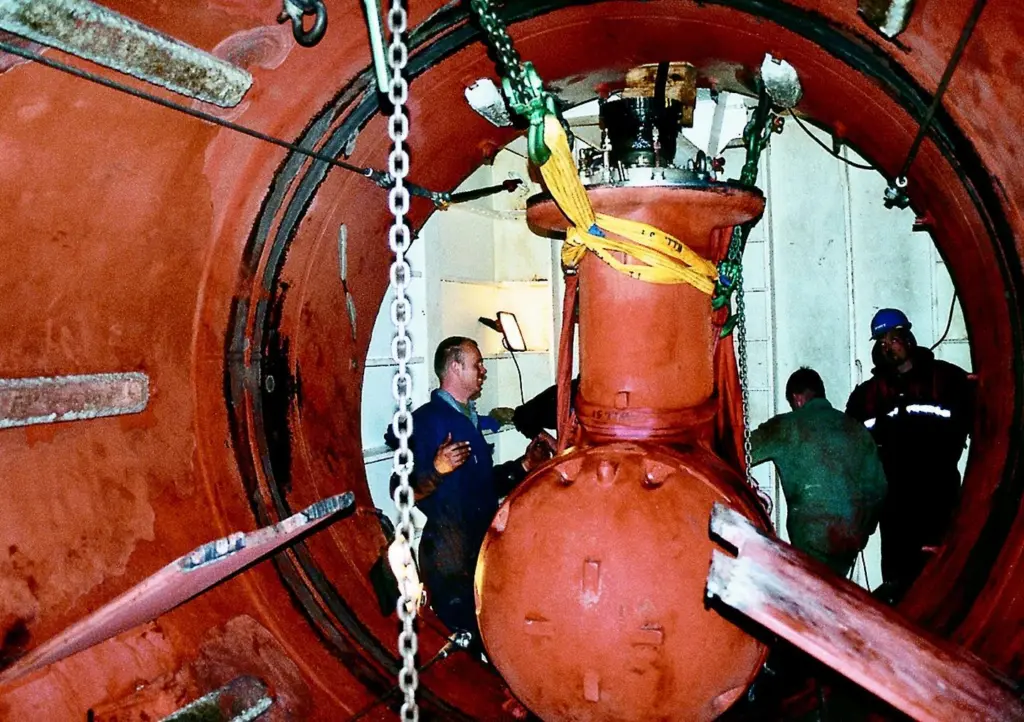
The development, which Hydrex believes ‘will change the face of underwater repair work’, was utilised recently to enable the successful removal, repair, and later reinstallation of the 7 tonne bowthruster and propeller of the 5,477teu containership Hanjin Vienna within its loading and unloading schedule in the Port of Rotterdam.
The design of the vessel was carefully studied in advance and a technical plan to remove the thruster underwater was devised and approved by all concerned.
The primary challenge was the irregular shape of the vessel in the area surrounding the bow thruster, which had to be measured precisely in order to construct specially designed mobdocks for both the port and starboard sides as the tunnel thruster had to be sealed completely to prevent water entry while dismantling work was underway.
A ‘double mobdock’ system was thus designed and manufactured to fit the Hanjin Vienna. Hydrex developed a technique for calculating, designing and constructing mobdocks especially for this purpose. These were constructed under Hydrex’s supervision and certified by Germanischer Lloyd.
The new installation techniques require precision in order to ensure water tightness, safety for workers and project success.
In the event, the seals were to remain watertight, providing a secure and dry working environment 8 to 10m underwater despite stormy weather conditions.
Work commenced, with the first inspection of the bowthruster revealing a broken off propeller blade. The remaining three blades were removed, secured inside the mobdock and blanks fitted where they had been.
A support system for the block and tackle was welded into place on the ship’s hull and two large metal supports were cut away from the gearbox. The thruster was lowered and secured so that it could be removed after the mobdocks were taken away.
All external connecting surfaces were blanked or otherwise secured to prevent water entering the ship.
With the mobdocks removed, the thruster was brought to the surface and sent for repair.
Hanjin Vienna sailed on the next leg of its schedule as repairs were made to the thruster engine and propellers in readiness for the vessel’s return to Rotterdam some weeks later.
When that day came, the mobdocks were already lowered underwater prior to the vessel’s arrival. The thruster unit had been blanked off at all points where water could enter and had also been lowered into the water.
When the vessel was safely secured, the thruster was placed within the thruster tunnel and the mobdocks fitted at either end.
Water was pumped out of the entire area and the works team began reconnecting the repaired thruster. The entire unit was reinstalled during the vessel’s scheduled time in port and it was once again able to manoeuvre under its own control. Hydrex now has the technical and engineering capacity to carry out similar operations to other vessels.
MJ Information No: 17514
Related Articles
 MERGERS & ACQUISITIONS
 OTHER NEWS
 ENVIRONMENT