


Bright ideas gain power
There are over 5,000 Aids to Navigation in the waters around Finland, so AtoN manufacturer Meritaito had the bright idea these could work smarter. One issue, however, is onboard power.
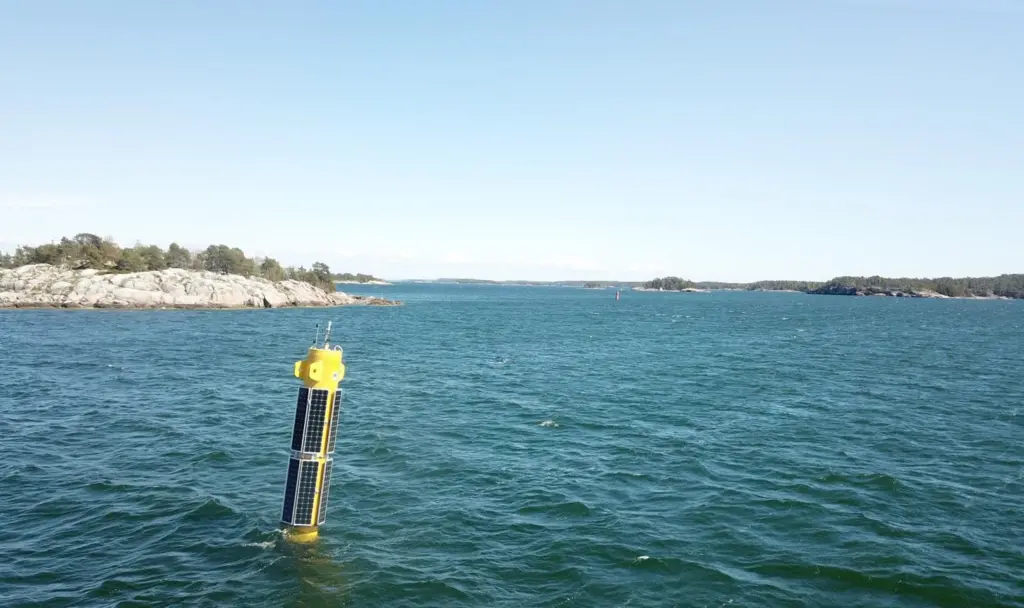
“These AtoN are already remotely linked to a cloud service that monitors position, battery charge, light function and allows pilots to switch to higher than normal luminosity in bad or foggy conditions,” explained Nina Savijoki of Meritaito: “So, it makes sense to use them to return other information that can be shared to increase navigational safety and environmental awareness: wave height, current, water and air quality, and so on.” Therefore, Meritaito joined with the ports of Naantali (Finland) and Stockholm (Sweden) to form the EU/CEF-funded Intelligent Sea project.
Even though it means expanding the AtoNs’ remit, rechargeable batteries linked to a photovoltaic system provide adequate power as these sensors are optimised for very light electrical loads. For example, the Meritaito/Kine Robot Solutions’ air quality and emission monitoring Sniffer Buoy is covered in solar cells, backing up an 8kWh battery. “It works well for locations such as the UK or further south, as the battery will give you a week’s power,” explained Savijoki.
However, locations like the Finnish Archipelago are notable for long winters with little-to-no sun and further, solar panels are also at risk from the annual ice covering.
So, while the photovoltaic panels will take care of the electrical demand during the summer months, a methanol powered, PEM fuel cell backup is being developed for the winter. “When the battery charge drops below a certain level, these fuel cells will be activated,” she explained.
However, a few points need consideration. Firstly, these need filtered air: salt is a killer for PEM fuel cells. For the same reason, the device has to include a watertight lock that will stop seawater ingress if the buoy is overtopped by a wave.
And then there’s the cold: at these latitudes temperatures below -30C are not uncommon. Fortunately, the AtoN’s robust polyethylene walls are very effective insulators “so we are beginning to look at creating an ice-free moonpool inside the buoy”, she said.
First phase testing is scheduled to start winter 2021 in Stockholm’s new Norvik container port, so it’s a case of ‘watch this space’ as the technology promises to enable a wide variety of digital services.
By Stevie Knight
Related Articles
 VESSELS
 MARINE CONSTRUCTION
 VESSELS