



British Waterways Invest in New Mini Pushers
British Waterways is to invest in a series of specially designed narrow beam tugs and barges intended to dramatically improve the working conditions of staff and offer greater flexibility, efficiency and innovative ways of working.
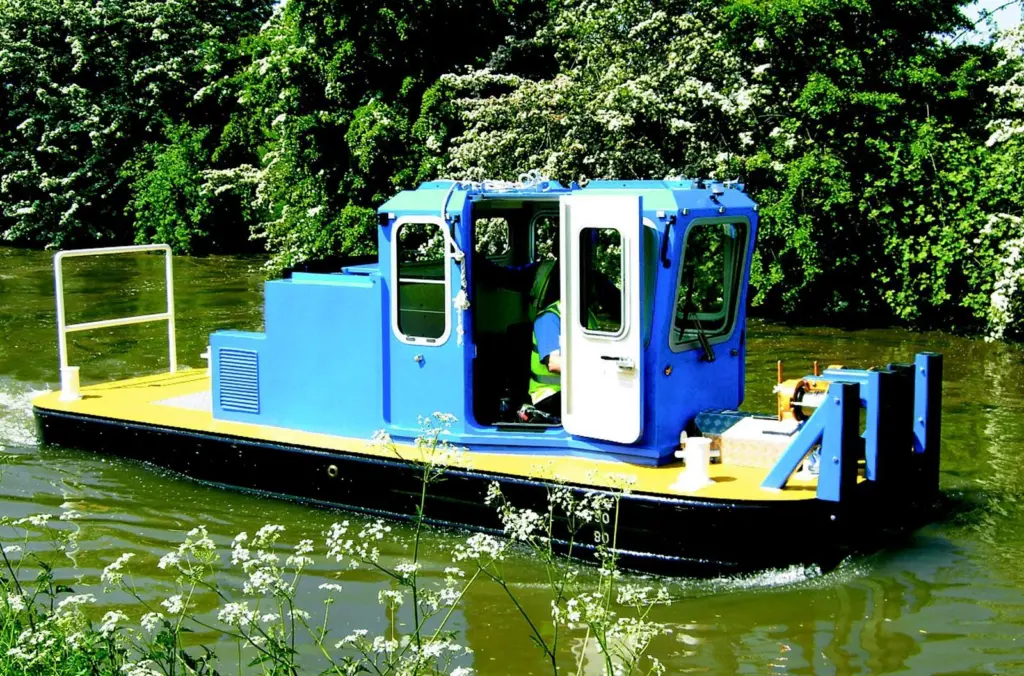
Over the next 18 months British Waterways (BW) will undertake an £8m programme to purchase new the new modular vessels, the prototypes of which are currently being trialled in the West Midlands. The prototypes are the result of two years of development carried out by a working group of waterway operatives, managers and engineers.
The narrow beam tug was designed by Keel Marine around a BW specification based upon previous designs and the need to incorporate modern welfare facilities and reduced emissions.
A fully developed steel hull has a length of 6m, a beam of 2m and draft of 0.7m. An aluminium wheelhouse is capable of carrying a skipper and two passengers and will have an elevating mechanism to allow to improve visibility over laden barges. The vessel is powered by a ‘Beta Marine Green Line 38’ (marinised Kubota), keel cooled, diesel driving a single 483mm diameter propeller via a hydraulic drive – incorporating a 3:1 reduction.
A “hospital” standard silencer provides very low noise levels, which along with a well-insulated machinery space gives the vessel a low noise signature underway and while moored.
Efficiency in operation is improved by fitting a hydraulic latching device enabling rapid connection to barges. Conventional push/tow winches are also fitted for use with craft not fitted with a dedicated pushing knee. Because the tugs will be used away from permanent land-based sanitary facilities or accommodation pods, they also have a compartment with hot and cold water washbasin and a flushing toilet.
Heating is provided from the engine cooling water system with a blown air matrix.
Included in the project are innovative designs for modular ‘workshop pods’ and ‘accommodation pods’ capable of being loaded onto barges.
Workshop pods allow for safe storage of equipment and offer a dry working environment, whilst accommodation pods provide a rest area, cooking facilities and sanitary facilities including flush toilets and hot and cold running water. The pods can either be transported to site by barge or, where possible, more efficiently and quickly by road, on the back of 7.5tonnes lorries. The barge design improves operative access and allows for flexible working as the barges can host a combination of pods, materials, excavators, cherry pickers or lifting equipment.
Under the 18 month long replacement programme British Waterways will call for 20 new tugs, 50 new barges, 100 pods and ten 7.5 tonnes flat bed lorries with hydraulic cranes on the back to transport the pods.
Investment in further boats and plans for broad canal craft and river craft are likely to follow.
Trials with the prototype boats have identified a number of operational issues that were remedied before production commenced last month.
Related Articles
 TUGS & SALVAGE
 EQUIPMENT
 MARINE CONSTRUCTION