



Consistency and control: large-scale 3D printing in steel
Sometimes something as apparently simple as a big lifting hook calls for very sophisticated technology, writes Stevie Knight.
It might not be generally appreciated, but casting a large hook that itself weighs in at over a tonne has a number of issues. The very high temperature of the molten metal, the large, complex volumes and the varying rates of heat loss, combined with steel’s considerable shrinkage (around 2%) together create enough stresses during cooling to damage the final product.
In fact Vincent Wegener, MD of Rotterdam-based Ramlab, explained the number of failures heavily outweighs the successes – by a factor of five to one. For large crane specialists like Huisman, hook casting is a lengthy, time consuming business and, moreover, one that leaves a question mark over a production period which runs into months for each attempt. This can leave a crane ready and waiting “but without a hook”, explained Wegener.
The alternative is a far more consistent method which promises vastly improved control over metal quality, as well as potentially allowing a non-stop forming process: 3D printing. However, this is a far cry from the now common fused filament fabrication (FFF) technologies, which usually spool-feed plastics into a shuttle mounted 3D extruder.
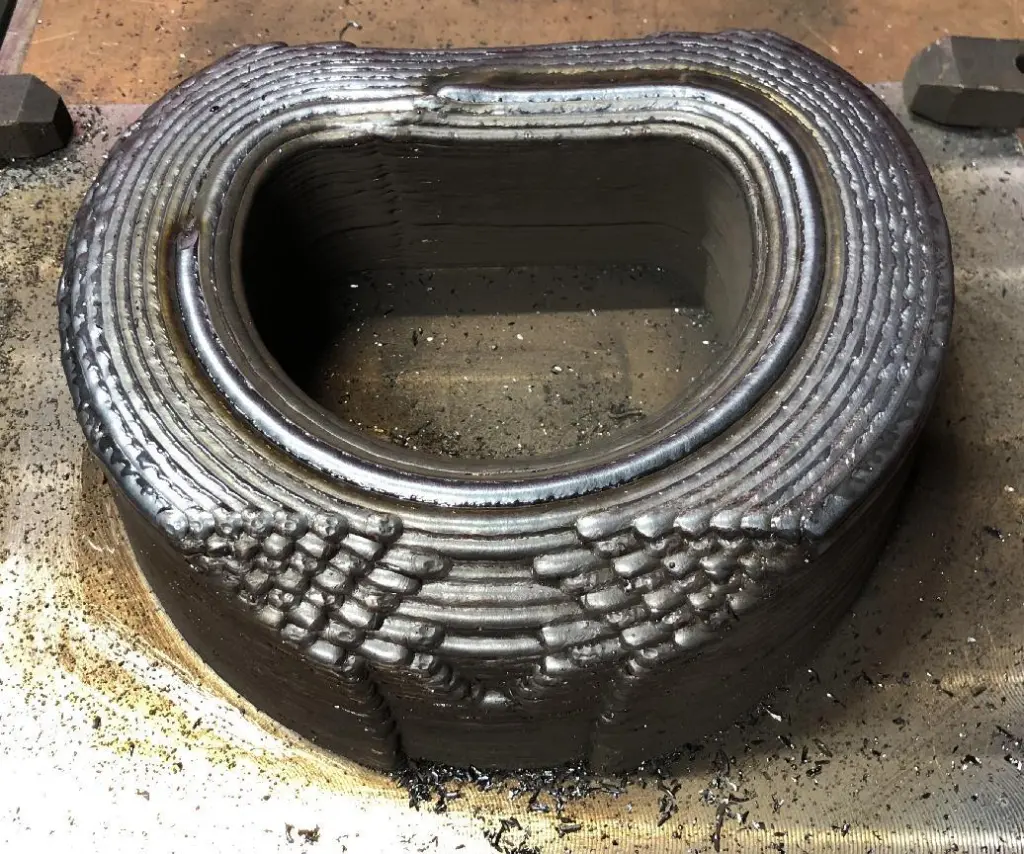
Instead, Ramlab specialises in Wire & Arc Additive Manufacturing (WAAM): the company uses a robotic head that can produce free-form shapes up to 6m in diameter by superimposing metal layers on top of each other. In fact, it’s based on a MIG principle, the electrode being fed through the head becomes the weld.
As this process offered far better consistency than casting, a fairly simple ramshorn model with a 40t SWL capacity was trialled; this proved very successful with the hook being subject to a load of 80t during class society tests, so the parties were set to go ahead with a bigger, more complex variety.
This hook is far more ambitious: four prongs instead of just two “measuring 1m across, and 1m from tip-to-tip”, said Wegener, with a capacity of around 325 tonnes SWL. However, he added that even this is only a step on the way: Huisman eventually wants to produce a version that reaches 4m, tip-to-tip.
The beauty of the WAAM approach for hooks of this scale “is that the prongs can be made hollow, which saves on material, weight and production time”, he explained, a characteristic that can only be created in a cast with considerable effort.
It’s also comparatively fast: “We can lay down around 2kg to 3kg an hour, and each of the prongs is around 400kg”, he says, bringing the 3D printing period down to a week or so, although he pointed out that like many 3D print methods, a little time needs to be added for grinding the surfaces smooth.
However, there have been some challenges. “We are building the prongs up from a forged, central block, and this proved more difficult to source than estimated,” said Wegener. Further, although the initial trial blocks looked good, “they didn’t include the geometry of the prong”.
The next round, unfortunately, wasn’t quite up to specification. “What we need to achieve is a homogenous material… but ultrasonic testing showed start-stop errors,” he explained, leaving tiny holes that become entrapped in the solidifying metal. However, the problem was investigated and a new tool path strategy was developed with software design partner Autodesk. The metal was then put through magnetic and ultrasonic examination, but this time no defects came to light.
As a result, the tool path strategy and material parameters for the four-prong hook have all recently been approved by all the classification societies, ABS, DNV GL and Bureau Veritas.
While this will be an industry first, it’s not just a win for Huisman, Ramlab and Autodesk. The innovation has significance in that it also opens the path for the necessary, underpinning regulation; this will in turn allow 3D printed products to gain acceptance across the maritime and offshore industry.
Related Articles
 ACCESSORIES & EQUIPMENT
 OTHER NEWS
 ACCESSORIES & EQUIPMENT