




Contractors appointed for Liverpool2 container terminal
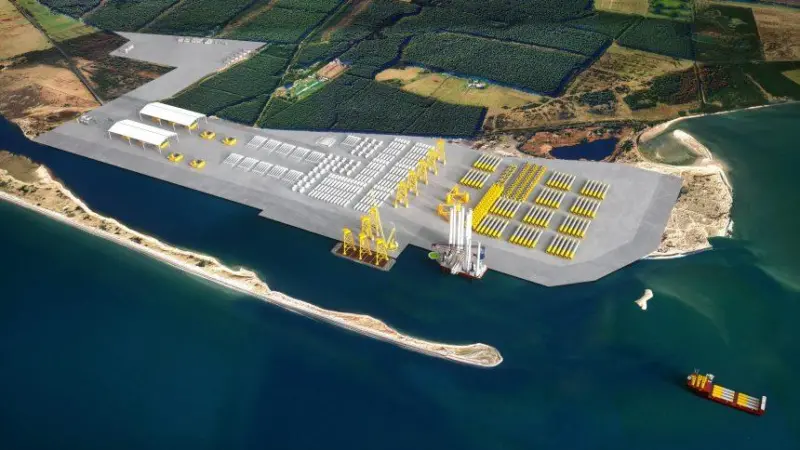
Peel Ports has awarded a contract to a joint venture comprising BAM Nuttall and Van Oord for construction of the new £300m Liverpool2 Container Terminal on the Mersey estuary.
As this article is being written, the first of Maersk’s new 18,000 TEU Triple-E container ships is enjoying a series of welcoming parties at ports at the European end of its maiden voyage from the Far East. With the introduction of increasingly bigger ships for the main global liner routes, the previous ‘biggest’ are often displaced onto shorter, less intensive routes. Ships that just ten years ago were operating for instance on the main Far East to Europe services, are now in effect often employed as feeders.
Just as major ports serving the likes of the Triple-E have had to adapt to accommodate the increased dimensions of the biggest, the same requirement has spilled down to smaller ports facing the prospect of seeing increasingly larger ships using their facilities.
Peel Ports own and operate a network of strategically located ports, of which Liverpool is but one. A particular feature of Liverpool is the Green Highway Network partnership with the Manchester Ship Canal. The alliance of these two historic rivals has led to creation of the North West Logistics Hub linking Liverpool with a string of facilities along the network comprising 12 terminals handling over 7m tonnes of cargo annually. Further investment to the tune of more than £500m is planned to further develop the inland container terminals at Bridgwater, Warrington and Salford.
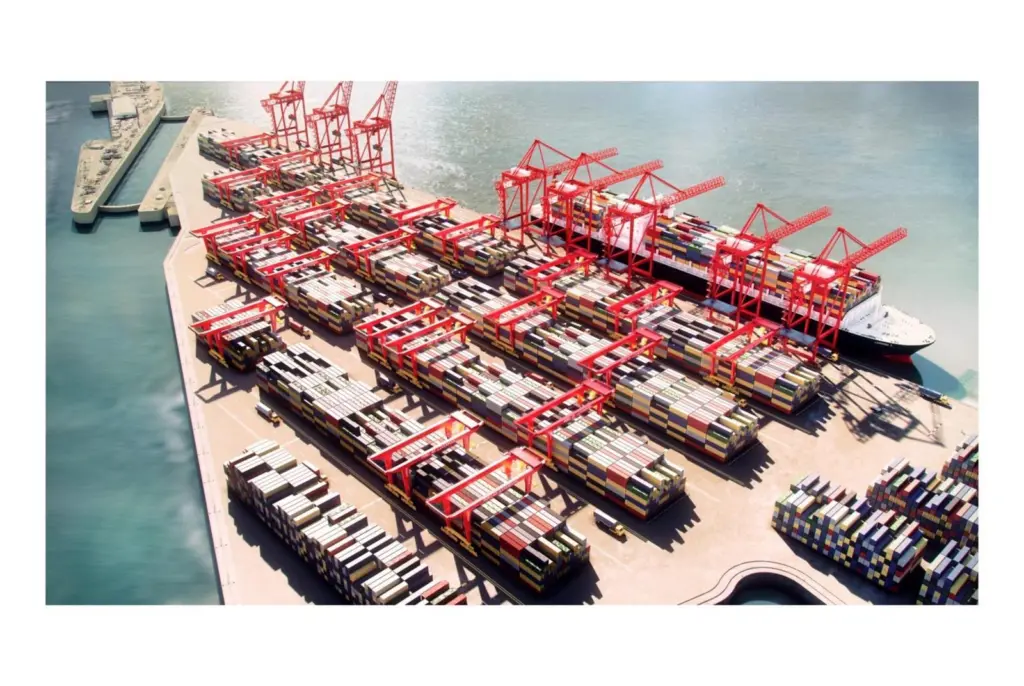
It is in this context that Peel Ports is now developing Liverpool2, able to accommodate two 13,500 TEU container vessels at a time alongside a new 854m long quay wall. Cargo handling equipment at the terminal will include eight ship to shore gantry cranes and 27 rail mounted gantry cranes.
The BAM Nuttall, Van Oord contract is valued at £75m and breaks down into a number of components. BAM Nuttall will design the quay wall and also be responsible for its construction. They will also install the ship to shore quay crane rails and supporting infrastructure including construction of new roads, surfacing and fencing.
Dredging contractor Van Oord will remove around 0.5m m3 of soft material using a combination of their water injection dredging technique and the backhoe dredger Goliath (the largest backhoe dredger in Europe). To create the new container area, 1m m3 of reclamation material sourced from the River Mersey will be delivered by a trailing suction hopper dredger, after which the berthing pocket will be dredged using a cutter suction dredger, the material reused as fill.
Gorinchem in the Netherlands based Wicks (a Van Oord subsidiary) is well established as an international ground treatment contractor including drilling and blasting. They will be responsible for installation of vertical drains to consolidate water-saturated subsoil and increase soil stability. This vertical drainage will result in reduced residual settlement.
Earlier this year, in a related announcement during a visit to the Port of Liverpool, the UK Chancellor George Osborne announced a grant of £35m from the Government’s Regional Growth Fund for a project to dredge the approach channel in the Mersey Estuary. The grant was made to Mersey Docks and Harbour Company (a Peel Ports subsidiary) as a contribution towards cost of dredging the estuary at Seaforth. The intention is to deepen the approach channel to 16m, allowing access for post-Panamax sized container ships as well as widening the tidal access window for a range of other river users. Around 5,000 new jobs are expected to be created by the Liverpool2 project, which is expected to open for business in 2015.
Related Articles
 MARINE CIVILS
 MARINE CONSTRUCTION
 EQUIPMENT