



Damen replaces the time honoured ‘PushyCat’ – by Jack Gaston
Damen Shipyards has replaced their famous ‘PushyCat’ with an entirely new vessel for their Stan Tug range.
The development of the ‘Damen Stan Tug’ range of tug-workboats has a history that dates back to the formation in1969 of Damen Shipyards as we know it today. Among the most important products selected as ‘standard’ designs for serial production in those early days, were the Pushy Cat and original versions of the Stan Tug. The Pushy Cat and the Stan Tug 1 became extremely popular, particularly in the dredging and marine construction industries. Early examples of both are still in operation and are a tribute to those original designs.
Although over four decades Damen has evolved into a massive shipbuilding group, it maintains a very close relationship with its clients in the towage, dredging and marine construction industries. In that way the company continually receives feedback from its customers and progressively refines established designs and introduces new vessels to meet the operators’ demands. That is especially true of the Damen Stan Tug range in which almost every vessel has been modernised or replaced and now numbers some eleven designs.
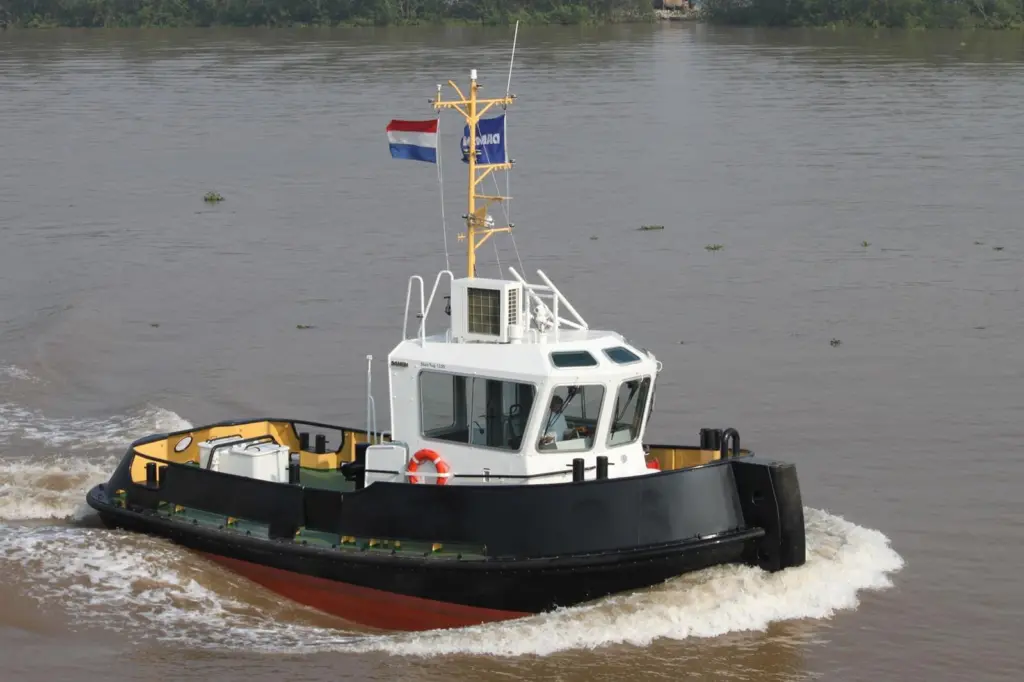
After careful market research and study it was decided to discontinue the Pushy Cat 1204 series and the Stan Tug 1404 and offer one brand new design in their place, the Damen Stan Tug 1205. The new Stan Tug 1205 design has benefited greatly from the considerable knowledge and experience gained while producing the new Stan Tug 1606 and Stan Tug 1907.
The Stan Tug 1205 is a small, very compact, and powerful twin-screw vessel with clean lines and many of the distinctive features in common with its larger sisters. In its basic form the tug/workboat is designed to carry out towing, mooring, transportation of passengers and pilotage duties. The first vessel was completed late in 2009 and during exhaustive trials it has surpassed even the most optimistic expectations. The vessel handled extremely well, was vibration free, extremely quiet and achieved a bollard pull of 9.0 tons and a free running speed of 9.8 knots.
Measuring 13.08m in length overall, with a maximum beam of 5.28m, a depth (at sides) of 2.30m an approximate draft (aft) of 2.00m, the new tug/workboat has a displacement of approximately 55 tons. The hull is of rugged single chine construction using 10mm thick plate in the sides and bottom and a 15mm sheer-strake. The hull form is based on that of the Stan Tug 1606 and incorporates a heavily built push knee in the bow. Incorporated in the hull structure are internal tanks capable of a accepting 5.5 cu/m of fuel, 0.35 cu/m of fresh water, 0.32 cu/m of sewage and 0.30 cu/m of bilge water.
The decks, fore and aft, have been kept as clear of obstructions as possible to provide a safe working environment, with maximum available space. Bulwark height can be chosen to suit operating conditions and national regulations. Mooring bits, the engineroom hatch and the exhaust outlet housings are neatly built in and tank vents, and other necessary protrusions, are guarded to prevent fouling. All of this is intended to improve safety and simplify maintenance. Towing gear comprises ‘H’ style bitts, carrying a Mampaey tow hook of 15 tons SWL.
At the heart of the Stan Tug 1205 is a rugged propulsion system. Two heavy duty, manganese bronze, Kaplan style fixed pitch propellers of 1,050mm diameter rotate within high performance Van der Giessen ‘Optima’ nozzles. Two streamlined ‘double plate’ rudders, one aft of each nozzle, are operated by a powered hydraulic steering gear giving 2 x 55 degrees of movement.
Two Volvo D9 MH diesel main engines generate a total of 644bhp (442bkW) at 1,800 rpm to drive the propellers via Twin Disc MG 5091, reverse reduction gearboxes with a ratio of 3.82:1. The clean ‘state of the art’ diesels comply with the requirements of IMO and US EPA Tier 2. These compact, rugged engines, are equipped with electronic fuel injection systems and twin turbo chargers for outstanding acceleration and economy. Flexible mountings and couplings reduce vibration and noise transmission throughout the vessel.
A well proven closed circuit ‘keel cooling’ system is utilised, enabling the vessel to operate in extremely shallow water without fear of contamination. Exhaust gases are discharged through the transom, via 40 dBA silencers, well lagged and mounted in the engineroom.
Electrical power is supplied by a single Onan MDKBP-eQD auxiliary generator rated at 17.5kvA at 230 volts, 50 Hz. Two 24volt 200Ah battery packs with a changeover facility are used for engine starting and domestic use.
The wheelhouse design follows closely the standards developed for the larger vessels in the series. It has a modern efficient layout with the controls and instrument panels positioned using ergonomic principles. Large, deep, windows with few blind spots give excellent all round visibility. A centrally located helmsman’s position is placed close to the forward windows, with all of the essential controls and instruments within easy reach. A standard instrumentation outfit includes a Fluxgate compass, a Furuno GP-32 GPS, a Furuno LS 6100 echosounder and Sailor RT2048 25W VHF radio. Mandatory modern LED navigation lights, towing and pilot lights, and a searchlight are also standard items.
Comfortable seating and a table for two persons are part of the standard wheelhouse layout. The entire wheelhouse structure is flexibly mounted and modern durable linings, insulating materials and a ‘Dampa’ acoustic ceiling is used. The result is a reduction in sound levels in the wheelhouse to just 55dBA when the vessel is underway. Both the wheelhouse and additional living facilities below decks are air conditioned and heated. The ‘standard’ basic vessel is fitted out as a ‘day boat’ with cooking facilities, a refrigerator, pantry, shelving and a toilet with hot and cold water. As an option, the same area below deck can be fitted out to include sleeping accommodation for two persons.
This first vessel is one of a batch of six, all of which will be fully fitted out ready for delivery. Most optional items can be supplied from stock, including a deck crane and additional fire fighting equipment. Even with a degree of customisation to suit a client’s particular needs, delivery can normally be made within eight weeks of placing an order.
Related Articles
 TUGS & SALVAGE
 EQUIPMENT
 MARINE CONSTRUCTION