




Darss completes fast Customs trio
The fast 27 knot Darss is now in service in the German Baltic, rounding off a trio of modern patrol boats completed this year for German Customs authorities, writes Tom Todd.
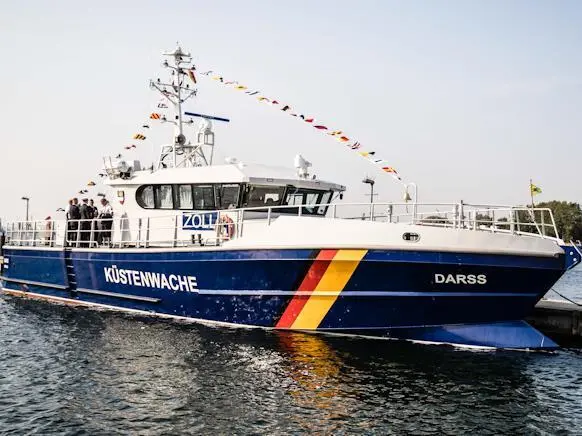
Darss is now operating out of the eastern German port of Rostock. It has joined sisters Bremen and Gelting which went into service, respectively, out of Bremerhaven on the North Sea and Flensburg on the western Baltic in March and April of this year. Earlier reports said each of the newbuildings had cost around €4 million.
The 23.99 x 6.49m boats are designed for inshore surveillance, draw 1.5m, displace 55t and carry crews of up to six. All have been built at Estonia’s Baltic Workboats for service with Germany’s Wasserzolldienst – the marine arm of the Federal German Customs Service.
Baltic Workboats said the development of the new Type Patrol 24 WP wave-piercing boats had been “a long and interesting journey” since the contract was signed in Hamburg in 2016, and had been marked by “close cooperation all along”.
It also said the boats had shown “outstanding performance capabilities in all weathers” – and claimed that “despite the powerful machinery our advanced design and interior assembly provide probably the best low vibration and low noise solution on the market”.
The machinery reference was to the boats’ propulsion which comprises, per boat, two diesel-electric MTU 8V2000M72 main engines and ZF gearboxes which the yard said provided up to 27 knots. A Customs spokesman was asked if consideration had been given to LNG propulsion – proving increasingly popular on relatively small ships such as ferries in Germany. The spokesman told MJ LNG was was not an option in this case because of the size of the newbuilds.
Like its two predecessors, Darss carries a 4.5m by 2.1m tender with 60hp 4-stroke propulsion. It also has an IMO Tier 111 diesel particle filter fitted which the Customs said had resulted in “significantly improved waste gas emissions”. The new boats have already also been praised because of what is described as “significantly better” sea-holding characteristics than previous boats of their type.
A Customs spokesman told MJ that it had 28 vessels patrolling the more than 3,000km long German North Sea and Baltic coastlines where 400,000 ship movements are recorded every year.
Related Articles
 ELECTRICAL SYSTEMS
 VESSELS
 INDUSTRY NEWS