
Deep water data sub successfully trialled
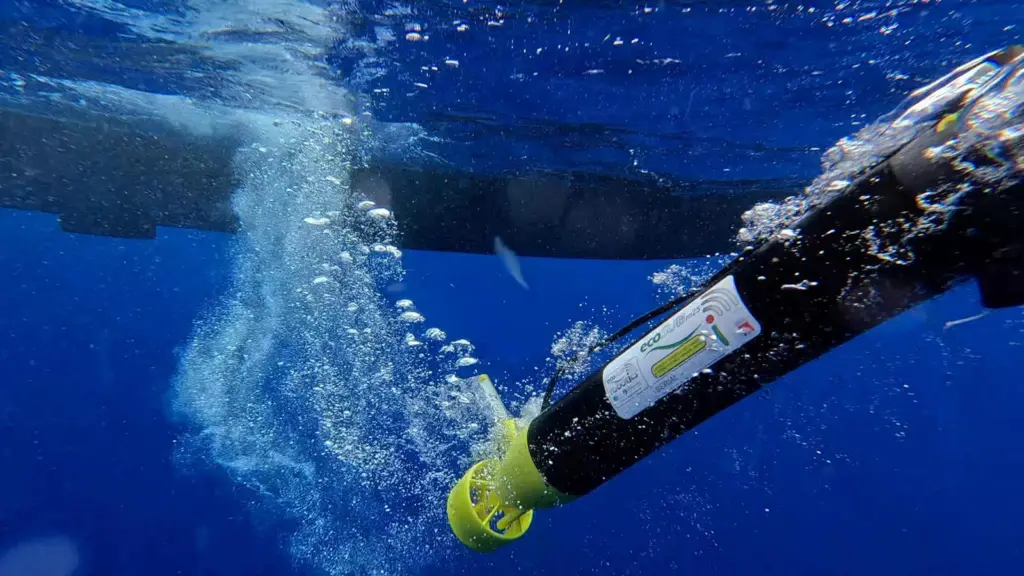
In a groundbreaking deep water trial off the coast of Madeira, an autonomous underwater vehicle has successfully completed a spiral behaviour mission, providing vertical profiling of the water column down to 2,000 metres and back.
This achievement marks a significant milestone in autonomous ocean data collection technology.
Part of ecoSUB Robotics’ ecoSUBm series, the ecoSUBm25-Science AUV weighs just 12kg and is depth-rated to 2,500 metres. Unlike traditional deep-rated AUVs, which are typically large and expensive, costing millions of dollars, the ecoSUB platform is priced in the tens of thousands, making it a more accessible choice.
Equipped with a conductivity, temperature and depth sensor and a Chelsea Technologies TriLux sensor, the AUV collected comprehensive measurements of conductivity, temperature, chlorophyll, turbidity, and phycoerythrin.
The platform is also versatile, capable of hosting additional sensors to measure dissolved oxygen, coloured dissolved organic matter, pH, oil in water, as well as navigation aids such as altimeters, doppler velocity logs, and underwater acoustic communications.
The mission, completed on 30 July 2024, was launched and recovered from Observatoio 1, a fast RIB research vessel provided by the Oceanic Observatory of Madeira. The observatory supported the trials with workshop and vessel resources.
The mission’s success demonstrates the ecoSUBm25-Science AUV’s ability to maintain precise navigation, with a launch and recovery point separation of just 125 metres, confirming its straight-down and straight-up capabilities.
With a total mission duration of 1 hour and 40 minutes, and a maximum depth recorded at 2,002 metres, this world-first 2,000m deployment for a micro-AUV system represents a significant advancement in the field, paving the way for enhanced ocean data collection and research.