


Another milestone reached for offshore vessel charging
Great inroads are being made into offshore charging which is paving the way for hybrid and fully electric vessels servicing offshore windfarms.
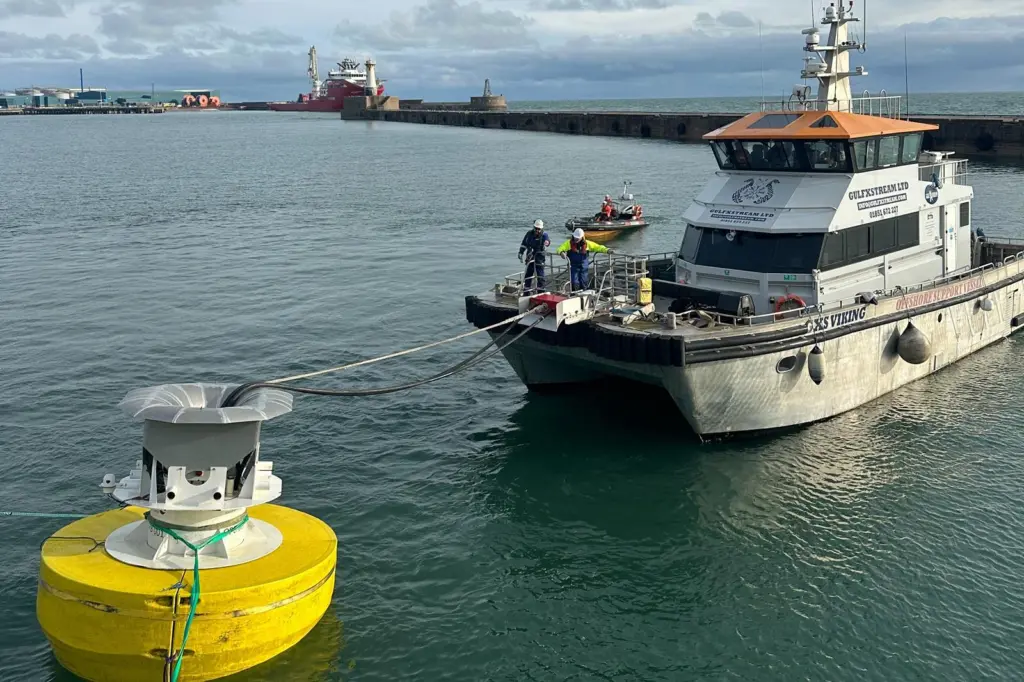
During a series of tests in Peterhead Port Authority, energy was successfully transferred via the Oasis Power Buoy (OPB) to a load bank onboard the Crew Transfer Vessel (CTV) GXS Viking, through a specially designed deck-head.
“Innovative developments are being made with the design and production of electrified vessels, but range will always be constrained by battery capabilities. The ability to re-charge offshore is crucial for decarbonising maritime,” said George Smith, managing director of Oasis Marine.
“We have proved that the Oasis Power Buoy expands the capability to charge vessels offshore, enabling a substantial reduction of CO2 emissions and fuel costs. This ensures hybrid and electric vessel use can be maximised and is a very encouraging development for the global maritime industry.”
Successful testing
During the tests, mooring tests were carried out, where the CTV, GXS Viking, successfully moored to the OPB. Testing was completed either side of Storm Babet, so achieving successful results was even more significant given the weather challenges faced.
Operational teams from 23 Degrees Renewables Ltd, GulfXStream Ltd, and JifMar Scotland Ltd all provided support during the trials.
The design of the buoy optimises CO2e reduction by supplying renewable power via zero-emission wind power.
Mr Smith said that with the core principles of the Oasis Power Buoy now proven, a programme of optimisation over the winter months and final tests lie ahead next spring, before deploying in an offshore windfarm for a pilot project thereafter.
Upon commercial deployment the Oasis Power Buoy will initially be connected at offshore windfarms to power CTVs. Next phases will be versions for larger Service Operations Vessels (SOV) in windfarms, as well as decarbonising emergency response vessels.
The project has received UK government funding through Innovate UK and MariUK.
Related Articles
 ELECTRICAL SYSTEMS
 ENVIRONMENT
 ENVIRONMENT