



Project seeks answers to harsh seas in floating wind
A project is looking to overcome the effects of strong winds and extreme wave loads on floating turbines.
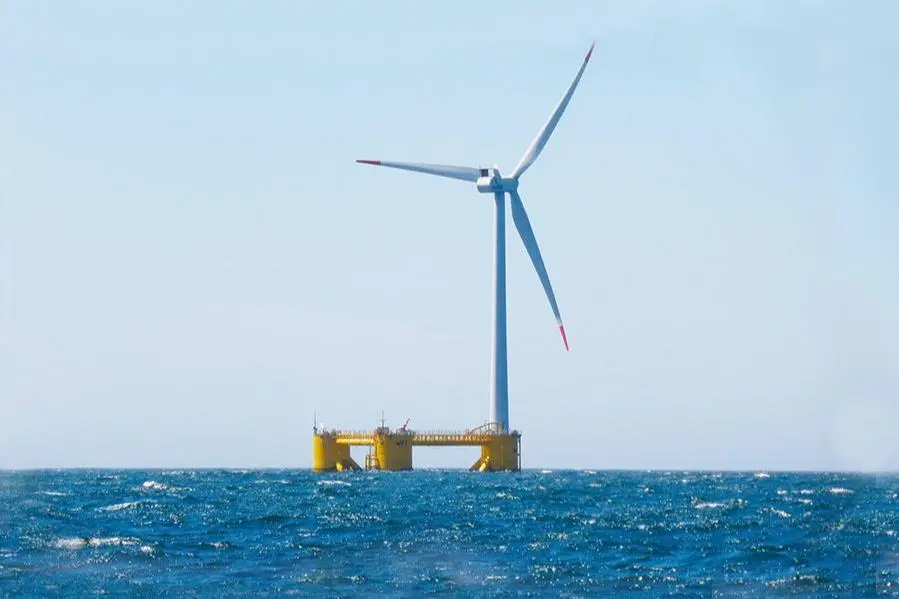
The DIMPACT R&D project, which was set up in 2020, has led to the development of a new method to define floating offshore wind turbine design, which differs significantly from those used for bottom-fixed offshore wind turbines.
This project, led by France Energies Marines, has also developed a new engineering solution to estimate non-linear wave loads in coupled numerical models like OpenFAST.
Under pressure
As floating offshore wind turbines (FOWT) will be generally deployed in areas with strong wind and wave conditions, they will inevitably experience severe meteorological and oceanic storm events during their lifetime.
The project underlines that the occurrence of breaking waves in severe storms should be considered in the design phase. They may induce local damages on the substructure, cause dangerous runup and green water events and excite structural modes of the turbine.
Although a vast amount of literature exists to describe methods to consider extreme wave loads on bottom fixed wind turbines, very little guidance is available when it comes to floating ones.
The DIMPACT project has been working to define the sea states with the highest slamming potential, to be run in aero-hydrodynamic coupled FOWT models.
It relies on the development of a theory to assess the severity of breaking waves at sea. This approach was validated thanks to wave flume and numerical experiments investigating the geometric and kinematic properties of breaking waves.
Further flume experiments involving an instrumented cylinder representative of a turbine deployed from a hexapod able to reproduce the motions and tilts typical of FOWT.
The cylinder was equipped with loads cells able to measure the vertical distribution of loads induced by breaking waves and an innovative methodology was developed to filter the structural response in the loads signal. This data was used to establish a relation between the properties of the breaking waves and the loads exerted on the cylinder.
The wave tank data was used to validate a FOWT-specific engineering formula that account for the motion and tilt of turbine in the extreme wave loads. A new solution was further developed to estimate the equivalent non-linear wave loads from the properties of linear waves.
Together, these findings have provided an engineering method to account for slamming load on FOWT that is being implemented in the DIEGO and OpenFAST codes. This innovative integrated method will be referred to in the 2024 update recommended practice of DNV certification body.
The aim is to ensure an efficient transfer of DIMPACT project’s breakthroughs to the floating offshore wind sector.
Related Articles
 ELECTRICAL SYSTEMS
 ENVIRONMENT
 ENVIRONMENT