![MaritimeJournal[Seawork]](https://www.maritimejournal.com/wp-content/uploads/2026/09/MaritimeJournalSeawork.svg)



Tidal, wave or floating wind? 4 emerging Spanish technologies
With a Spanish government target that 81 per cent of the country’s electricity must come from renewables by 2030, the fact that the country does not have a single megawatt of offshore wind contributing to the cause is not helpful to the cause.
It’s not as far behind as it looks, however: according to Juan de Dios Lopez, technical and industrial director at the Spanish Wind Energy Business Association, the Asociación Empresarial Eólica (AEE), onshore wind generated 24% of electricity in 2024; nuclear, 20%; solar, 17%; gas/hydro, 15/15%.
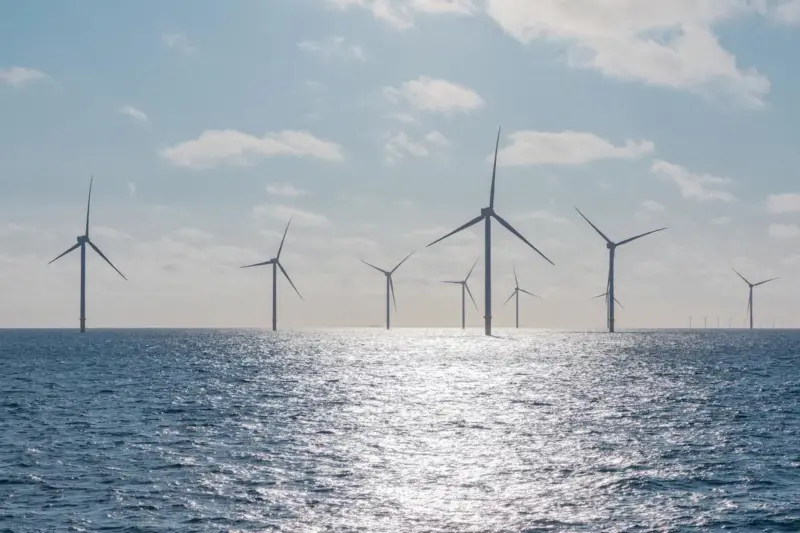
Offshore is where the lag is, but as Spain’s continental shelf ends so close to shore it makes fixed-bottom turbines impossible – which means floating wind or tidal and wave technologies are going to be needed to fill the renewables gap.
There are many contenders coming through, and some of them were presented at last week’s World Maritime Week at Bilbao Exhibition Centre. We look at four of them.
Enerocean’s W2Power platform
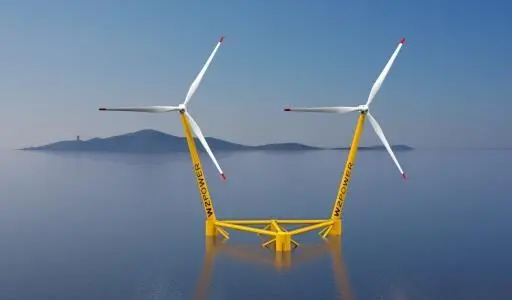
Enerocean CEO Pedro Mayorga presented his company’s semi-submersible steel platform with twin turbines and a single-point mooring system.
Called ‘W2Power’, the technology is an adaptation of proven offshore technologies to fit deep-water offshore wind.
Now being tested in the open sea, W2Power is designed to generate 12MW on its single foundation, with two turbines that can tilt in the direction of the wind.
“It’s a simple and vertical approach,” he said. “It is possible to get these things built and to withstand the weather conditions, but these are floating systems so there are challenges.
“We must make the most of generating energy in an element that moves around a lot – you also have to add the inertia because you have a large mass that moves around.”
The entire platform, he said, orientates itself towards the wind like a rotor on a ship, and the towers can tilt as they do not have to be vertical.
Tests are now being doing on functionality, stability and survivability but so far, he said, wave heights of 5-6 metres have been survived and Approval in Principle has been granted by Bureau Veritas.
Saitec catamaran platforms
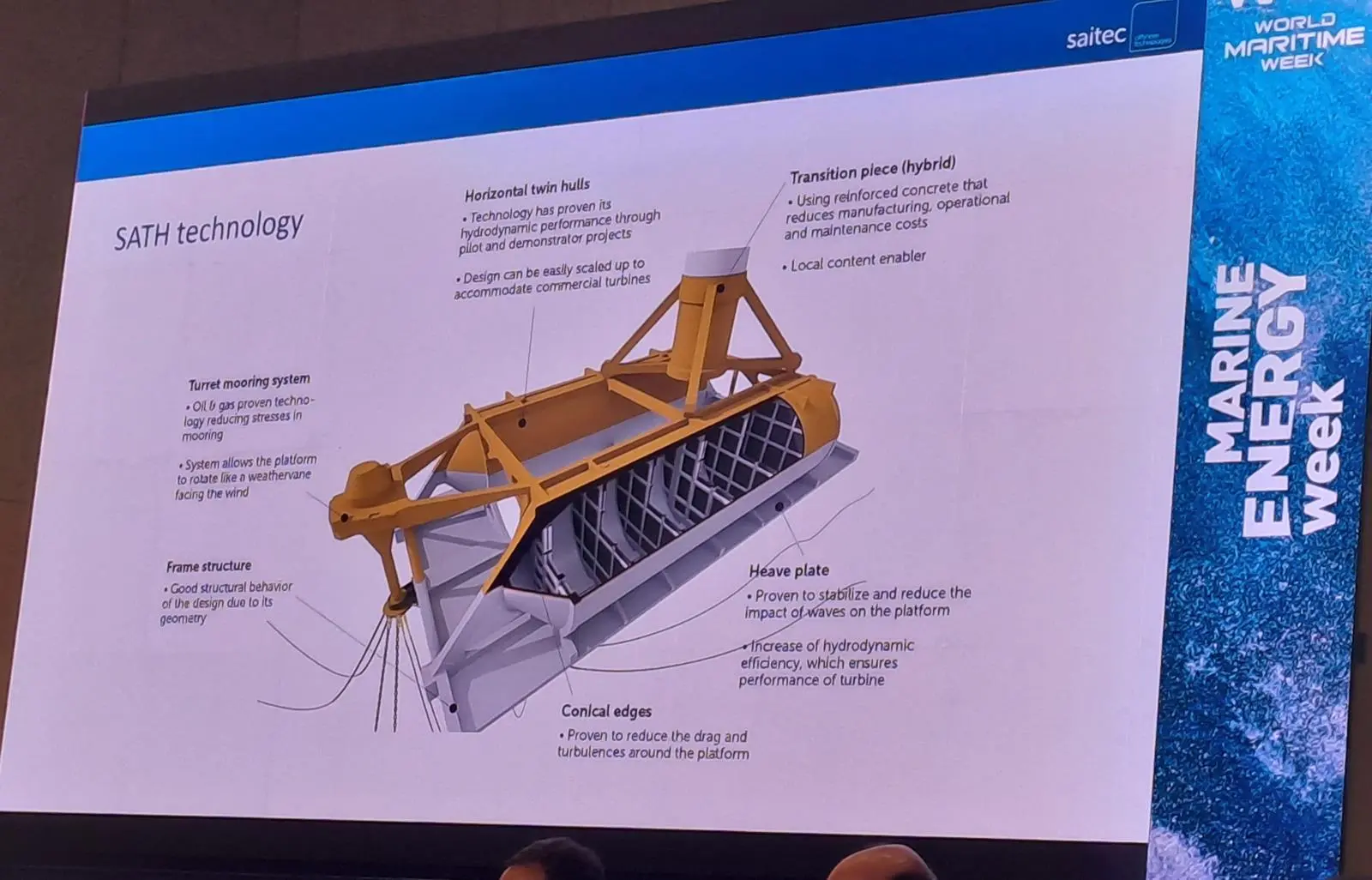
Inspired by the stability and sea-keeping nature of catamarans, Saitec Offshore Technologies – a spin-off from Saitec SA – has designed a floating platform featuring a twin-hull structure made of concrete, with a wind turbine mounted on top.
A turret system – a concept borrowed from the oil and gas industry – allows the platform to rotate and align with the wind, reducing structural stress.
The 2MW DemoSATH project has been entirely run in the Port of Bilbao, and Saitec chief operating officer David Carrascosa said 75% of the construction budget was awarded to local companies, highlighting the project’s commitment to supporting the regional economy.
The platform, the first floating wind to actually be connected to the grid in Spain, also serves as a laboratory for environmental monitoring, testing the platform’s impact on biodiversity and tracking how the turbines influence birds, bats, marine growth and mammals.
The initiative also provides a testing ground for new technologies such as crew transfer vessels (CTVs) and operations and maintenance (O&M) systems.
“It’s a very valuable step, making the demonstration project more of a laboratory for transversal projects,” said Carrascosa.
DemoSATH’s 2MW project morphing into the bigger 20MW versions of wind turbines seen today might seem to be a bit of a stretch, however Carrascosa said that while scaling up does present challenges, each part of the process does not have to be done at the same scale: ie a tenfold turbine power rating increase would require a platform scale-up factor of just 1.5
“The 2MW platform is already designed to cope with ocean conditions, so while the turbines increase in size, the platform’s ton-per-megawatt ratio actually decreases, making the system more efficient,” he said.
He also believes the same vessels used to install the 2MW platforms can handle larger turbines, although there may be a need for bigger cranes.
Tapping into current
The symmetrical 45m-long ATIR vessel sits on the surface of the ocean with its turbine hanging off a 15m-long hull to generate electricity from one of the most predictable features of the ocean – its currents.
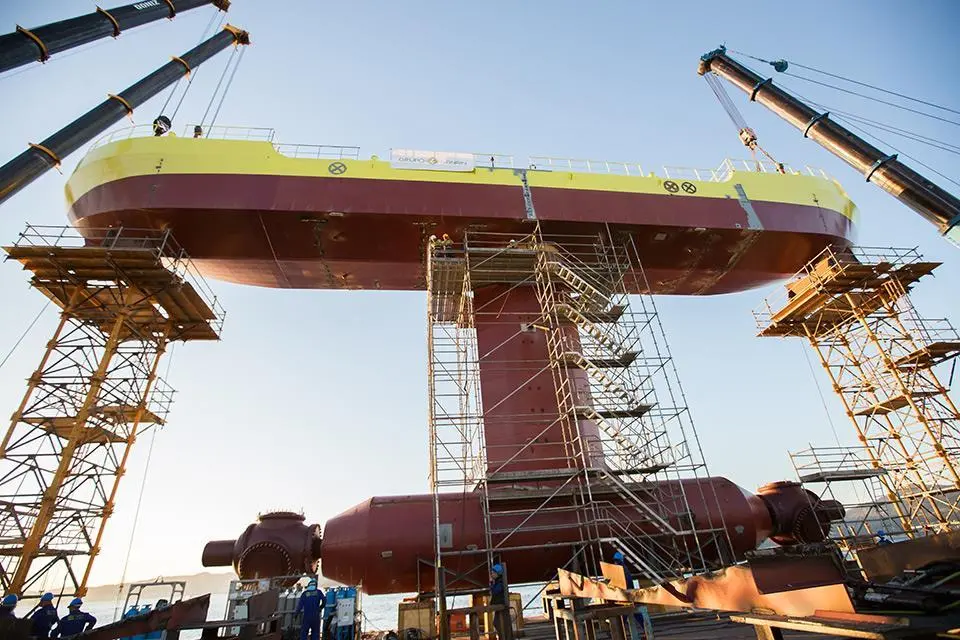
Having tested their technology at the European Marine Energy Centre (EMEC) in the Orkney Islands since 2014, Magallanes Renovables chief operating officer Mario Iglesias says the technology should be going commercial in 2026, with a longer platform and a 4.5GW generating power.
“It’s going to be launched in the Magallanes Strait in Chile, where it has exactly the right conditions – current speed of 5.2 metres per second at a depth of 70-80 metres,” he said.
It’s niche, admits Iglesias – but this is why there are so many different technologies coming through: few conditions are the same, so each requires a different solution.
The ATIR turbine has to be installed in the hour between neap and peak tides, and when it comes to maintenance it has been designed so that only the shaft needs to be extracted for repair – the rest can be done in situ, he said. And maintainability is one of the key elements.
“The main challenge is accessibility,” he said. “These are massive machines and they need to be flexible. The seabed has to be studied for the moorings, and how that might affect the quality of the yield of the turbine.
“There are many challenges with wind power and floating technologies. But the currents depend on the sun and the moon. It’s totally predictable – you can tell what the current will be in 65 years’ time. The moon will never disappear.”
IDOM on the waves
Wave energy was in fact the first technology to developed, but it’s complicated, said head of Marine Energies at IDOM Patxi Etxaniz.
“The minute you put something under the water it gets more difficult,” he said.
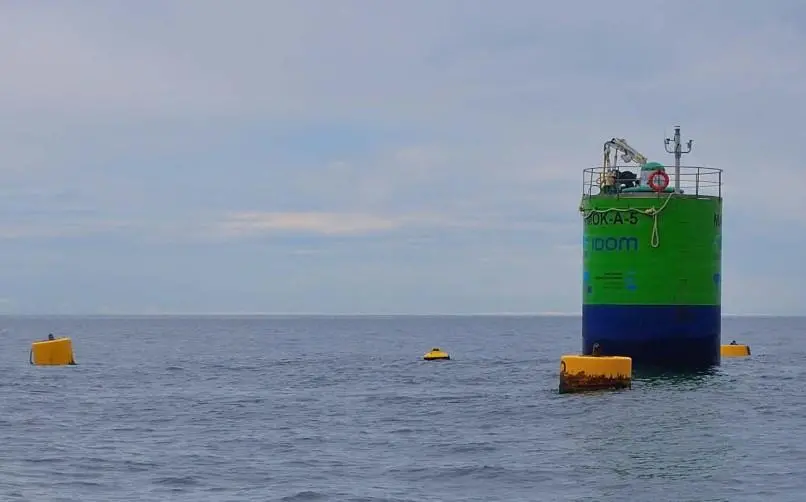
IDOM’s 2,000-tonne Marmok A-5 wave energy converter is effectively a hollow barrel, and generates electricity with two 15kW turbines turned by water flowing in and out and displacing the air.
“It’s an oscillating water column, a buoy structure with a water column inside, with the cylinder open at the bottom,” said Etxaniz. “There’s an air chamber at the top of the cylinder, and a turbine on top of the chamber which generates electricity as the air is pushed out. It’s very robust, there are no moving parts and little maintenance.”
The prototype – the result of public pre-commercial procurement by the EVE (Basque Energy Agency) – is 42m long and 5m in diameter.
One of the problems is with the steel cable connections, he said – because of the expense and the risk, as they are always moving.
“I am confident it works, but at what price?” said Etxaniz. “You need lots of time and resources to be competitive. All technologies are very different and need a lot of public money to be developed.”
Originally funded by Iberdrola, the funding stopped seven years ago because the Spanish energy company saw the road to commercialisation was too long.
So IDOM bought the project, and it now has an office in Minneapolis, where two others are being tested.
“Mooring is more expensive in deep water, but there’s a balance,” he said. “The deeper the water, the stronger the tides.”
Related Articles
 FEATURES & VIDEOS
 ENVIRONMENT
 OTHER NEWS