


Researchers model crash barrier concepts
Researchers have modelled three concepts which they say could avoid ships crashing into wind turbines and other offshore installations.
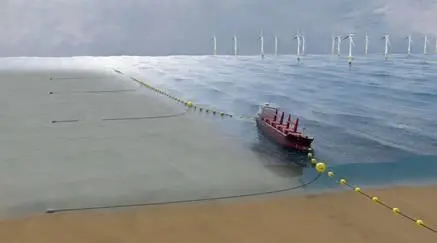
The chances of vessels colliding with turbines are going to increase dramatically in the future, with some 2,500 wind turbines scheduled to be installed in the North Sea alone in the period to 2030.
This will increase the risk of collision to around twice a year, says the Maritime Research Institute Netherlands, which carried out its research on behalf of the Dutch government.
It says that up to 80 vessels are known to go adrift in the North Sea every year, and that although most use active interventions to avoid accidents, such as dropping anchor or getting towed, some slip through the net.
In January 31, 2022 a drifting bulk carrier, Julietta D, collided with a tanker before hitting a transformer platform and turbine foundation for the Hollandse Kust Zuid wind farm currently being installed. This could have resulted in the turbine toppling onto the vessel, seriously endangering crew and passengers as well as the environment.
As an initial answer, 20 people from MARIN and others from the wider maritime sector have developed three innovations that could serve as maritime crash barriers between shipping routes and wind farms.
One is a string of surface buoys secured by drag anchors, the second a smart suspension net between fixed poles, and the third an anchored underwater hook line that can catch the anchors of drifting vessels.
Scale models of each solution have been made and tests run to see if they could have averted the Julietta D accident in storm conditions.
“We established that all three concepts are able to intercept the vessel,” said MARIN Offshore Project manager William Otto. ”The drag anchors of the buoy string dissipate the drift energy evenly, so that the vessel stays afloat across the waves. The anchored underwater hook heads the vessel into the waves, so reducing roll – which means the vessel remains in place while being exposed to relatively low force.
“The smart suspension net initially showed too much droop, but with a bit of fine-tuning we were able to get this functioning too. Over the coming months we will go on to assess the various pros and cons of these systems.”
Related Articles
 OTHER NEWS
 ACCESSORIES & EQUIPMENT
 EQUIPMENT