




Esbjerg: Ahead of the times
“Generally, I’d say wind port operations should be so smooth their contribution goes almost unnoticed. Helping cargo to run through, just like water,” said Jesper Bank of the port of Esbjerg.
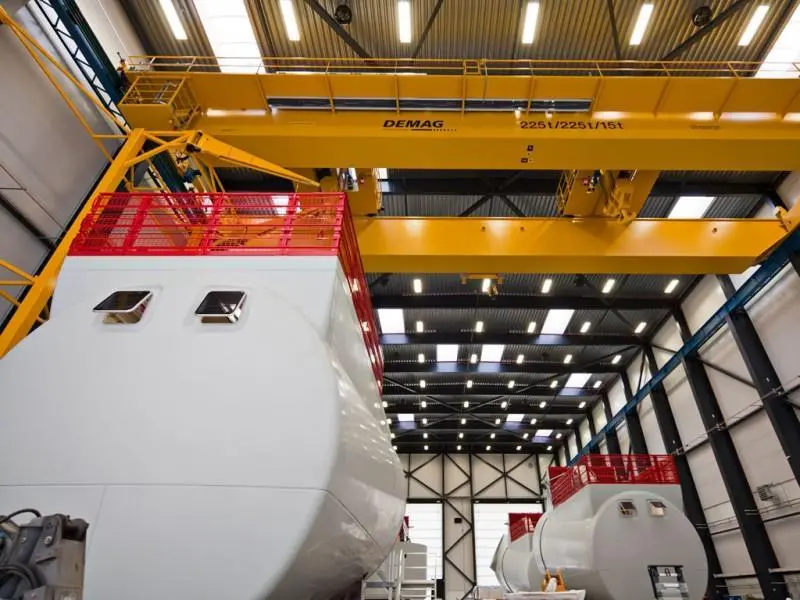
“It’s when you get it wrong that people start paying attention – and the costs start running up.” Given this, it should please Mr Bank that the port’s name isn’t often bandied about, despite the fact that around 67% of Europe’s total offshore capacity has been shipped from Esbjerg: for example, it handles the majority of the nacelles produced in Denmark by Siemens and MHI Vestas.
It can take up quite a space: in January the 100-plus nacelles stored at the port were joined by 300 blades.
To do it all, the port has worked hard on its capacity: “In all we have reclaimed 1,000,000 m2 at the East Port since 2011 in order to expand our wind business,” he explained. It also has 1.8km of quay, 10.5m depths and not least, direct access to its hinterland via the E20 motorway.
Despite this, he doesn’t believe that the space requirement will continue on its present trajectory. In fact, precisely because the power of the turbines has increased by leaps and bounds – the largest now hovering at around 8MW – there has been a consequential drop in the number of towers being deployed on any one site: “Compared with three to five years ago, the number used on any one project is actually reducing… so where we used to see a hundred turbines deployed, now we are seeing 40 turbines having the same output.”
However, there’s no doubt that the increasing size of wind turbines is having an impact. Quite a physical one.
While floating load outs still provide a fast option “it’s not always suitable and you have tidal and current issues to work on”, said Mr Bank.
So, this means the greater number of operations see jack-ups putting their feet down – and this means physical stress, especially when it comes to installation ships like the 139m, Seajacks Scylla. However, the challenge isn’t only down to the scale of the vessel itself.
“While we used to have jack-up calls that didn’t need a reinforced seabed, it was only possible with smaller components as the vessels could be as much as 20m off the quay,” he said. “Now the pieces have become so heavy the cranes can’t reach out that far: that means the jack-ups have to get very close – maybe only 5m off the wall. And of course, the heavier the load, the more the feet penetrate.”
The issue “isn’t when the feet go in… it’s the problems they cause on retracting” he explained, as this can undermine the quay’s footings.” The answer was strengthening the jack-up’s berthing areas with stone, a decision tailored to the demands of specific vessels.
Likewise, on top of the quay there are 10, reinforced tower stands which can hold eight towers at a time: these distribute the truly enormous loads along the structure “as a single prefitted tower can weigh 1,000 tonnes” he explained.
Despite this, according to Mr Bank it’s not the increasing weight alone that is the most demanding element. Nor is it the size of, say, the 25m a side jacket foundations. Rather, it’s handling the large, sophisticated – but also vulnerable – 400 tonne plus nacelles and other complex technology.
Interestingly, manufacturers are also thinking hard about the issues and Esbjerg is just finishing two ro-ro ramps that play into Siemens’ new logistics concept.
This involves ro-ro transport of the huge nacelles by the manufacturer’s first specialised transport vessel, the 141m long Rotra Vente (delivered last December) and sister Rotra Mare, which started calling at the port this spring.
These can carry multiple 8-megawatt nacelles per trip – each around 430 tonnes and loaded by self-propelled modular transporters (SPMTs) through a specially adapted bow door and hydraulic bow ramp.
This means there’s no need for cranes (either loading or unloading) and therefore the high tech, fast ballasting vessels aren’t dependent on wind conditions.
However, Mr Bank added that while Siemens has brought this pair to the market, “we made the ramps as flexible and accessible as possible as I am sure there will be other ship designs in the future”.
Siemens is not the only one to be ramping up operations at Esbjerg: MHI Vestas has constructed a 5,600 m2 dedicated, power converter module assembly plant into the port which will start up at the end of this year.
This is an interesting development – amongst many others – and reflects an important trend: “Components are getting so large that it’s not so easy to move them around… as a result we are seeing production starting to move into the ports themselves, giving them another dimension.”
In fact with this latest move, Esbjerg is showing signs of becoming a manufacturing hub itself: It is prepared: the port has another 2,000,000 m2 that could be called on for future development.
Added to this, there is the operation and management element: at the moment the port has around 25 crew transfer vessels using the port to service four German and Denmark wind farms. “While they don’t need much depth, the do need workshop and storage facilities,” he explained, so the port has provided around 10,000m2 of warehousing and is looking at further development. More, another stream of ships have started to appear in the last year or so: the hotel vessels, a number of which are using the facility as a base port, typically for two week rotations.
Lastly, the port is also used for vessel commissioning and decom projects: Seajacks Scylla and Fred Olsen’s Bold Tern were both in for prepping in December for the Veja Mate farm and at time of writing Swire Blue Ocean’s Pacific Osprey and Orca have just come in for mobilisation works for the Galloper project.
So, as Mr Bank is willing to admit, wind operations at Esbjerg may no longer be the invisible partner for much longer.
By Stevie Knight
Related Articles
 MARINE CONSTRUCTION
 EQUIPMENT
 MARINE CONSTRUCTION