


Facing the big clean up
A recent study brings a ray of hope to our seas: it shows clearing plastic pollution from the ocean’s notorious ‘garbage patches’ is indeed feasible. But surprisingly, the necessary novel approach started with a high school project.
When 16 year-old Boyan Slat “saw more plastic bags than fish during a diving holiday” he started to research it for a school science assignment, he told MJ.
Most people have heard of the Great Pacific Garbage Patch between Hawaii and California, one of the five major ocean gyres that catches our unwanted plastics with devastating effect: at least one million sea birds and hundreds of thousands of marine mammals die each year. Entangled, trapped or simply unable to process ingested plastic the creatures often suffer a lingering, painful death.
Despite some focus on a solution the issue has remained intractable: while these gyres – located in the Indian Ocean, North Atlantic, North Pacific, South Atlantic and South Pacific – do trap plastic, it’s spread across millions of square kilometres and fishing it out isn’t just prohibitively expensive, the bycatch would kill a significant amount of marine life.
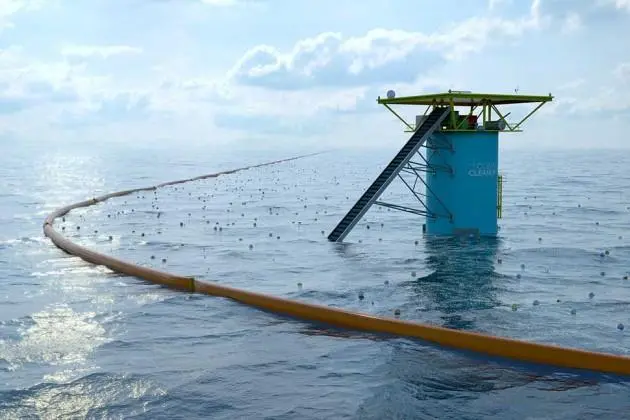
Mr Slat however asked: “Why move through the ocean if the ocean can move through you?” In other words, capture the debris as it flows past. His ‘floating barrier’ idea nearly remained a school project, “but even after going on to study aerospace engineering at university I couldn’t stop thinking about it,” says Mr Slat, now 20. “In the end I was so distracted I made a decision to let go of my studies and follow it up.”
Despite a few months of worry that he hadn’t made the right choice, the concept suddenly ‘went viral’ in 2013, providing the basis for gathering a 100 strong team of people from various companies, universities and other institutions under the banner of the Ocean Cleanup Foundation.
One of the main advantages of this concept is that it is scalable: by using the natural circulation of the gyres operational expenses are kept low and the cleanup duration is massively reduced. More, as the booms are made of non-permeable materials, marine life shouldn’t get entangled and while mitigation measures would be necessary around the processing plant, taken all together even the impact on plankton is minimal. To top it all, there’s the potential of revenue from the recycled plastic.
But as all engineers know, the devil is in the detail. Firstly it was necessary to measure the vertical distribution of the plastic debris: as expected sampling showed an increase of mass closer to the surface – which allows the floating barrier to have a relatively shallow, 3m depth.
It was also necessary to make sure the plastics would be moved along and concentrated by the boom, after all, it’s no use if they simply stick there. Happily, fluid dynamic simulations showed that particles keep around 40% of their initial velocity when the boom is placed at an angle of 30° to the flow.
However, Mr Slat admits “while the original idea seemed simple, we’ve found each solution springs two more problems into being”. For example, running a boom-and-mooring dynamic analysis model (Orcaflex) showed segment length and tension can prevent the boom from following the surface, overtopping waves carrying debris across the boom.
The answer was running the tension cable 30m below the surface, only linking with the boom every 60m; a configuration which allows the floating sections to effectively follow the waves.
The final design is a boom with a 95% operational window, coping with significant wave heights of 5.5m. Given even harsher weather the booms segments will decouple at one end and let the waves move through the array unimpeded, saving the equipment from catastrophic failure.
The mooring systems, faced with an average 4,000m depth, also had to break new ground: fibre rope being the only option that wouldn’t drag the whole array under. A crossover solution from the offshore industry, a surface-deployed Vryhof three-line Vertical Load Anchor with proven use at 2,500m, was chosen for the mooring points.
The processing plant is another offshore industry crossover, a cylindrical 11m diameter, 58m high floating platform. Fitted with conveyor, shredder, slurry pumps, centrifugal separator plus workshop and a 50 tonne crane for maintenance, it needs only a ship collection every 45 days. Notably, the platform goes further to minimise environmental impact: roof mounted photovoltaic panels will provide the primary power supply.
With the finances being the limiting factor, a decade’s deployment of a 100km array has been initially proposed, supported by the recently published, detailed feasibility study. As the booms are in fact around 90% efficient in dealing with what comes past “we predict we could, for example, clear around half the North Pacific Gyre in around 10 years”, explains Mr Slat.
A break-even cost of €4.53 per kg of plastic collected (operation as well as investment included) means the array is about 33 times less expensive than conventional methods. Further, Mr Slat says: “There’s a good chance that the value of the extracted plastic may cover a major part, if not all, of these costs.” Either way it needs to be put against the $13bn of annual damage estimated by UNEP to get a real feel for the potential.
“So now we have to make it executable,” says Mr Slat. The core of the next three years will be scale tests building to a 10km array that should be deployed in 2017 “and we already have some government interest on where to deploy this large-scale prototype” he adds. “From there it’s one step to the full scale deployment in the subtropical gyres.”
However, a note of caution is necessary before abandoning attempts to limit our use of throwaway plastic: dealing with the tough nut of the Great Pacific Garbage Patch also rests on radically reducing the influx of new pollution.
By Stevie Knight
Related Articles
 ACCESSORIES & EQUIPMENT
 ENVIRONMENT
 MARINE CONSTRUCTION