



VIDEO: Electric passenger vessel unveiled
Three companies have unveiled a fully electric vessel currently in build that features Air Hull technology and other smart features.
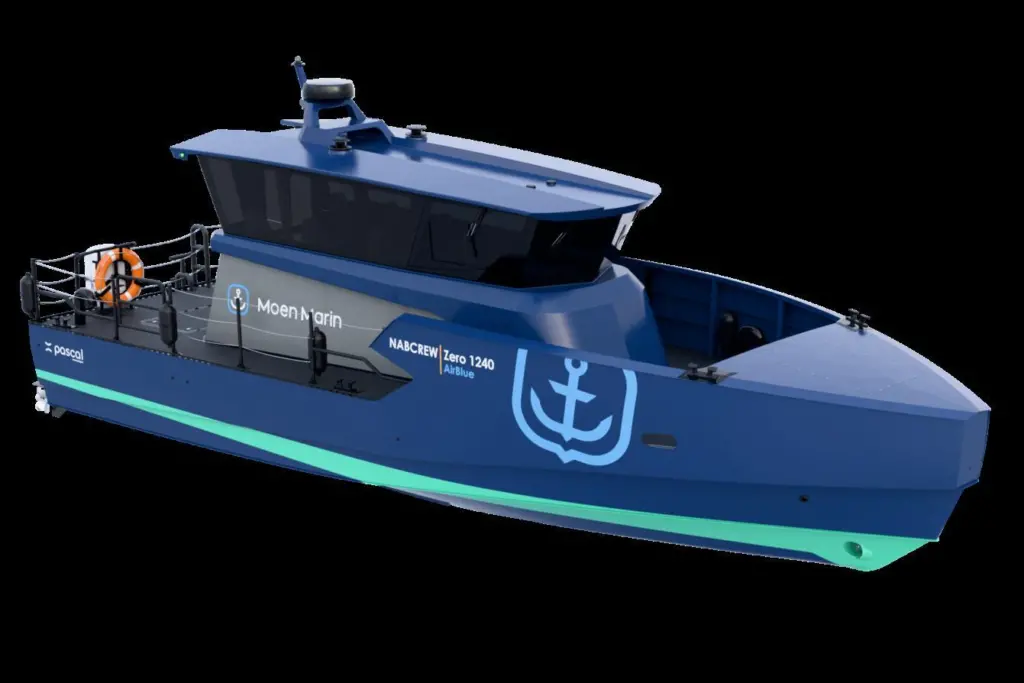
Primarily designed by Finland-based naval architect R2 Marine, the NABCREW Zero AirBlue 1240 vessel’s Air Hull technology comes from Pascal Technologies, in Norway.
The hull has a distinctive shape with a cavity underneath that fills with air as the vessel picks up speed, effectively reducing the boat’s resistance by lifting the hull slightly out of the water. The air cavity is secured by a hinged flap aft, which extends to maintain the air inside the cavity, ensuring optimal performance of the air system, Pascal says.
“This technology has the potential to cut the energy consumption of planing vessels by up to 50% compared to traditional hull designs,” says project leader Moen Marin, which is also based in Norway. “Furthermore, it does not sacrifice comfort, but rather employing systems that ensure smooth and efficient movement through the water.”
At the bow, a lift fan pumps air into the cavity, generating overpressure that also lifts the boat. The fan is optimized for energy efficiency, low noise and minimal weight, while ensuring steady air pressure and flow.
To decrease the weight, welding has been replaced with gluing – something, says R2 Marine CEO Arttu Mylläri, is not new, but also not common. R2 Marine is taking on the design and engineering of the project, bringing it all together, he says.
“It can be used for transportation in any industry,” he says, adding that because it is battery powered, charging structure is essential. Notorious for having problems with the cold, the batteries have a heating system alongside to allay that problem.
Shore power is also certainly on the increase, he says, especially in the Scandinavian countries of Finland, Sweden and Norway, where electric vehicles have taken off in a way not yet seen in many other countries.
The vessel has a maximum speed of 30 knots, a length of 12 metres and a beam of four metres. Battery capacity is 378kWh, with a range of 40nm. The vessel is due to be launched in two months’ time.