



Flying high: thickness gauge for drones overcomes development challenges
A drone-mounted thickness gauge will be flown by Dorchester-based, Tritex NDT at Seawork this year, showing how far the industry has come in exploring safer, quicker (and cheaper) inspection options.
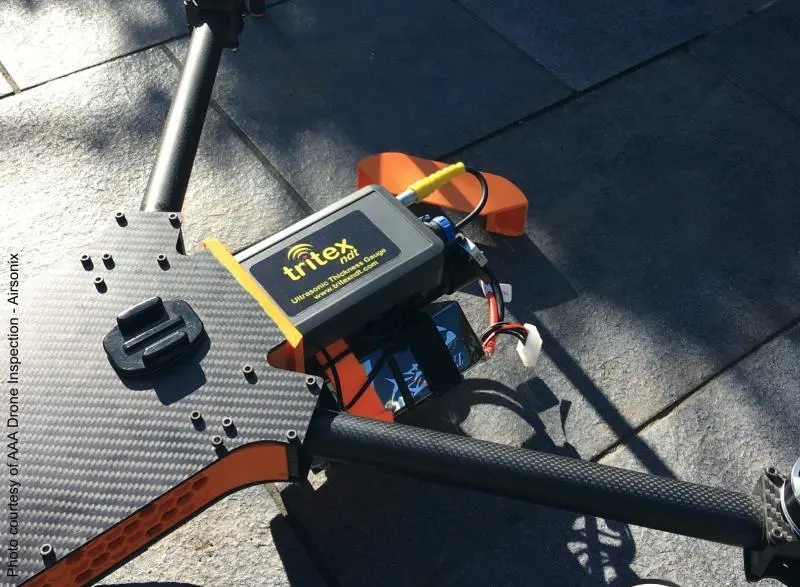
The Multigauge 6000 has a single probe on a flexible head. This projects forward of the drone and can take readings on curved or complex surfaces “so you don’t have to come in at exactly 90 degrees”, Jon Sharland of Tritex told MJ. This will then transmit real-time measurements “up to a line of sight distance of 500 metres” said Sharland, using an integrated RF transmitter on the gauge to a ‘dongle-type’ transceiver that simply plugs into a laptop’s USB port.
Usefully the readings are displayed and stored in a grid or string format, easily read by Excel or other programmes, making analysis fairly straightforward.
For Jon Sharland, it’s the logical extension of the company’s already established technologies. The multi-echo device has already been proven on the company’s ROV mounted kit, using an Automatic Measurement Verification System (AMVS) the gauge will ignore painted coatings up to 20mm thick and give true readings even on the most heavily corroded metals.
However, there have been a few challenges to overcome that are specific to drone-mounted gauges.
Firstly, a ROV mounted gauge has little problem making a good connection with an object, as ultrasound waves carry in water. However, those in air need a ‘gel’ connection medium: of course one answer is to supply a ‘gel squirter’ to coat the probe before contact, but a simpler, more effective option has been the development of a ‘dry couplant’: “This is a very soft membrane positioned in front of the probe with similar ultrasound velocity properties to water,” explained Sharland.
But just as important is the weight: this is a critical aspect of any in-flight inspection tools. “As a rule, you get ten minutes of flight time from your onboard battery,” said Sharland. “For every gram of weight you add, you have to subtract a second from that. As a 60-gram payload will take a minute, that’s roughly 10% off your flight time, so we need to make it all as light as possible.”
The OEM-integrated version has a total weight of 55 grams, but at Seawork, there will be a new, mountable variety, again with a minimal weight to retain the all-important flight time. This will come in a case, complete with transceiver plug-in and everything else that enables a flying inspection – apart from the drone.
Visit Tritex NDT at Seawork International 2018 on stand PG5.
By Stevie Knight