


Further progress for Zeebrugge’s second LNG jetty
Foundation work on Zeebrugge’s second LNG jetty is complete, allowing progress with building of the superstructure in a project with one eye on the supplying of LNG as a fuel for shipping.
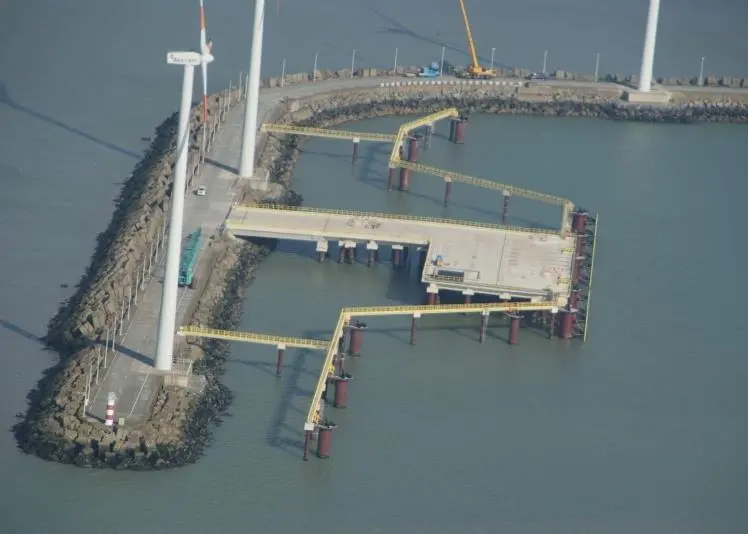
Well over 1,300 vessels have used the LNG terminal at Zeebrugge since it was established in 1987. Operated by Brussels based natural gas infrastructure company Fluxys Belgium, the terminal is a major gateway in the supply of LNG to northwest Europe. The facilities provide buffer storage tanks allowing LNG to be regasified and distributed into Belgium’s national grid system and beyond including to the UK, the Netherlands, Germany, Luxemburg, France and southern Europe. It is this export element of the LNG trade that is an important and relevant factor in the development with the terminal currently underway.
The second jetty will provide additional importing and exporting flexibility at a time when European emission control regulations are focussing minds on alternative means of fuelling Europe’s shipping fleets. In Norway, LNG has been used as fuel for certain sectors of the shipping industry for many years but while refuelling facilities can be established for vessels running regular fixed services, the lack of such facilities has been one of the barriers for vessels employed in less predictable trading patterns. Europe’s inland shipping fleet is one area where progress is being made in developing LNG fuelled vessels and a number of ports including Rotterdam (Gate LNG terminal) are exploring ways of providing LNG fuelling facilities. Existing LNG powered vessels are often refuelled by road tankers.
Port of Zeebrugge is seeing an increase in the demand for export LNG cargoes and the second jetty, due to commence operations in 2015, will be well placed to cater for demand for this developing market. The jetty will be able to accommodate both small and large LNG carriers, with capacities of between 2,000m3 and 217,000m3. Loading/unloading capacity will be 14,000m3/hour.
For construction of the superstructure, Fluxys LNG NV have appointed the Spanish-Italian company TS LNG as contractor, a joint venture between TechInt E&C and SENER.
By Peter Barker