![MaritimeJournal[Seawork]](https://www.maritimejournal.com/wp-content/uploads/2026/09/MaritimeJournalSeawork.svg)



Crew injured as guard vessel crashes into wind turbine
Two injured crew were evacuated from a vessel that had collided with a wind turbine in the North Sea, the Royal Dutch Rescue Society (KNRM) has confirmed.
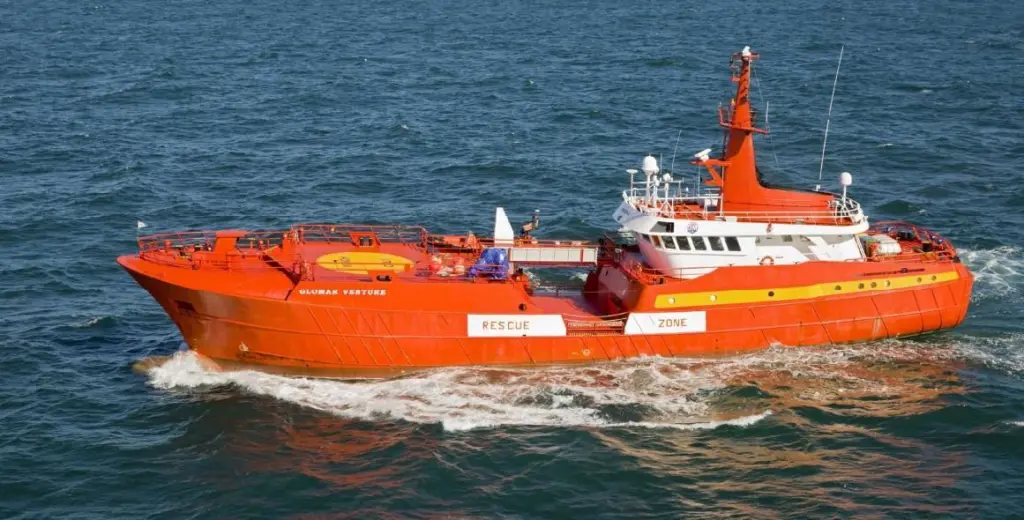
The Glomar Venture, a RINA-class guard vessel that was built in 1987, is 45.7 in length by 9 metres.
Total accommodation is four 12 persons, but it is not known how many were actually on board at the time of the incident.
Details of the incident have not yet been officially released to Maritime Journal by the Dutch Coastguard or vessel owner Glomar Offshore.
However on its Facebook page, SNP Ship Management said there were eight crew members, and the collision had occurred 24 kilometres from the coast near Callantsoog.
“Despite the collision, Glomar Venture continued the journey under its own power and safely arrived at the port of Den Helder, Netherlands,” the post says.
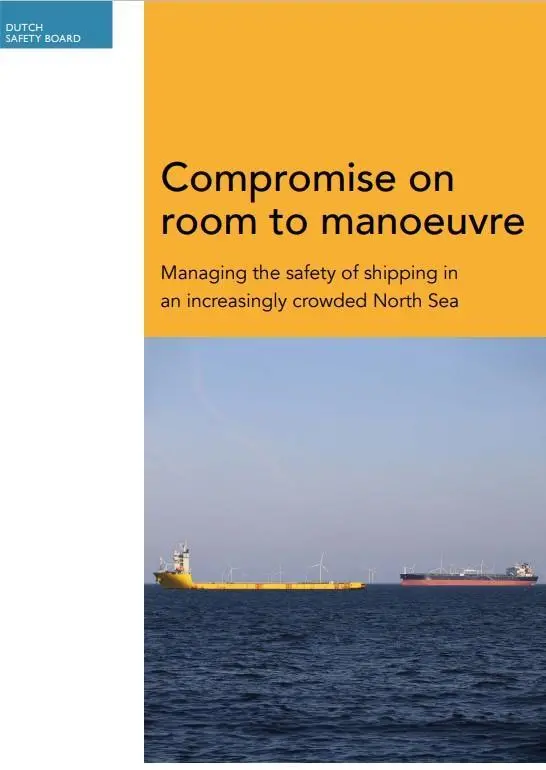
Last year, the Dutch Safety Board published a report about North Sea incidents, warning that free space for shipping was coming under increasing pressure.
“Shipping routes, wind farms, and oil rigs are all competing for space in the North Sea,” the report, Compromise on Room to Manoeuvre: Managing the safety of shipping in an increasingly crowded North Sea – says. “The increasing number of fixed objects poses risks for shipping. However, those risks are not properly understood.
“In the North Sea, wind-sensitive vessels such as ultra large container ships can already encounter problems in a wind force of just 6 Beaufort. There is not enough room for those vessels to make a complete turn in case of an emergency. And in hazardous situations, the current emergency response towing vessels cannot always assist them.”
The report was written after the Maltese bulk carrier Julietta D collided with another ship and then two structures forming part of a wind farm under construction in early 2022.
“It is important to realise that decisions that are taken now on the installation of fixed objects in the North Sea have implications for the risks in 2030-2050,” the report says. “In other words, the future of shipping safety in the North Sea is being determined right now.
“Thousands of fixed objects are expected to be installed there in the future (after 2030). There are plans for converting the electricity generated by wind turbines into hydrogen or ammonia. This will require new platforms to be constructed, and it will also need to be possible to transport the hydrogen on board tankers or via pipelines.
“All this means that the North Sea is gradually being transformed into an offshore industrial zone, with ships constantly finding fixed objects or other vessels alongside them. Shipping traffic in traffic separation schemes will also increase in intensity, with vessels sailing closer together.
“In contrast to air traffic in the skies over the Netherlands, there is no traffic management system for shipping in the greater part of the North Sea. Moreover, further upscaling is also taking place within the shipping industry and vessels are being equipped with new power sources. This brings with it new incident scenarios and safety risks.
“The Dutch Safety Board therefore considers it necessary for the approach to shipping safety to evolve along with the increasing complexity that results from the scaling up of wind energy and shipping.”
At the time of writing, neither the Dutch Coastguard nor Glomar had responded to Maritime Journal’s request for clarification of the Glomar Venture collision incident.