





EU mission to overturn Jones Act revealed
The European Commission has paid a media firm €7,000 to produce ‘TikTok-style’ videos to lobby the US government to overturn or amend the Jones Act.
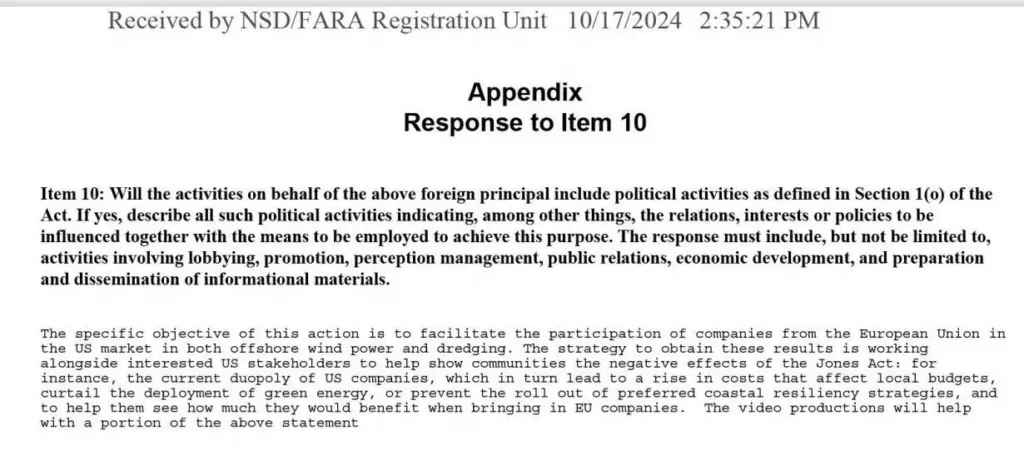
Official documents show a contract under the project named ‘EU Policy and Outreach Partnership in the US and Policy Dialogue Support’ and financed by the European Commission aims for the ‘Realization of two short “TikTok style” videos on the effects of Jones Act’.
IBF Connect, a private company based in Brussels that organises events for various European Union bodies, has registered with the Foreign Agents Registration Act (FARA) and hired US-based StorySquad Media to do the work.
In documents filed with the US Department of Justice, it has hired StorySquad ‘to facilitate the participation of companies from the European Union in the US market in both offshore wind power and dredging’.
Item 10 of the US Department of Justice Registration Statement that has to be filled out in accordance with the FARA continues: “The strategy to obtain these results is working alongside interested US stakeholders to help show communities the negative effects of the Jones Act: for instance, the current duopoly of US companies, which in turn lead to a rise in costs that affect local budgets, curtail the deployment of green energy, or prevent the roll out of preferred coastal resiliency strategies, and to help them see how much they would benefit when bringing in EU companies. The video productions will help with a portion of the above statement.”
Incumbent US president Donald Trump has not made his opinions known as to the Jones Act, but has already threatened to impose many trade tariffs. Although new personal advisor Elon Musk has vowed to scrap many federal regulations, the Jones Act has not been named as one of them.
At the time of writing, neither IBF Connect nor StorySquad had responded to Maritime Journal.
Cato think-tank
The EU is not alone in its desire to see the end of the Jones Act, and in a December 11, 2024 report to the US Department of Government Efficiency (DOGE), the Cato Institute, an influential public policy research think-tank founded in 1977, puts the case.
“Ships that comply with (the Jones Act) are four to five times more expensive to build and approximately three times more expensive to operate than internationally flagged vessels, thus dramatically raising the cost of domestic transportation,” it says.
This has resulted in Americans ‘largely abandoning water as a transport mode’, it says, substituting domestic goods with imported products that can take advantage of efficient international shipping.

“For example, California is set to begin importing fuel from as far away as the Netherlands and Singapore instead of Texas due to the high cost of Jones Act-compliant shipping,” it says.
“In some cases, it is impossible to move goods within the United States… due to a complete lack of appropriate Jones Act-compliant shipping.
“The Jones Act is an internal trade barrier that harms Americans’ ability to trade and do business with each other.”
If not repealed in its entirety, the Cato report says, the Act could be amended in several ways, including allowing non-Jones Act vessels to be used if Jones Act vessels were not available, or at least eliminating the US-built requirement and open cabotage out to vessels built in countries with which the US has a defence agreement.
Related Articles
 OTHER NEWS
 OTHER NEWS
 SPONSOREDSTORY