



Faster operations can be kinder on crews
Seawork exhibitor Hefring Marine is using intelligent systems to digitize seamanship for small, fast commercial vessels, writes Jake Frith.
Led by navies, coastguards, search & rescue organisations and law enforcement agencies, some of the biggest drivers in fast boat design and operations for the last decade have been crew health, safety and welfare.
Icelandic company and first time Seawork exhibitor Hefring Marine specializes in the development of digital guidance and monitoring solutions to augment the vessel operating experience, and is bringing its complete ‘guidance system’ product (also called Hefring Marine) to market after several years of development.
As well as reducing injuries, Hefring believes the system has other significant cost drivers, such as improving fuel consumption, reducing repair bills and potentially lowering insurance premiums.
Admin console
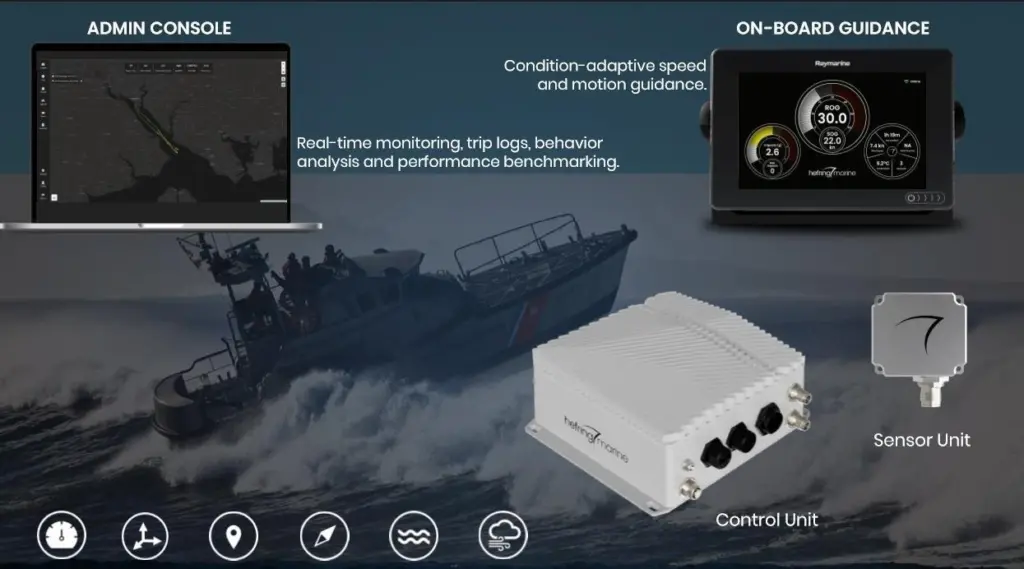
The product, which has been developed in collaboration with a number of auspicious names in high speed operations including Viking Norsafe and KNRM (Dutch sea rescue service), uses control and sensor units that both record and provide real-time data to the boat’s MFD (Multifunction Display), crunching data such as wave impact G-forces, number of impacts and trim setting.
The system is compatible with Garmin, Simrad and Raymarine MFDs and helps to ensure that boats are operated in a safe and efficient operational envelope. The onboard system is supported by a cloud-based fleet management Admin Console for real-time monitoring and collection of detailed historical trip logs.
Motions, speed, location, and other analysis and data can be reviewed on a second-by-second basis.
All data is recorded to and presented in a fleet management desktop portal that provides insightful analysis into each trip.
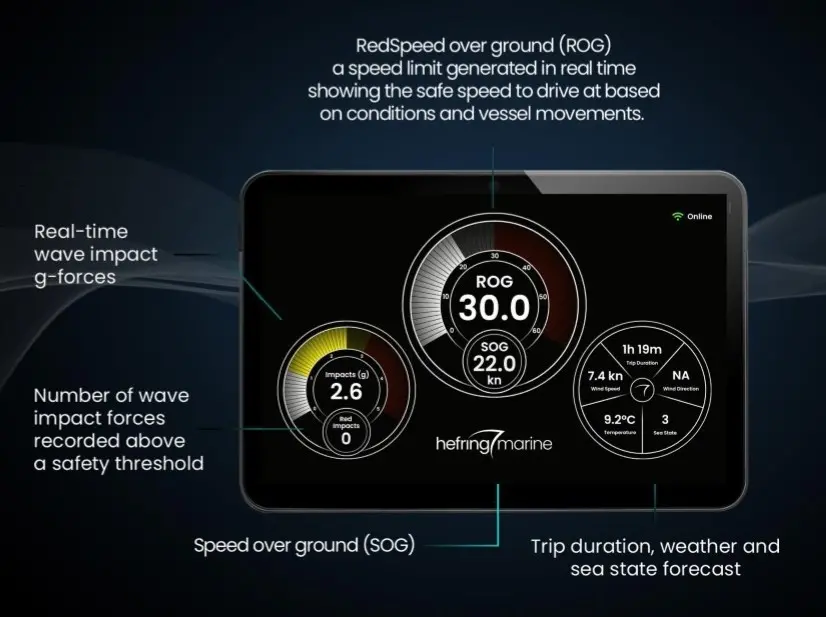
Hefring Marine’s MFD display showing ROG
On board the vessel, it shows the boat’s actual SOG (Speed over the ground) in the same ‘dial’ as the calculated ROG (RedSpeed over the ground).
The latter is effectively the maximum ‘safe’ speed at which the vessel’s accelerations will not cause short-term injury or long-term damage to passengers or crew.
The system automatically varies its guidance to reflect prevailing conditions, actual speed and vessel motions.
Impacts reduced
With all data being both recorded and available real-time to vessel operators, the technology has a marked psychological effect.
Hefring has demonstrated in a recent trial that boat drivers dramatically modified their driving style when the system was turned on, making it much less damaging to a potential crew. Hefring’s claims are that vessel fuel efficiency can be improved by 30% and crew impacts can be reduced by 70%.
In one case study Hefring ran, a 213 nautical mile open sea RIB passage between Norway and Denmark, 90% of impacts of over 3.0g would have been flagged up by the system and been immediately flagged up as ROG exceeding SOG.
In this study, the RIB driver was not given real-time access to the system so that the real-world behaviors that the system seeks to address could be monitored. This driver, in fact, spent 66% of the 10-hour trip with the boat’s actual SOG exceeding ROG. The Hefring system recorded one impact of 6.1g off the North Coast of Denmark – a figure that the US Navy would have considered risky enough to be deemed as acceptable only for a ‘vessel under fire’.
Fine on this occasion as a one off, and the crew all recovered, although were described as ‘highly fatigued’ after the trip.
If repeated a number of times over multiple trips, accelerations like this could have severe chronic effects on a crew and increase their risk of acute injury.
Training aid
Less common than fast boat drivers going too fast for the prevailing conditions is a driver going the other way, being overly concerned about crew welfare and going slower than is ideal for the operation.
This is where the Hefring system also shows its worth for military or SAR operators, because in the case of a more cautious driver, the system will encourage them to speed up a little, thus potentially getting clear of danger or arriving at a casualty faster.
Hefring also considers the system a useful aid to driver training. It captures data on such variables as the boat’s trim setting, so a novice or inattentive operator burning excess fuel with an inappropriate trim tab or engine trim setting would be quickly flagged up.
Visit Hefring ehf at Seawork International 2022 on June 21-23.
Related Articles
 OTHER NEWS
 OTHER NEWS
 SPONSOREDSTORY