![MaritimeJournal[Seawork]](https://www.maritimejournal.com/wp-content/uploads/2026/09/MaritimeJournalSeawork.svg)



Luxury cars sink onboard fire-struck Felicity Ace
The car carrier Felicity Ace, which caught fire in the Atlantic Ocean on its way from Germany to the US, has now sunk, ship owner and operator MOL has confirmed in a statement.
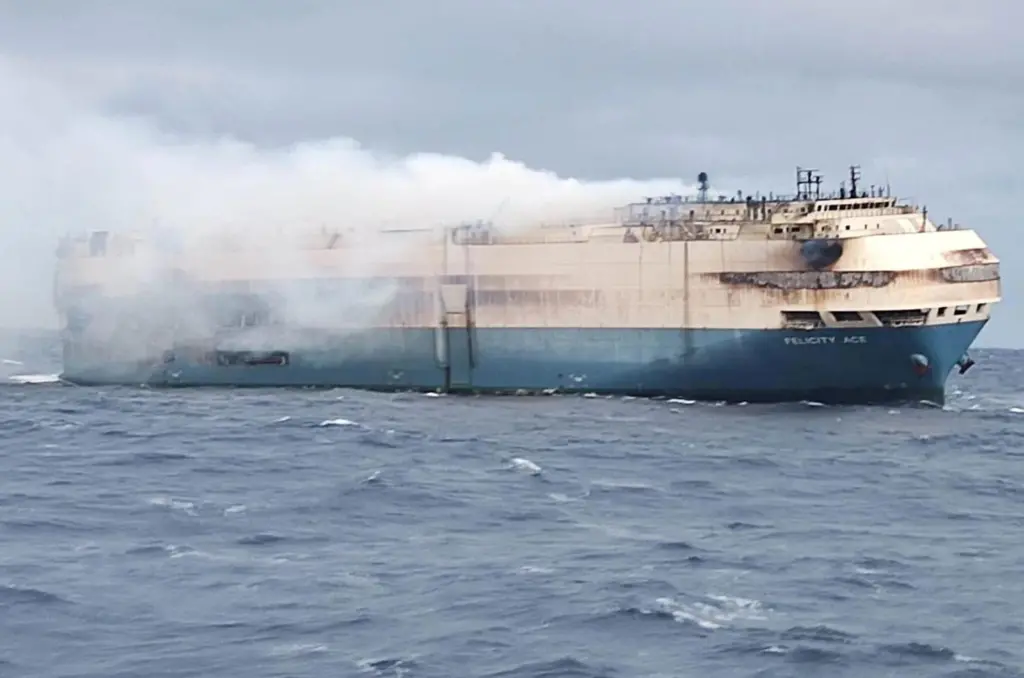
The Portuguese Navy rescued all 22 crew members safely from the vessel, which was carrying up to 4,000 top-end cars, including Lamborghinis, Audis and Porsches owned by the car firm Volkswagen.
The navy deployed its NRO Setubal ocean patrol vessel to the incident, some 90 miles from the Azores islands, to monitor the area – and although no oil leaks were visible at the time of the fire, MOL says an oil slick appeared when the vessel finally sank.
Two large tugs with firefighting equipment arrived on the scene from Gibraltar along with a salvage craft from Rotterdam, six days after the fire broke out on February 16.
“The salvage team on site were able to board Felicity Ace by a helicopter and the vessel has started being towed by the large salvage craft Bear to a safe area off Azores,” MOL Ship Management said on February 25.
“Two tugs, ALP Guard and Dian Kingdom, together with a large salvage craft with additional firefighting capacity VB Hispanic, are escorting the vessel.”
However on March 1, MOL confirmed that the vessel had sunk around 220nm off the Azores ‘after having suffered a list to starboard side’.
“When the vessel sank, there was a small oil slick seen in the water,” MOL said on March 1.
The cause of the fire has not been confirmed, but several news outlets have suggested lithium batteries inside some of the cars – which were electric vehicles – could have sustained the blaze, if not caused it.
Lithium-ion battery fires are particularly difficult to put out, partly because when lithium is exposed to water it produces hydrogen, which is flammable.
They are known to re-ignite and have to be stored away from anything flammable, sometimes in whole tanks of water until the risk of reignition is over.