![MaritimeJournal[Seawork]](https://www.maritimejournal.com/wp-content/uploads/2026/09/MaritimeJournalSeawork.svg)






‘Sparky’ finally starts work
Damen’s first all-electric harbour tug Sparky has finally commenced operations following delivery and christening for its owners Ports of Auckland (POAL).
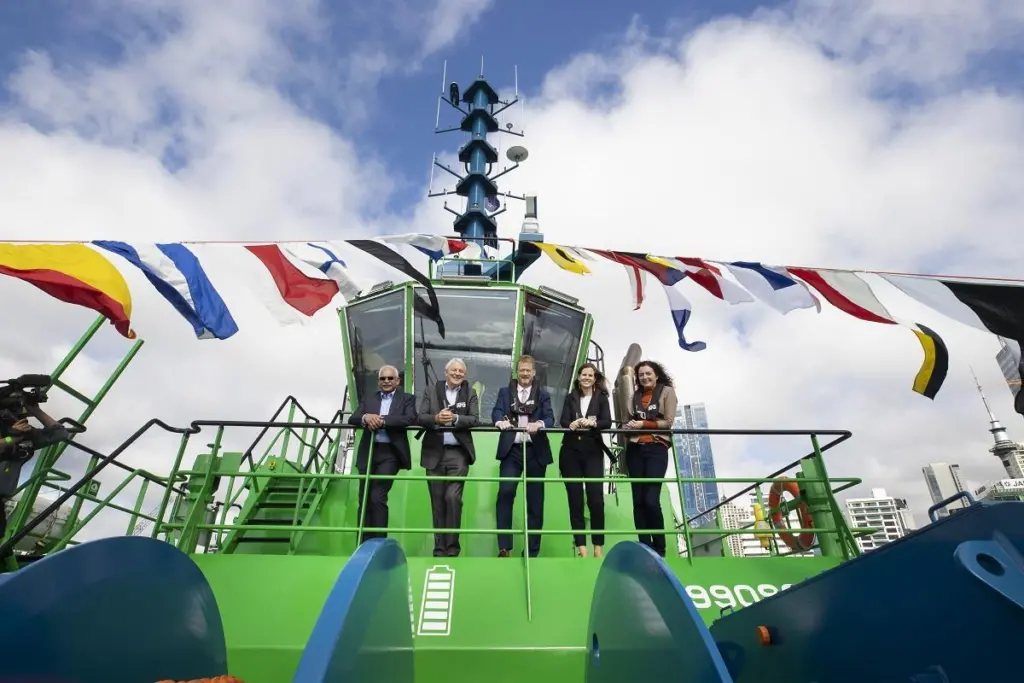
MJ has been reporting regularly on progress with Damen’s “revolutionary” all-electric tug, based on its increasingly successful RSD Tug 2513. With the final steps in this six-year journey for Damen and POAL from concept to operation now complete, a release of its detailed specification allows a closer examination of this powerful vessel.
Sparky carries similar specifications to others of the same class but with the new design name RSD-E Tug 2513. Headline of note records the tug capable of manoeuvring even the largest vessels undertaking two or more assignments before recharging, which takes just two hours. The LR-classed vessel carries notation ✠ 100A1 Tug, Specified Coastal Service, [✠] LMC UMS IES CAC3 Electric Hybrid DC. Dimensions include: LOA 24.73m, beam OA 13.13m, depth 4.95m, draught aft 6.4m and displacement (98% consumables) 540t.
Main Engines (electric) are two TW 1400r L electric motors from Ramme Electric Machines GmbH delivering 3,700bkW at 500rpm to Kongsberg US 255 L-Drive thrusters. Battery capacity is 2,782kWh maximum with bollard pull 70.9 tons ahead and speed ahead 12.3kn.
Two Caterpillar C32TA gensets delivering 1,175kVA, 690V at 60Hz are included with Azcue providing general service, bilge water and fuel transfer pumps. Azcue also provides a fresh-water pressure set with Wärtsilä Hamworthy supplying the sewage treatment plant. A generator-driven pump provides 1,200-1,400m3/hr to a 1,200m3/hr water/foam monitor for external firefighting. Tank capacities include 50m3 fuel oil, 8.7m3 fresh water and 8.8m3 foam.
An anchor and separate towing winch are installed forward, the latter a hydraulically driven split-drum model providing a pull of 31t up to 11m/min and a reduced pull up to 50m/min with a brake holding force of 175t (all second layer). Typical sturdy D section, W section and cylindrical fendering are included and accommodation is provided for four persons in two single and one double cabins. The accommodation is air conditioned, completely insulated and resiliently mounted to reduce noise levels.
While principally for harbour use, Sparky has an adequate navigation and communication system installation including Furuno radar, Navi-Sailor electronic chart system and Simrad autopilot and satellite compass/GPS. Two Cobham Sailor VHFs are included along with two Jotron handheld VHFs and a Sailor UHF radiotelephone.