

Jas Singh: Auriga Energy
It was the closure of a small, space industry site that got Jas Singh thinking about “being involved in the energy industry of the future”: hydrogen.
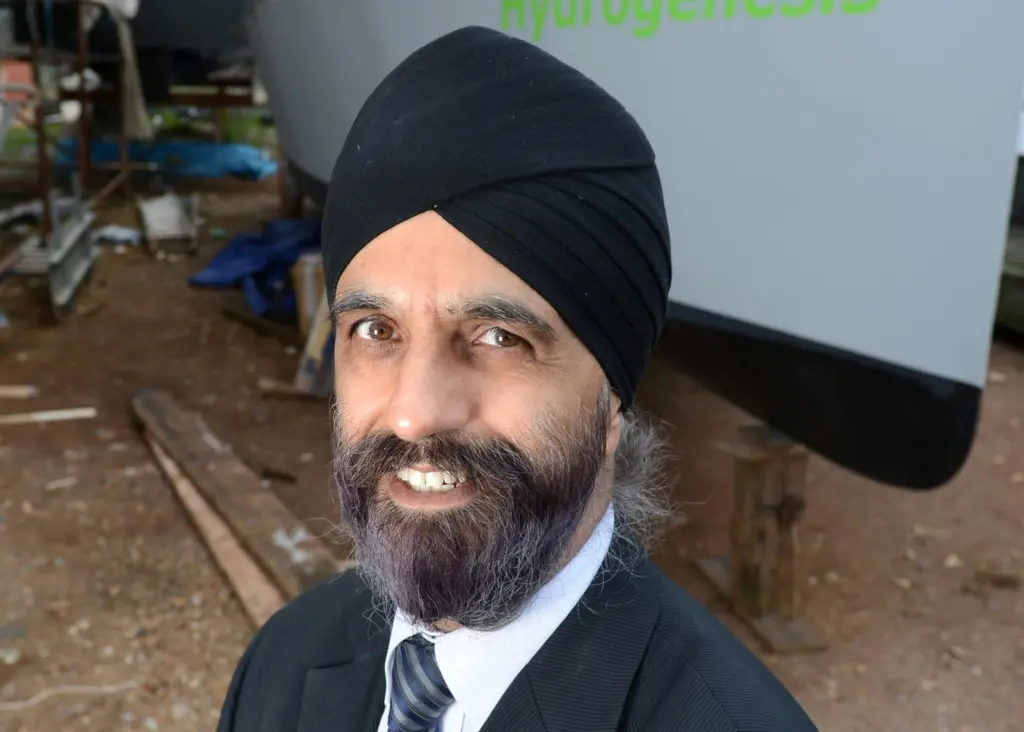
However, the end of the 90s wasn’t the right time for the commercial deployment of fuel cells so instead he wholeheartedly threw himself into building up a marine technologies division for a small company called SEA, starting with research on Unmanned Underwater Vehicles (UUV). The group grew, reaching 2.5m turnover by the mid 2000s – but by this time fuel cell technology was maturing out of the laboratory and “the dream” seemed closer. He made the jump and Auriga Energy started trading in January 2007.
“My idea was to get into a niche product area, not cars because the mighty corporations will always win. But here I was in the maritime town of Bristol; I thought something like a ferry in the docks has a high profile and could start to dispel some of the concerns about hydrogen and fuel cells.”
After a several years of lobbying Bristol City Council the authorities gave the novel concept their blessing: “Whenever I presented the idea everyone in the audience was excited, but getting through the bureaucratic hoops was a nightmare – no one wants to take that initial responsibility.” And on approaching the MCA, he saw “lever arch files with thousands of mentions of diesel – but nothing that could be applied to hydrogen”.
Further, even after getting agreement on the boat, “the usual response was ‘you can’t do it here’ when I mentioned the refuelling station location”. Money was even tighter than the bureaucracy: “Whatever you are creating, the first is always expensive… prototypes are always costly,” he pointed out.
Finally in the water in 2012, the 11m steel-hulled ferry, manufactured by Bristol Hydrogen Boats (a joint company formed along with two of the existing operators, the Bristol Packet and No 7 Boat Trips), proved the point by working throughout the 2013 season in temperatures that plunged below zero then rose to the scorching 30s.
However, as it was only a demonstrator project the Air Products refuelling station was funded on a time-limited basis “although the boat is still working and we are adapting it to run on portable hydrogen cylinders for hiring out”, he said.
So, all that work for something that only lasted a relatively short while? It’s just part of the process to open the doors for larger deployments, he explained, adding that there are other regions interested in taking it further.
Moreover, Mr Singh is adamant that there’s value in carving out new ground and you can’t expect an easy ride. “Aspirations are necessary for this world, we need to get the pollution cleaned up, this is a technology that will help make it happen.” And someone has to be first.
By Stevie Knight