



Keeping a lonely vigil
There can be few Aids to Navigation (AtoN) as remotely located as the three Rigwatcher units marking the decommissioned Frigg Field on the UK/Norwegian median in the North Sea.
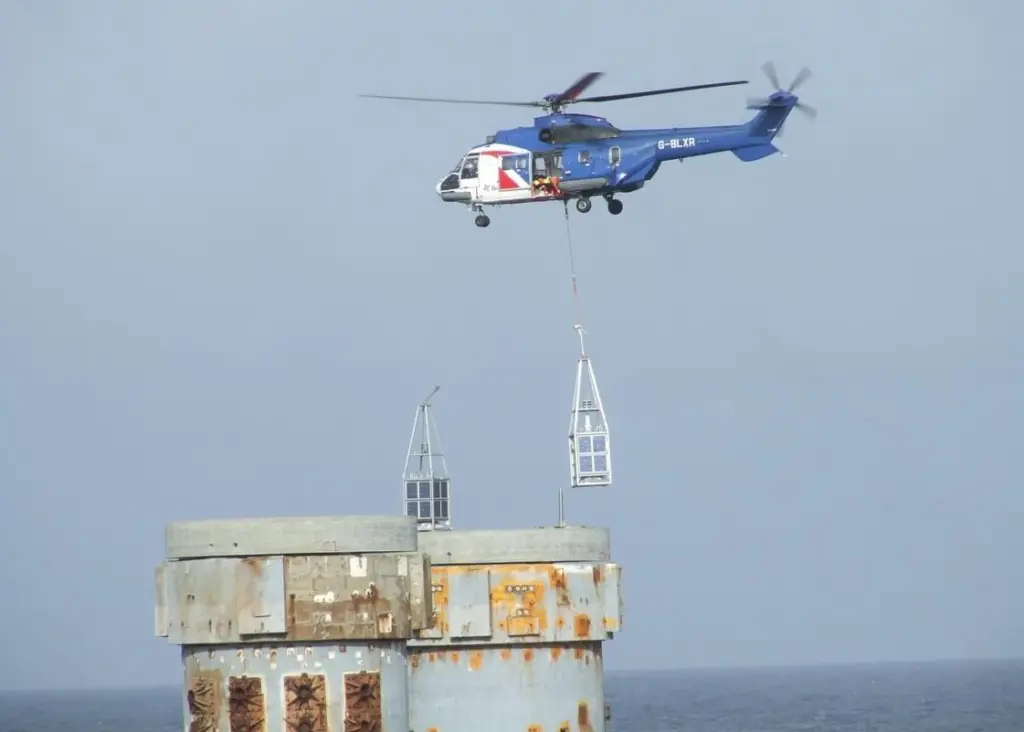
Three concrete gravity based structures were decommissioned in place, leaving the remnants of the pillar legs and sub-sea caissons as the only visible sign of Total’s once busy field. These remnants are marked for navigational safety by specially designed air portable Rigwatcher self-contained Aids to Navigation which are monitored and maintained under contract to Total E&P Norge by the Northern Lighthouse Board (NLB). A further dual Rigwatcher unit marks the remains of the MCP01 platform for Total E&P UK.
The Rigwatchers are designed for a deployment of up to four years remote operation. The first of the Rigwatchers was deployed in July 2007 and they have now been in operation offshore for up to 8 years.
A full set of back-up units are stored on warm stand-by in NLB’s Marine Support base in Oban, on the west coast of Scotland. These are used to effect both planned and un-scheduled change-outs to permit compliance with IALA Category 1 AtoN and IALA Guidance O-139 – Marking of Offshore Structures. AtoN performance is monitored 24/7 to provide predictive as well as reactive maintenance scheduling.
Working closely with Total logistics teams and their helicopter contractors, change-outs are planned and trained for using dummy units ashore. This provides familiarity with the techniques and challenges of engaging a lifting ball to a structure with no external assistance.
Three sequences of change-outs have now been made, two at Frigg and one at MCP01. As with so many operations offshore the key determining factor is weather, with a requirement for swells to be at or below two metres to allow safe lifting operations. Relatively short weather windows are workable as a complete sequence of changing out three Rigwatcher units can take as little as 30 minutes on location.
The replacement Rigwatcher AtoNs are transported to location on NLV Pharos, the Board’s Multi-Function Tender. Final checks and sign off are conducted by Board engineers before operations commence. Once the green light is given the helicopter, out of Aberdeen, flew directly to the field to carry out a final visual inspection before transiting to a nearby helideck, which was held clear as a “virgin deck” throughout the operation, to fit the lifting array. It then rejoined Pharos and transferred the new Rigwatchers to the pre-installed docking poles on the structure using remote lifting hooks before uplifting the in-situ units to Pharos. Following a refuelling stop at the virgin deck the helicopter returned to Aberdeen.
The close cooperation between ship and aircrew allowed the operations to proceed even though they were at the limit of feasibility due to the sea state. The pilots had to engage a suspended ball and chain into the crook of the lifting arm on top of the AtoN while having no fixed visual reference. To achieve this three times from a moving deck was difficult enough. The AtoN then had to be lowered onto a two metre steel pillar mounted onto a 20 metre tower in the sea again with no static visual reference. Recovering the old units was an equal challenge.
The Rigwatchers on station will be monitored remotely by the Northern Lighthouse Board and the returned units will be prepped for warm standby – ready to do it all again in four years’ time.
By Jake Frith
Related Articles
 VESSELS
 MARINE CONSTRUCTION
 VESSELS