![MaritimeJournal[Seawork]](https://www.maritimejournal.com/wp-content/uploads/2026/09/MaritimeJournalSeawork.svg)

Major engineering for Rotterdam tunnel crossing
A major civil engineering project has been hit by a few setbacks and delays, but the Maasdelta Tunnel is well on its way to providing the major port city of Rotterdam with a new crossing.
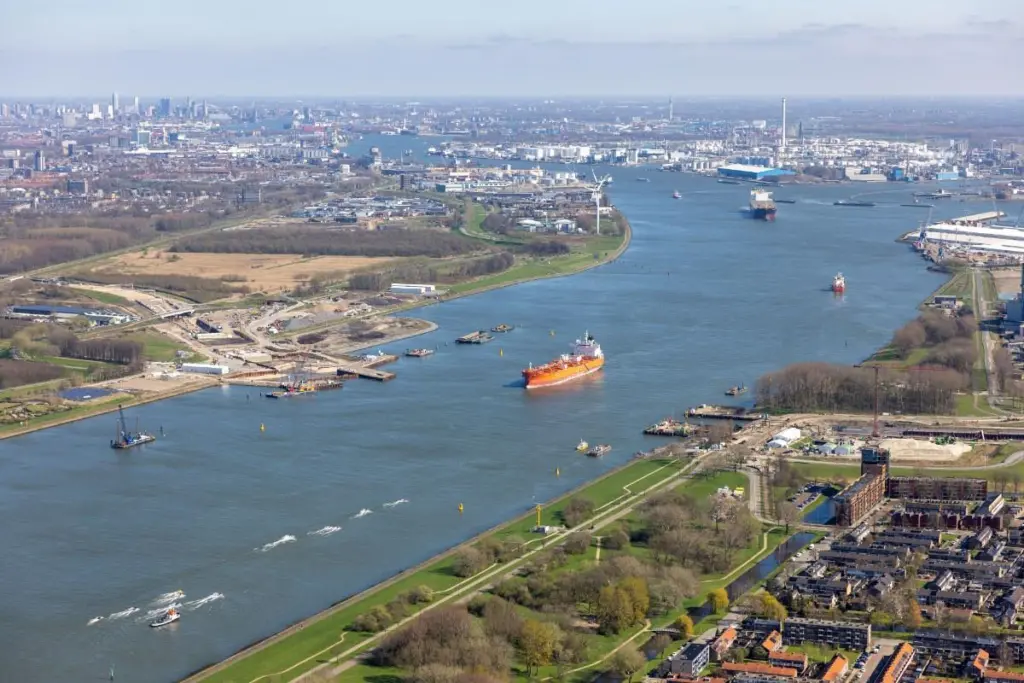
Tugs from Boluda Towage have taken the lead role with the sinking of two sections of the new Maasdelta Tunnel in Rotterdam.
In reporting the marine element of what is one of the Netherlands largest infrastructure projects in recent years, it is worth providing some background to this interesting story.
Like other major cities worldwide, Rotterdam has its own ring road, the city itself occupying the eastern portion of the ring road ‘square’ and extending north and south of the Nieuwe Maas. The ring road boundary extends westwards to Schiedam on the right bank and on the left bank Pernis, the village ‘enclave’ surrounded by industry typical of a busy seaport, including Shell’s giant oil refinery, the largest in Europe.
The ring road crosses the river via the Van Brienenoord Bridge on the eastward north/south leg and the Benelux Tunnel in the west. A second smaller tunnel, the Maastunnel, accommodates mostly commuter traffic between the (now) largely non-commercial port areas in Rotterdam centre itself.
Over many decades the port of Rotterdam has gradually expanded towards the coast, including Maasvlakte 2, which extends beyond the coastline. The vast majority of the port estate now lies to the west of the ring road.
Increased traffic needed a solution
The expansion has led to a significant increase in road traffic heading to the Maasvlaktes and Europort, with subsequent congestion during busy periods. With a lot of this traffic coming from the north it was clear another crossing was required in this western sector to ease the load in an area where freight and lighter commuter traffic battle for space.
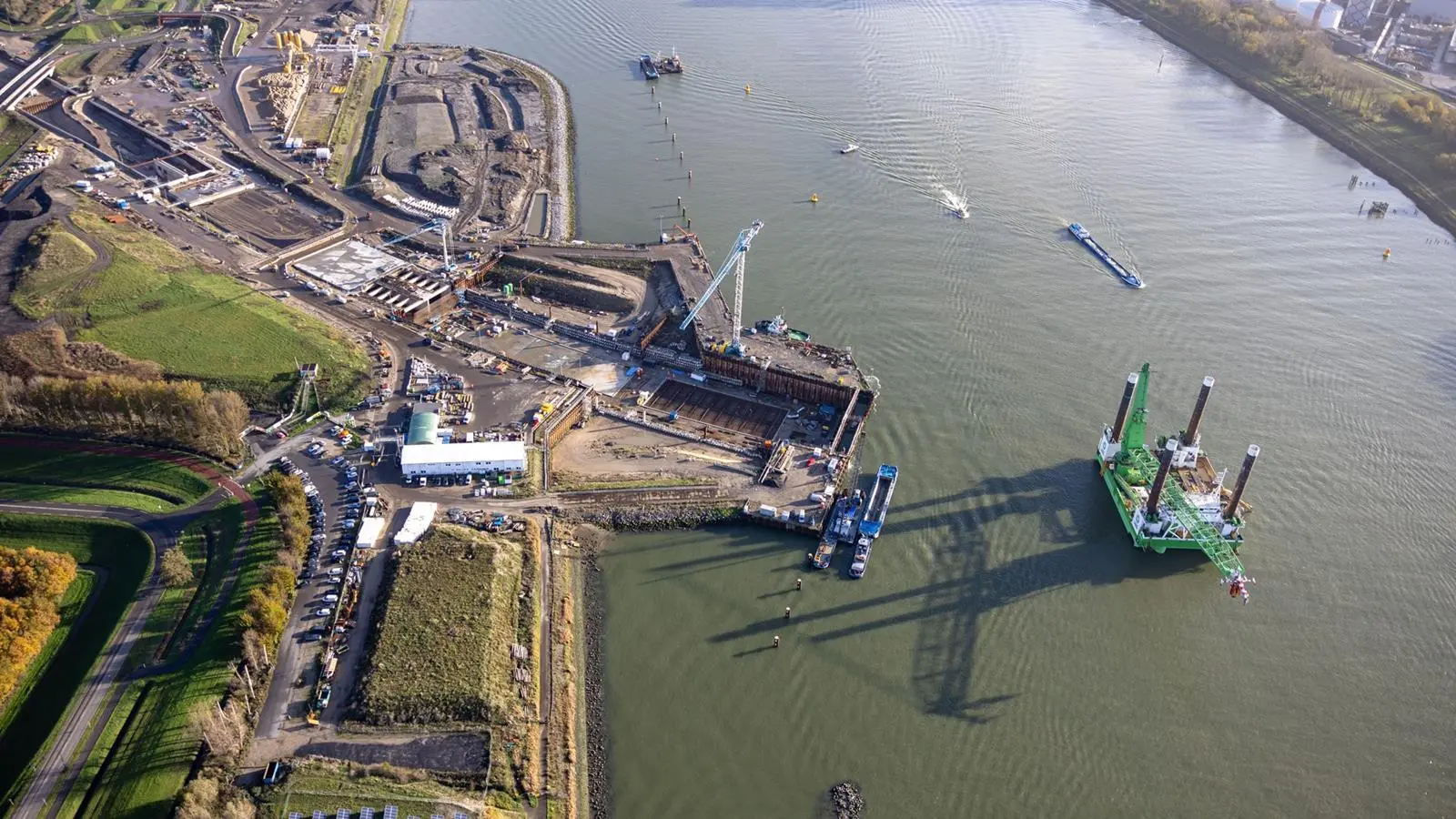
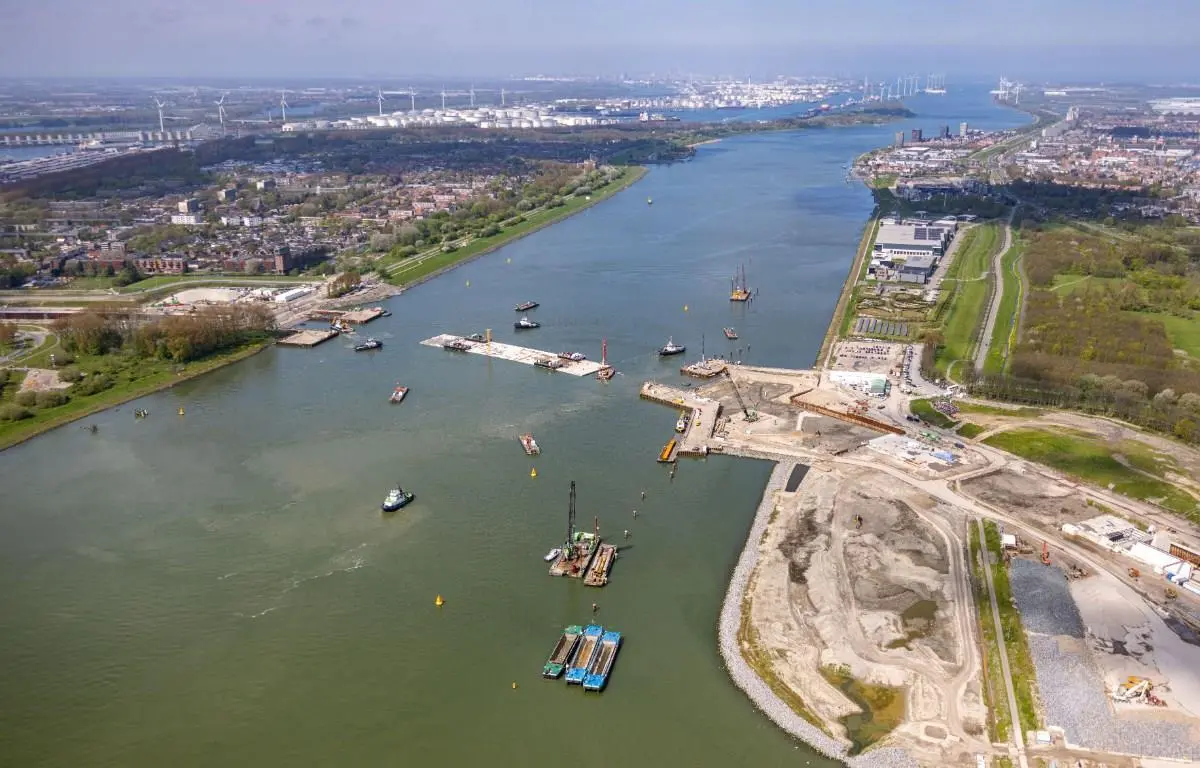
Collectively known as the Blankenburgverbinding (Blankenburg Connection), the new link comprises a 4km long sequence of road junctions and connections from Vlaardingen on the north side, a land tunnel called Hollandtunnel, included to preserve the green landscape, which is why two immersed tunnel elements (Maasdeltatunnel) were needed beneath the navigable waterway Het Scheur, part of the shipping route to and from Rotterdam itself.
The tunnel elements are each 200m and 185m long, 42m wide and 8m high, sunk to a depth of 28m and leading to another complex junction at Rozenburg on the south side linking to the busy A15 motorway with connections to local communities.
The requirement for the river tunnel elements to be at a depth of around 28m meant that the land approaches on each side of the river (including the Hollandtunnel on the north side) had also to be excavated to the same depth while able to provide a precise interface, when the time came, with the submerged tunnel sections.
Around 100,000m3 of underwater concrete weighing in at 250,000 tonnes was required for the three sub-projects Maasdeltatunnel Zuid, Maasdeltatunnel Noord and the Hollandtunnel. This would fill the equivalent of 51 Olympic-sized swimming pools.
Marine civil engineering
Looking at the marine element, a lot of preparatory work preceded the sinking of the two tunnels, which were given the names Alara (south tunnel) and Isabella (north tunnel).
The original plan was to build them on each bank, but potential delays from the Covid pandemic led to a rethink and construction was moved to the nearby Damen Verolme shipyard at Botlek, whose giant 405m long, 90m wide drydock was just large enough to accommodate the two curved tunnel sections.
As the aerial picture of the northern approach illustrates, the access ramps extended beyond the river banks and an important stage came when the pits were flooded, becoming tidal to accept the sunken tunnel elements.
A ‘letterbox’ structure forms the connection with the tunnels sealed by bulkheads and a steel profile of the same dimensions, called a Gina profile, creates a watertight seal between the tunnel element and access ramp. Omega profiles form the seams between the two tunnel elements themselves.
Prior to this, late in 2022 a trench was dredged to around 30m below NAP (Amsterdam Ordnance Datum, in basic terms, water level) to accommodate the tunnel sections which had to be beneath the seabed to maintain the existing water depth of around 17m for shipping.
Dredgers Artevelde and Meuse River removed around 500,000m3 of sand and soil, which was transported to the North Sea near Scheveningen. A 3D computer programme was produced for each vessel to ensure the correct depth was achieved throughout the trenching.
DEME’s jack-up construction vessel Neptune then laid 12 enormous 110t concrete tiles in the trench to provide a temporary foundation for the tunnels. Jacks resting on the tiles adjust the elements precisely to the centimetre after which the space beneath is filled with sand, the tiles no longer having a function. Neptune also had to dig a 6x6m well into which gravel was poured as foundation for each tile. Navigation was restricted in Het Scheur at times during this operation while it occupied the centre of the navigation channel.
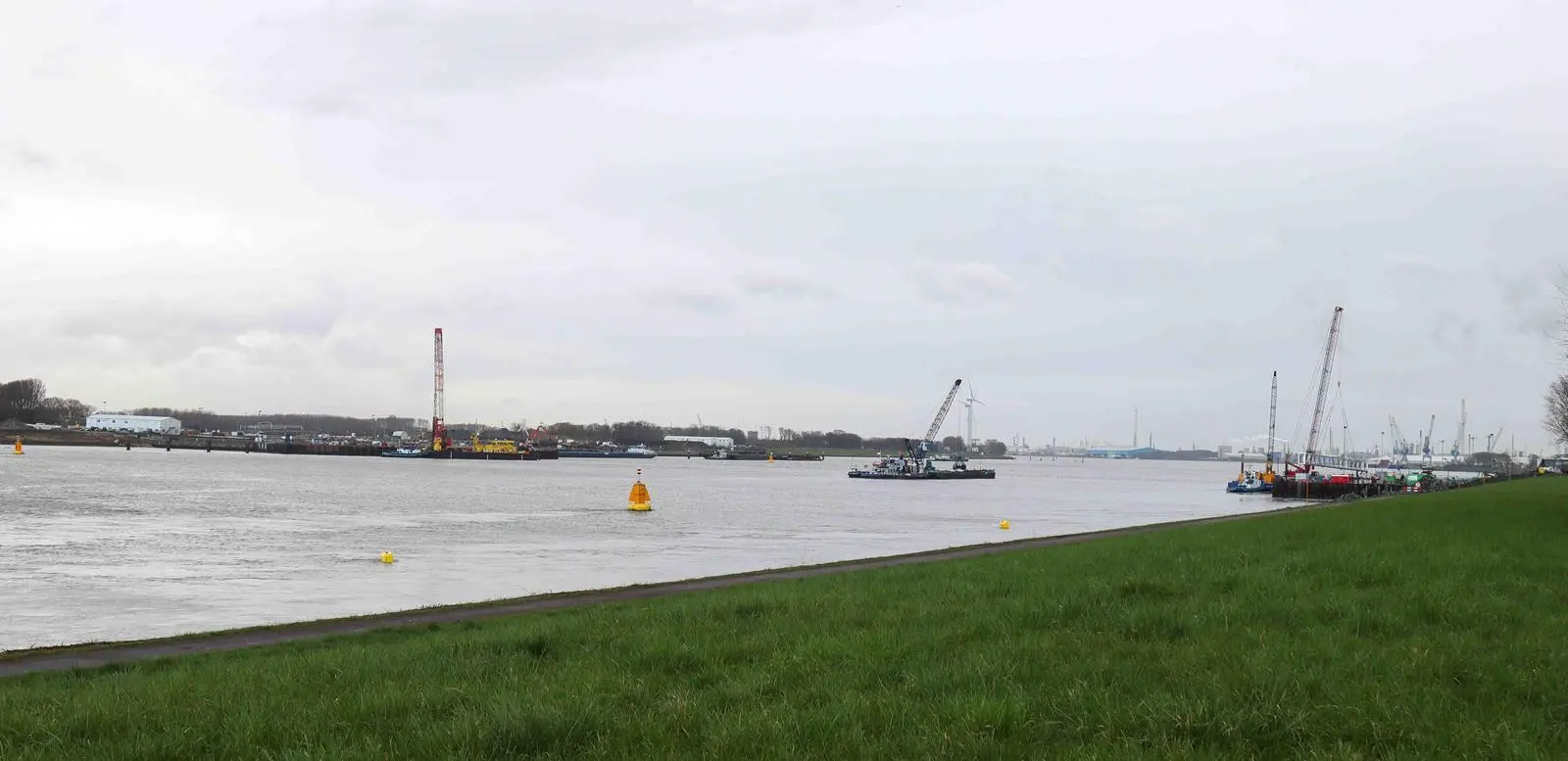
Further activity involved the placing of six poles, vibrated into the river bed, two on the Rozenburg side, two on the Vlaardingen side and two in the middle of the river, all ensure the tunnel elements would be sunk precisely in position. The centre two were installed at the same time as the nearby Maeslant storm surge barrier was carrying out its annual closure test, with the river closed to traffic.
Hiccups in operations
It was almost inevitable that such a major infrastructure project would face unforeseen problems and delays, and this came about during arguably the most critical part of the operation, the sinking of the two tunnel elements into the pre-dredged trench and onto the pre-laid foundation tiles.
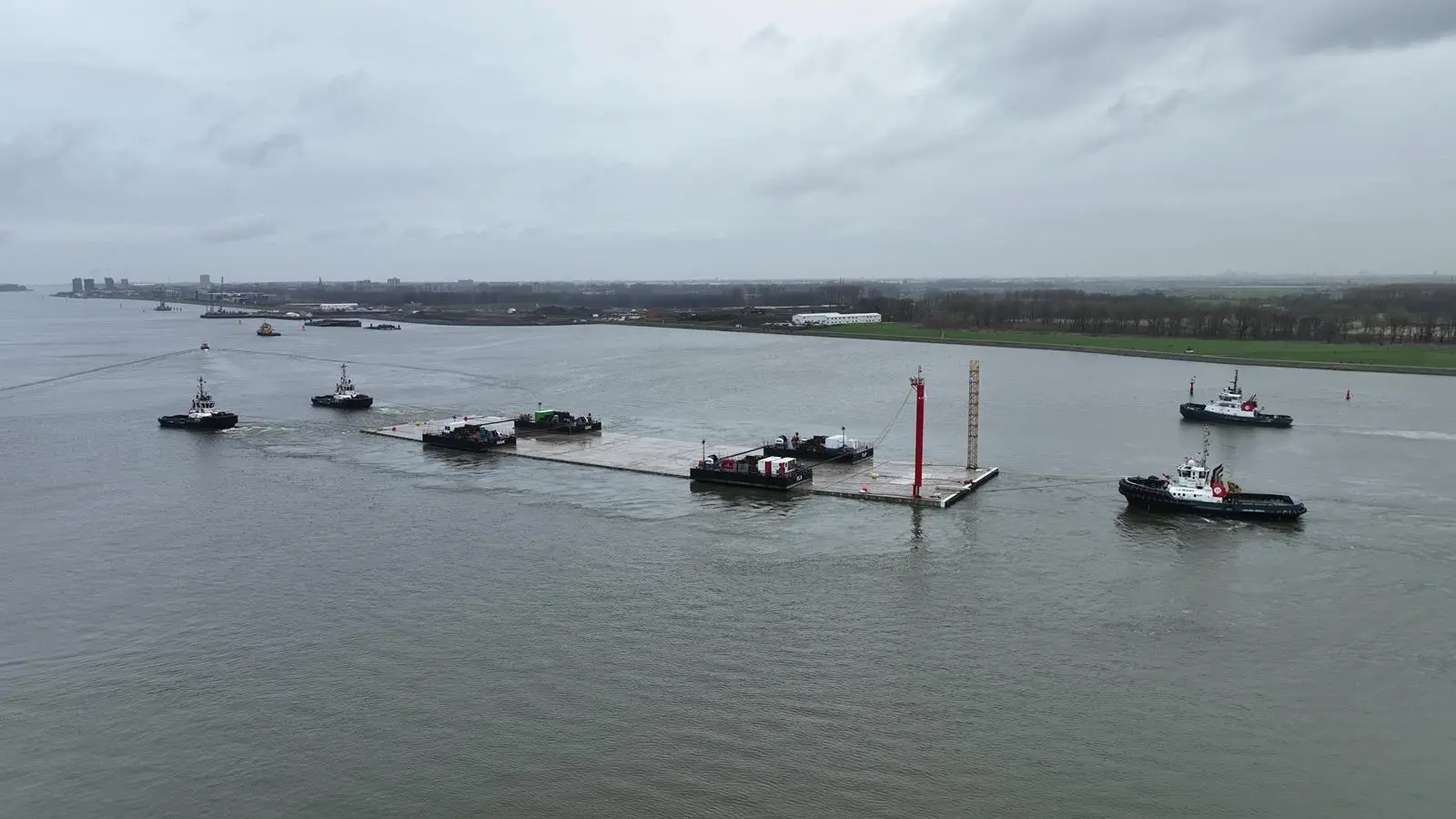
Precise coordination of the operation was required, involving tugs manoeuvring the elements, of which just a low surface area was visible above water in a dynamic environment that also includes the unpredictable influence of wind and tidal currents.
Once ballasted down and lowered out of sight, the elements had to be aligned precisely with the approach elements that had been excavated ‘dry’ and subsequently flooded on each side of the river.
Project sponsors Rijkwaterstaat, along with the BAAK consortium (Ballast Nedam and DEME Group), kept local communities including schools and the wider public informed of progress and the two tunnel sinkings were scheduled for weekends a month apart with provision made for the public to witness them, with tiered seating, car parking and information officers on hand.
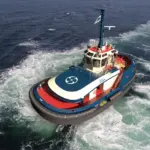
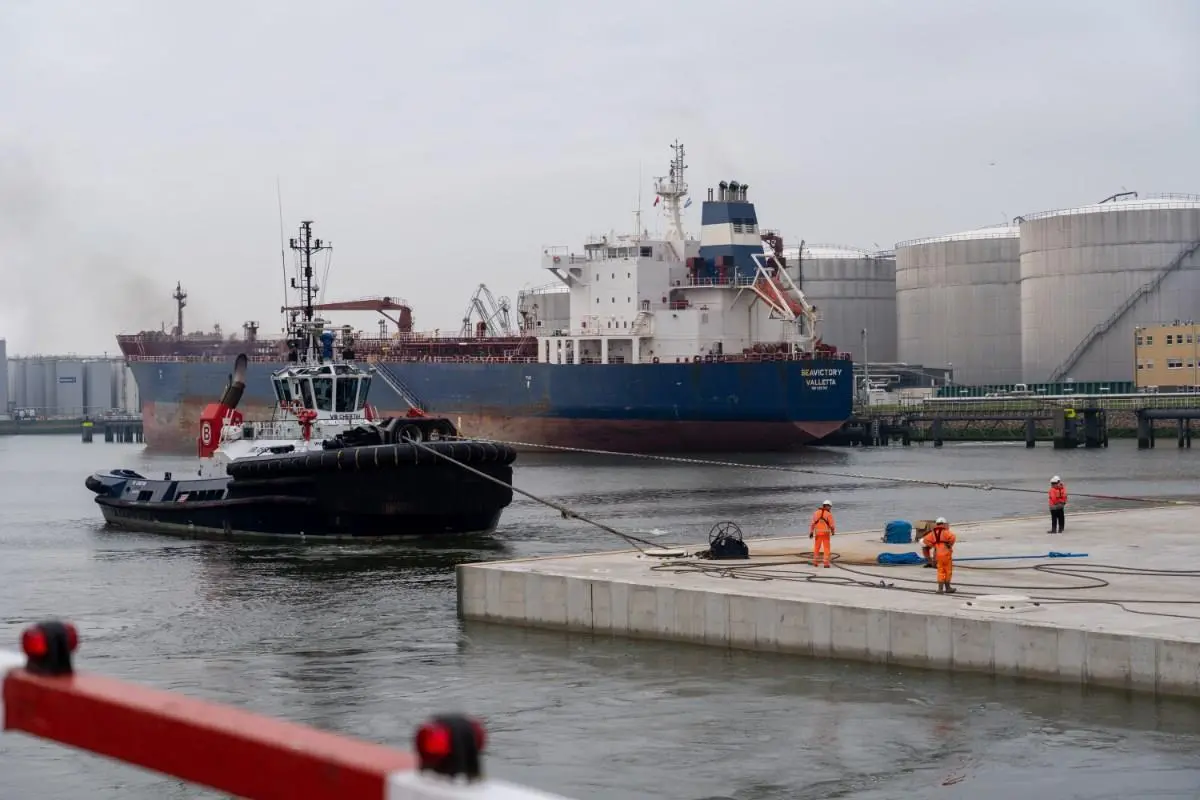
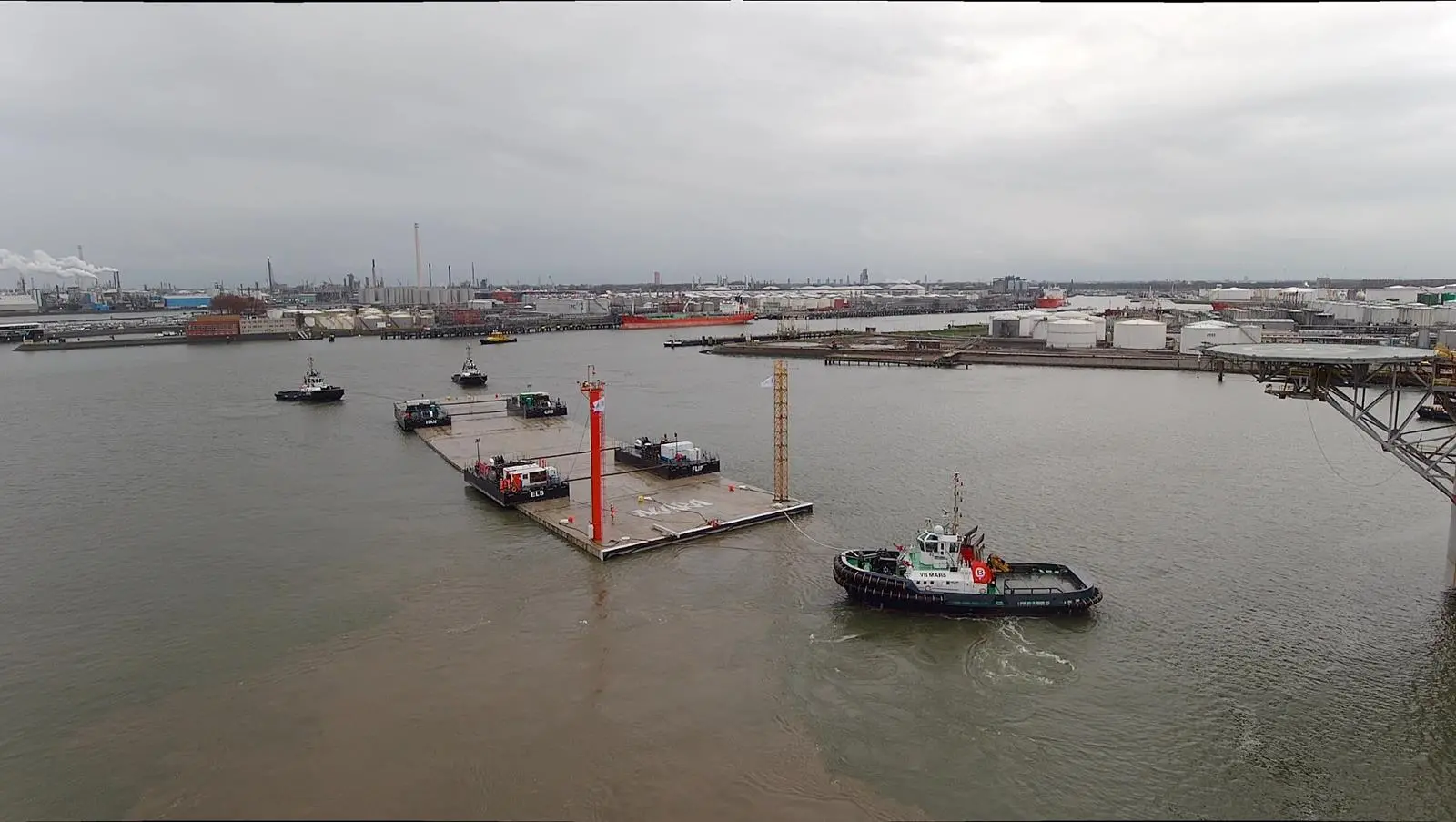
The weather for the first sinking was somewhat inclement, but did not prevent the operation going ahead. Four of Boluda Towage’s Rotterdam-based tugs, VB Ebro, VB Schelde, VB Mars and VB Furie were allocated to tow Alara from the drydock at Damen Verolme the short distance to the site.
A flotilla of support vessels/workboats including Demi J, Viking Energy, Husky and Panda was also on hand to provide the fine tuning with vessels from the Port of Rotterdam Authority and Rijkwaterstaat, including RPA 5,10 and 14 along with RWS 73, watching over.
The first section was successfully sunk into place, although a leak at the headboard of the element caused a short circuit, which affected the pumps. Additional pumps were deployed to keep the situation under control but it did lead to Het Scheur being closed for longer than planned.
The setbacks for Alara led to a delay for sinking Isabella, the second northern element. All was in place however for the re-arranged date and Boluda’s tugs VB Mars, VB Ebro, Thamesbank and Rotterdam once again towed the second element to the Vlaardingen side of Het Scheur. Supporting vessels this time also included Odin and Smit Waalhaven 4.
Cable break
This part of the operation had to be aborted when a cable that held the tunnel section on the south side broke and the element contacted the temporary quay on the Vlaardingen side.
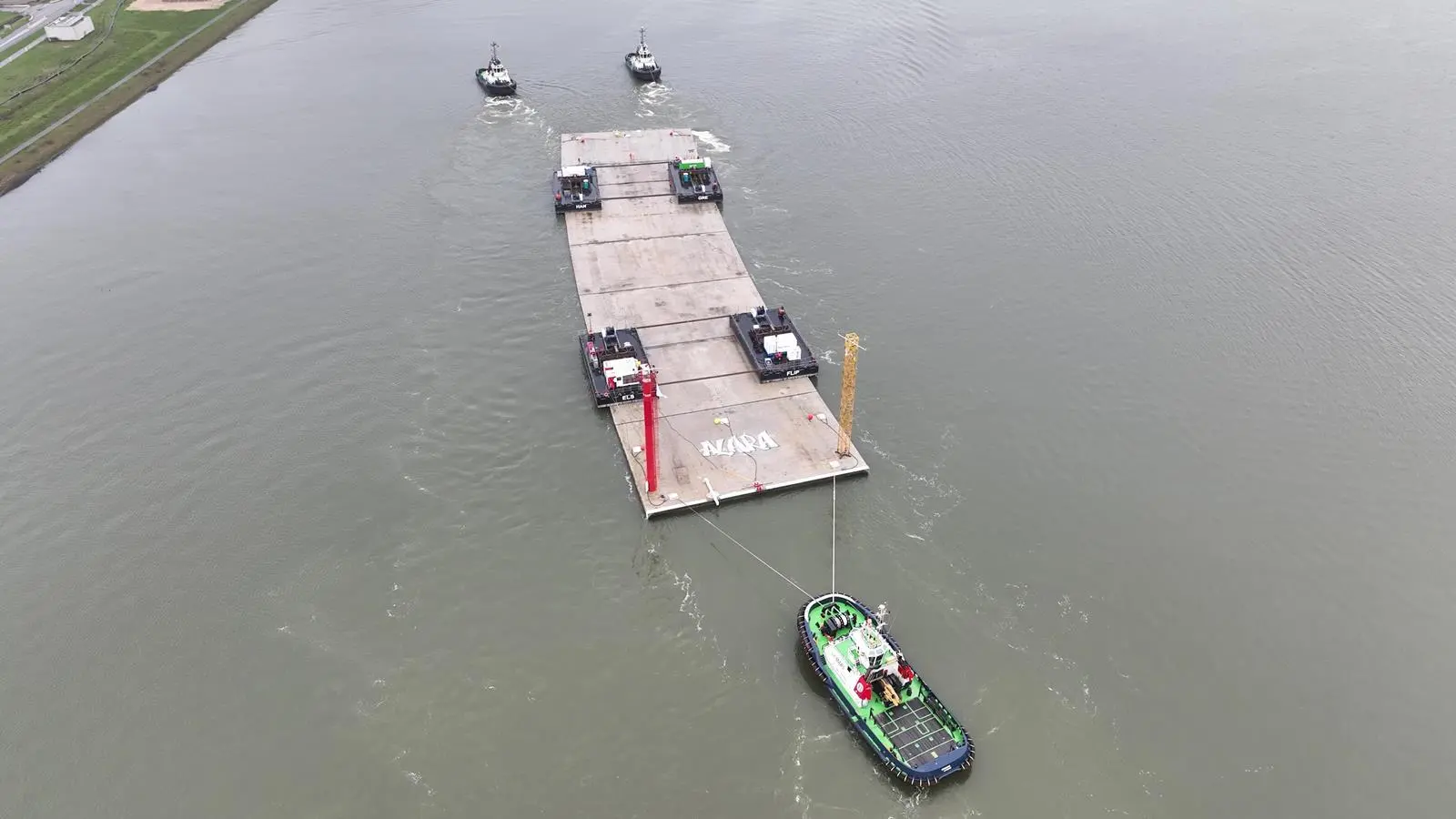
Isabella was returned to Damen Verolme while investigations were carried out, and at the time of writing no dates have been announced for a rescheduled attempt to sink the second tunnel element.
Setbacks with a project of this scale are to be expected and the typical ‘can do’ attitude of the Dutch, in particular Rotterdam’s extensive maritime community, means the region will eventually benefit from the new connection once completed.
One question that still remains unanswered is what the future for the Maassluis/Rozenburg vehicle ferry holds.
This route connecting the two sides and avoiding the longer Benelux Tunnel connection has been out of action for around a year due to technical problems. A smaller ferry service for foot passengers and bikes only has been established, but with the opening of the Blankenburg Connection toll tunnel, planned for 2024, it is possible this vehicle connection, popular for both locals and tourists, will never return.
Related Articles
 INDUSTRY NEWS
 MARINE CIVILS
 MARINE CIVILS