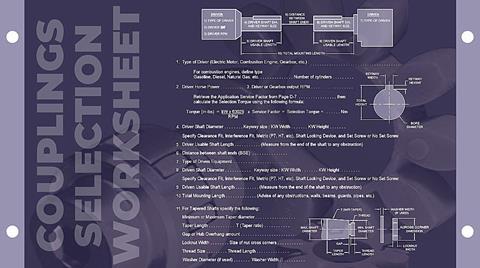







In mechanical design, small components can create big problems.

Few parts are as underestimated, yet as critical, as the shaft coupling.
When correctly specified, a coupling quietly transmits torque, absorbs misalignment, and protects connected equipment. When incorrectly selected, it can lead to premature bearing failure, vibration issues, unexpected downtime, and costly redesigns.
And yet, coupling selection is often rushed.
The Problem: Too Many Variables, Not Enough Structure.
Selecting the right coupling isn’t just about torque
Engineers must consider:
- Power and rotational speed.
- Service factor.
- Type of driver and driven equipment.
- Expected misalignment (angular, parallel, axial)
- Shock loads, cyclic loads or end loads.
- Environmental conditions.
- Space constraints.
- Maintenance access.
That’s a lot of moving parts, especially when you’re juggling multiple projects and tight deadlines.
Too often, specification data is scattered across emails, spreadsheets, and catalogue pages. Important details get missed. Assumptions creep in. Decisions become harder to validate later.
Why We Built the Couplings Selection Worksheet
At jbj Techniques, we regularly work with engineers who know what they need but don’t always have a simple framework to capture and organise application data before choosing a coupling.
So we created a practical tool to help.
The Couplings Selection Worksheet is designed to:
- Capture all critical application parameters in one structured format.
- Reduce back-and-forth during technical discussions.
- Improve accuracy of initial selections.
- Provide documented justification for procurement and design reviews.
- Save time in both specification and support.
It is not a replacement for engineering judgement. It is a way to support it.
How It Fits into a Modern Engineering Workflow
Whether you’re designing new machinery, upgrading legacy systems, or trouble-shooting vibration issues, structured data improves decision-making.
The worksheet can be used to:
- Validate an existing coupling choice.
- Support RFQs with complete technical information.
- Speed up consultation with our engineering team.
- Reduce risk in high-duty or critical applications.
Instead of starting with “Which coupling should I use?”, you start with “Here are the full operating conditions.”
That shift alone can prevent costly oversights.
Engineering Shouldn’t Rely on Guesswork
Couplings may not be the most glamorous part of a system, but they sit at the heart of power transmission.
A few extra minutes spent structuring your data can mean years of reliable operation.