




Foam-filled fenders are designed for long operational service life.

Over time, however, the outer polyurethane skin can suffer wear and tear from continuous operations, similar to steel components that experience corrosion or mechanical damage. In such cases, refurbishment can offer an alternative to replacing the entire fender.
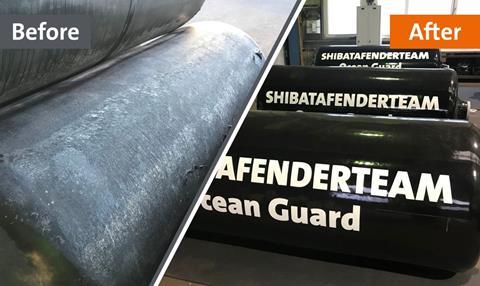
Several reskinning projects, carried out by ShibataFenderTeam for Ocean Guard and Donut Fenders after approximately ten years in operation, demonstrate how technical assessment and PU refurbishment can extend operational service life and return the fenders in fit-for-purpose condition for continued use.
Commonly referred to as “reskinning,” the process involves removing the existing PU skin from the body of the fender and applying a new outer layer of thick nylon-reinforced polyurethane. However, the service extends beyond renewal of the polyurethane outer layer alone. The fenders also undergo detailed evaluation covering mechanical damage and critical steel components exposed to long-term marine operation, including top plates, end plates, internal chains and turning swivels, which are particularly exposed to wear during operation.
Projects carried out by SFT include the reskinning of 11 Ocean Guard Fenders for the Port of Kiel in Germany, and just recently 2 Ocean Guard Fenders Ø2500x5000 mm supplied for the Dutch Navy in Curaçao, and a Ø3000x3520 mm Donut Fender for Wyk auf Föhr in northern Germany. The projects were completed by SFT’s specialized foam fender manufacturing facilities in Rechlin (Germany) and Sollana (Spain), which are equipped not only for the production of new foam-filled fenders but also for refurbishment and overhaul services.
Reskinning can offer a cost-effective alternative to replacements, while significantly extending the operational service life. Supported by dedicated manufacturing know-how and technical expertise, the process allows foam-filled fenders to continue operating reliably under demanding marine conditions. Testing to verify performance characteristics can also be carried out when required.
For operators, refurbishment can form part of long-term asset management strategies for foam-filled fenders exposed to continuous marine operation, supporting both operational continuity and more sustainable lifecycle management – an approach also reflected in the PIANC 2024 Fender Guidelines regarding refurbishment of foam fenders.