


Multi-role oil recovery catamaran under development
Work is underway in preparation to build the first of a new Multipurpose Oil Recovery & Rescue Catamaran (MORCAT) design which will also have firefighting, SAR, emergency standby and towing, hospital ship, and hydro survey vessel capabilities.
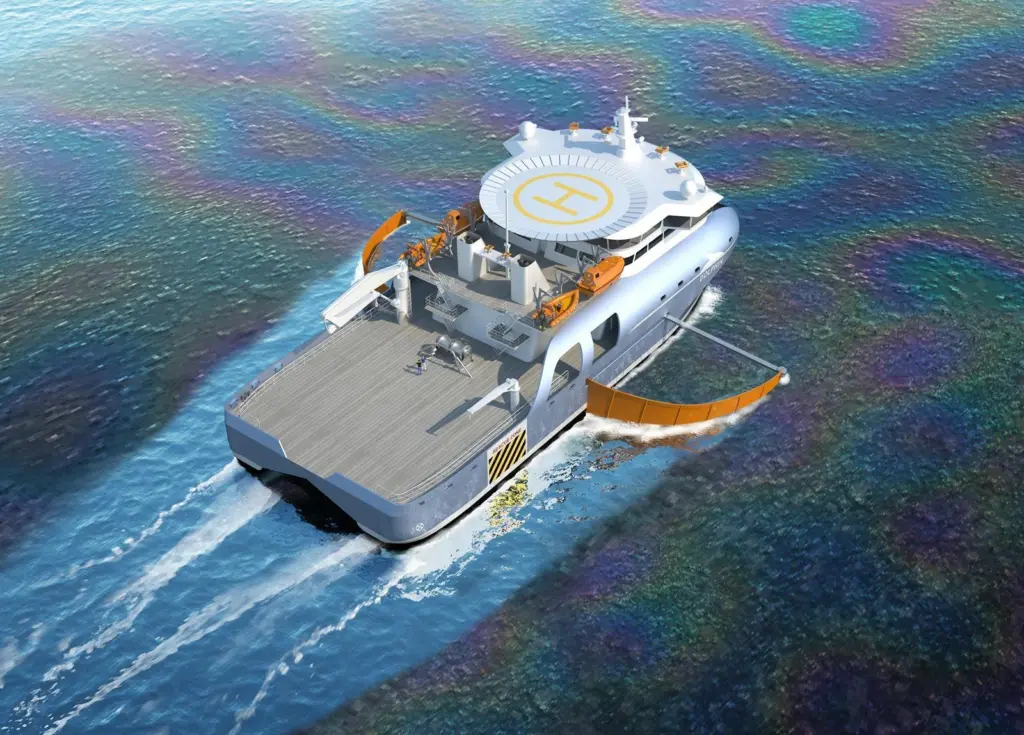
The 65m MORCAT concept was initiated by master mariner and inventor Captain Stig Reinlert of Sweden’s Shipboard Safety International, who now serves as project manager for the MORCAT Group. The Group consists of Swedish and Norwegian shipyards and other companies in the fields of maritime technology and design. A comprehensive project study has been carried out by the Department of Naval Architecture and Ocean Engineering at the University of Chalmers, while complementary development and project design work has been carried out at Kockums Engineering AB. Design presentation has been carried out by Karolina Adolfsson, a ship designer at FKAB Marine Design in Gothenburg.
The vessel will have the operational versatility to carry out a variety of specialist tasks but the main focus initially is upon oil spill recovery. MORCAT will undertake efficient and continuous oil recovery in most conditions, with three LAMOR/LORS oil recovery systems collecting at a theoretical capacity of some 300 cu/m/hr. At a speed of two knots, the massive sweeping width of 52m enables a sea area of 180,000 sq/m to be swept in an hour. Oil containment barges can be connected to the ship to receive collected oil, making it possible to continue oil spill recovery operations without interruption.
MORCATs will be built Green Ship and ESQ standards, with diesel electric power driving twin azimuthing propellers for a deployment speed of 17 knots and on site oil recovery at two to four knots.
The parallel hulls are designed with a soft nose and transom stern, interconnected by a double deck which serves as the base for the superstructure. The hulls will be built of HT steel while the superstructure will be of aluminium, with an aim of keeping weight to the specified 1,700dwt. A working deck of 650 sq/m gives space for optional moonpools, an ‘A’ frame, and deck equipment for subsea work. Other options will include a helicopter deck atop the wheelhouse and dynamic positioning.
Related Articles
 ACCESSORIES & EQUIPMENT
 ENVIRONMENT
 MARINE CONSTRUCTION