![MaritimeJournal[Seawork]](https://www.maritimejournal.com/wp-content/uploads/2026/09/MaritimeJournalSeawork.svg)

‘Charge Offshore’ launches two charging systems
Tidal Transit, Blackfish Engineering and MJR Power have launched two offshore charging systems suitable for delivering power to Service Operation Vessels working at wind farms.
With some support from the government agency Innovate UK, an ‘in air’ concept was first created by MJR in 2018, before a battery-electric crew transfer vessel was designed and other developments followed.
In 2021, an 250kW offshore charging system was built and tested with all partners on board, and a year later an 8MW prototype was built, winning the European Commercial Marine award at Seawork.
Offshore trials have been successfully carried out on a prototype system, which will now be commercialised bythe Charge Offshore joint venture.
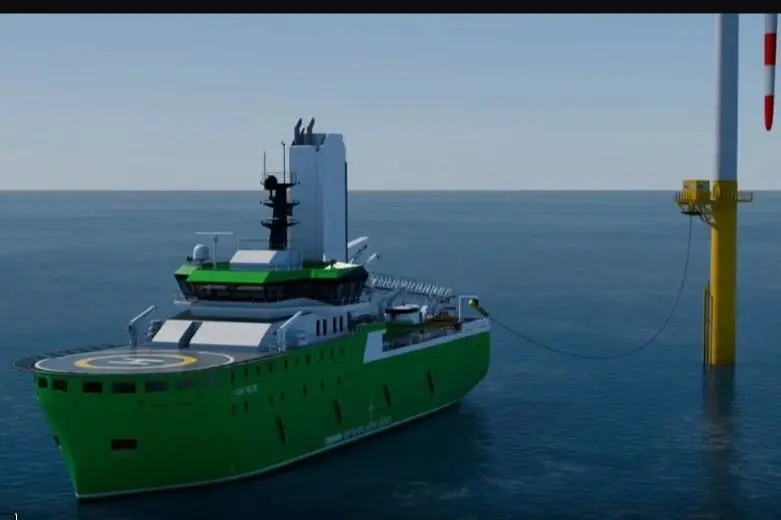
Two systems – Aquarius Eco and Aquarius Plus – have been developed, with the former aimed at smaller vessels such as CTVs, charging at 2MW, and the latter for larger vessels like SOVs, charging at 8MW.
The systems are installable on turbines, offshore substations, floating and fixed foundations and structures, the JV says.
Aquarius Eco is moored using the power cable as a tether, Aquarius Plus uses the vessel’s positioning system, and both devices have hands-free connection, disconnection and safety/overload release protection, the JV says.
“”It’s been a long journey from initial conception to successfully completing sea trials and now releasing to the market,” said Tidal Transit’s Leo Hambro.
The announcement comes less than six months after Seawork, when the viability was discussed at one of the many panel discussions.
Other systems out there
The concept of charging offshore vessels at a site of power generation is gaining traction in the field.
The companies are looking at integrating charging into wind farms in the Irish Sea, where the JV is developing a system at ‘Morgan’ and ‘Mona’ offshore wind farms.
In September, a consortium of partners including Vard and Norwegian firm Seaonics unveiled an offshore charger for SOVs that can charge directly from the turbines. During testing, the ‘Ocean Charger’ system delivered 6MW of power to a hybrid-electric CSOV and the company said it would soon commercialise its technology.
The partners also include Rem Offshore, Solstad Offshore, SINTEF Energi, SINTEF Ocean, DigiCat, Sustainable Energy, Equinor, Source Galileo Norge, Corvus Energy, Plug, Shoreline, Sustainable Energy, University of Bergen, Norce and Maritime CleanTech.
Related Articles
 FEATURES & VIDEOS
 ENVIRONMENT
 OTHER NEWS