![MaritimeJournal[Seawork]](https://www.maritimejournal.com/wp-content/uploads/2026/09/MaritimeJournalSeawork.svg)






Delegates call on industry to ramp up floating wind
The UK has to ramp up its floating wind industry if it is not to be left behind by other European countries such as France and Spain, a Seawork conference discussed on Wednesday.

But there are huge challenges, said CECA (Civil Engineering Contractors Association) chief executive Alasdair Reisner – and not just in floating wind.
“There are 14.8GW at work in UK seas, and this is to more than double by 2030 under the government’s Clean Power Action Plan,” he said. “Offshore floating wind will be limited, and the conversation isn’t just about 2030 – with AI etc, we will need a lot more. There are deeper water opportunities with offshore floating wind, and an opportunity for the UK to lead the world.”
Reisner said there were opportunities in concrete and steel manufacturing to allow platform fabrication and moorings to be done in the UK, and as well as getting ports ready to deliver substations, the so-called ‘Great Grid Upgrade’ was a priority to enable transmission.
Challenges
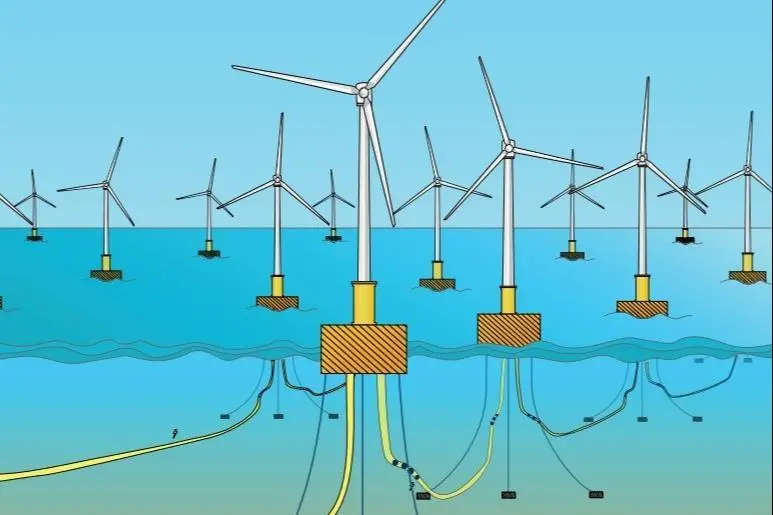
Reisner said floating wind technology was only just emerging and experience in the UK was limited, unlike in France and Spain, where it has been in the pipeline for a few years.
The harsher environment for floating wind installations needed to be better understood, and the difficulties with waves and corrosion, he said.
“Politics could completely change the picture,” he said, citing the Middle East and US as adding to uncertainties that included government changes, unforeseen events like Covid, a chronic lack of skills capacity and regulations that led to delays and legal issues.
Money of course is at the root of it. Whereas in Europe, port infrastructure is funded by regional governments, said John Chaplin, director of External Affairs and Special Projects at Bristol Port, in Britain it was done with private investment.
“You can’t get to the end game because you can’t get going,” said one delegate. “Is the whole thing going to come to an end simply because there aren’t enough ports with capability?”
Grid connectivity is also a ‘massive problem’, said Reisner. “There is a lot in the pipeline but it’s a mishmash,” he said. “Projects are first come, first served, but they should be prioritised.”
The next round of bidding for renewable energy projects in the UK is currently under way, with awards expected to be made at the end of this month.
Bristol Port

Plans are already afoot for floating wind at one of the UK’s southern ports. John Chaplin told delegates of Bristol Port’s aspirations to deliver floating wind.
“There’s potential for carbon capture and storage, we are also looking at hydrogen as a potential future fuel,” he said. “We are dredging and building a breakwater to allow bigger vessels in, and our modus operandi is to bring by sea to Bristol Port the parts needed to build the turbines – the tower, nacelle and blades.
“The fabrication of the concrete foundations can be done in Bristol, we could use a barge into the estuary and bring the foundation base to the berth side, build the turbine there and move the tower and for commissioning tow it out to the Celtic Sea by tug.”
He said the port was in the middle of the consenting process and expected fabrication to begin next year with construction in 2027.
Chaplin also offered a rare acknowledgement of the damage wind farm deployment does to the environment,
“We know we will destroy a part of the natural environment, so we have bought 650 acres of farmland and will undertake natural impact assessment to deliver a compensatory habitat,” he said.
“We also know that if Britain doesn’t take up the opportunities for floating wind, it will disappear to Europe. We know that Europe is taking significant steps to support it. The maritime sector is the cornerstone of the UK economy and offshore wind is a massive opportunity.”
Related Articles
 FEATURES & VIDEOS
 ENVIRONMENT
 OTHER NEWS