![MaritimeJournal[Seawork]](https://www.maritimejournal.com/wp-content/uploads/2026/09/MaritimeJournalSeawork.svg)





Floating wind: ‘Industrial opportunity of the century’
Floating wind is expanding across the globe, with Europe at the forefront of a growing industry.
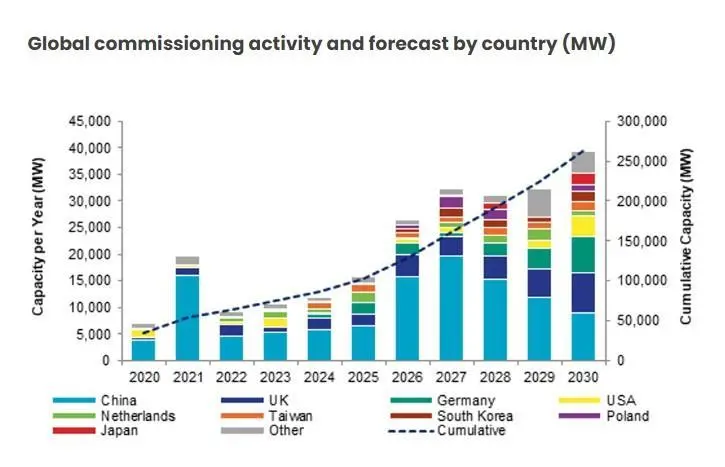
RenewableUK, formerly known as the British Wind Energy Association (BWEA), has released a report in which it says the global pipeline of floating offshore wind projects has expanded from 244GW to 266GW within the past year, with the number of projects growing from 285 to 316.
At the forefront of the phenomenon is Europe, with Italy, Spain, Sweden and the UK in the top five, along with the US.
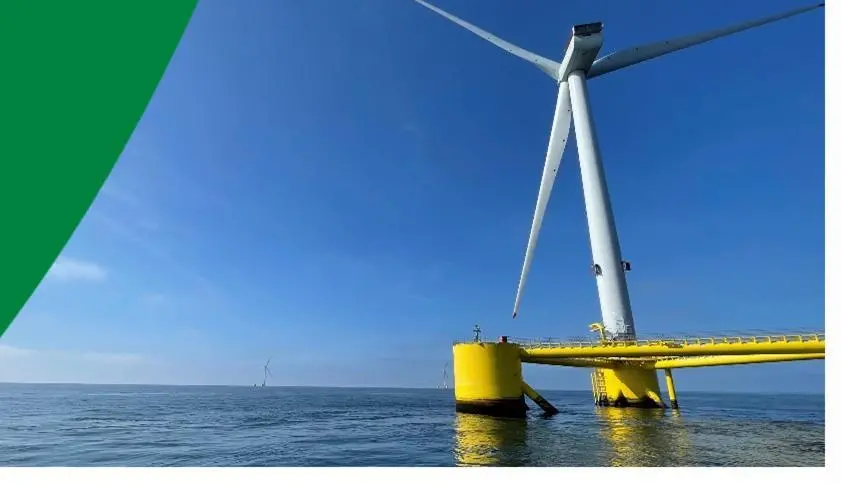
Fully operational floating wind totals a fraction of current operational offshore wind, just 245MW across 15 projects in seven countries.
But In light of the fact that today’s global operational wind capacity stands at 77.4GW, according to the report Global Offshore Wind Pipeline October 2024, the future of floating wind capacity is considerable, even though it is mainly still in the pipeline.
The report says of the pipeline, four projects generating 102MW are being built, 22 projects of a total of 7.3GW have been approved, 15 projects (21.6GW) are in the planning system and 184GW are in early development or applying for a lease.
UK foremost in a European growth phenomenon
A report by a joint government /industry initiative calling itself the UK Floating Offshore Wind Task Force (FLOW) sets out five ‘industrial missions’ that it says ’are designed to guide, inspire and coordinate what could be this century’s biggest British industrial success story’.
Funded by entities including the Crown Estate, Catapult, RenewableUK and Scottish Enterprise, the five missions set out are:
- Driving cost reduction
- Building our pipeline
- Enabling infrastructure
- Commercialising supply chain opportunities
- Innovating to win
Details of the ‘missions’ are available in the full report here, but in summary, the authors believe the UK’s natural assets – deep waters, wind – and experience in offshore wind, oil and gas will help it maintain its place in the frontline of floating wind.
“Floating offshore wind is a once-in-a-generation industrial and economic opportunity, and the UK is uniquely well placed to benefit from first-mover advantage,” the report says.
It also admits that while it has 24GW of seabed leases in place, a lack of suitable port capacity could hold things up.
And it also warns that a domestic supply chain is vital.
“Strong competition from European suppliers means that if development of industrial capacity and infrastructure are not prioritised, supported and scaled up, UK wind farms could conceivably be built and installed with many high-value components never having touched British soil,” it says, with a consequent reduction in gross value added contribution to the UK’s GDP.
Related Articles
 FEATURES & VIDEOS
 ENVIRONMENT
 OTHER NEWS