![MaritimeJournal[Seawork]](https://www.maritimejournal.com/wp-content/uploads/2026/09/MaritimeJournalSeawork.svg)






Gothenburg switches on H2 generator to supply shorepower
Scandinavia’s biggest port has reached the final phase of a pilot project that uses a hydrogen generator to supply electricity to docked ships.
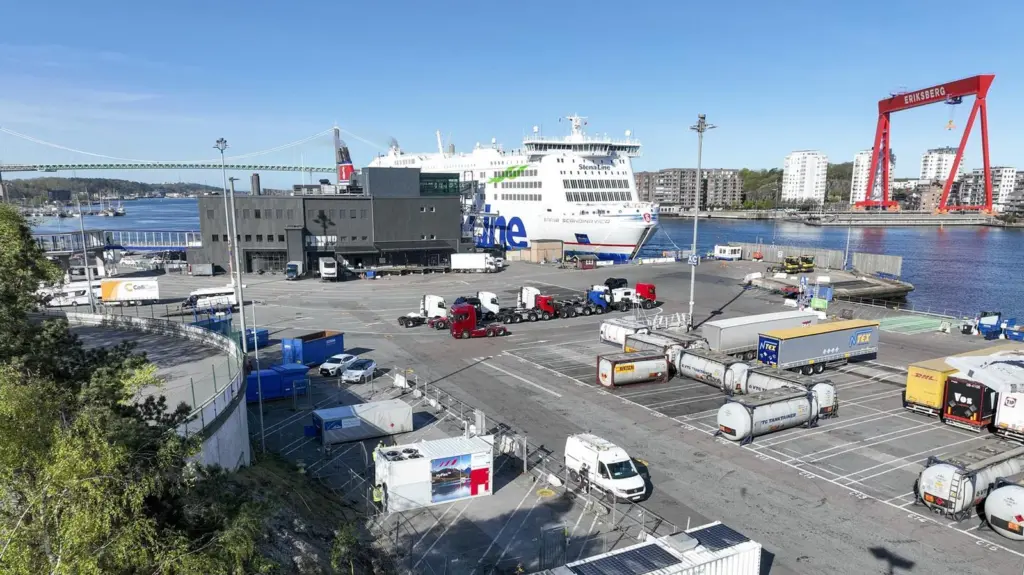
A hydrogen-powered generator has been connected to Stena Line’s existing shorepower facility at the Port of Gothenburg and has supplied electricity to the vessels Stena Germanica and Stena Scandinavica while both were docked.
The hydrogen is classed as green, which means it has been produced using power from renewable sources.
“At Stena Line, we are eager to collaborate to test new technologies aimed at reducing emissions from our industry. This project shows that there are alternative solutions for ports that lack the infrastructure for shore power,” said Anders Peterson, Group Head of Port Development & Engineering at Stena Line.
The method, he said, could pave the way for reduced emissions in ports where conventional shorepower connections are not feasible.
The amount of carbon dioxide saved is not insignificant, says the port, quoting a report from the European Parliamentary Research Service, which estimates that 6-7% of CO2 emissions from the shipping sector are generated while vessels are docked at ports within the European Economic Area (EEA).
The first facilities for connecting ships to shore-side electricity were installed at the Port of Gothenburg in the early 2000s, when the OPS-facilities at Stena Line’s terminals for Germany and Denmark traffic were among the first of their kind in the world.
“However, many other ports in the EU and across the globe have not come as far and often lack necessary prerequisites,” says the port. “OPS systems require significant investment as well as a robust underlying electrical infrastructure in the ports.
“In such ports, alternative solutions are needed. Mobile hydrogen generators, like the one currently being tested at Stena Line’s Germany terminal, may offer a promising way forward.”
Heading off regulations
In 2030, a new EU regulation will come into effect requiring container and passenger vessels to use OPS while at berth.
This is expected to reduce emissions by just over one million tonnes of carbon dioxide a year, according to a study by ICCT, the International Council on Clean Transportation.
“Currently, 51 ports in 15 EU coastal member states have shorepower infrastructure, supplying 309MW of power, 283MW of which are intended for container, passenger, and cruise ships,” it says. “We estimate the EU needs to triple or quadruple its installed shore power by 2030 to meet the current ambitions of the FuelEU Maritime regulation and AFIR.”
Hydrogen could help ports to meet these requirements, said Viktor Allgurén, Head of Innovation at the Port of Gothenburg.

“Since the climate is a shared concern for us all, it is also in everyone’s interest that as many ports as possible around us succeed in meeting these demands,” he said. “With our extensive experience in OPS, we are pleased to partner with Stena Line to serve as a test bed for this new technology, which may very well prove to be a viable solution for many ports.”
The hydrogen generator being tested at the Port of Gothenburg was developed by Hitachi Energy, whose technology partner PowerCell Group supplies the generator’s power modules and expertise in fuel cell integration. During the test, the generator used 100% green hydrogen supplied by gas producer Linde Gas.
“We are very pleased with the results of the latest collaboration with Stena Line, PowerCell Group, Linde Gas, and the Port of Gothenburg. We value working with these industry players to continue exploring new application areas for HyFlex and to demonstrate its broad potential—from construction sites to port terminals—to accelerate the energy transition,” said Tobias Hansson, Managing Director of Hitachi Energy in Sweden.
Hydrogen as a fuel has a range of potential applications in a port context.
Today, the Port of Gothenburg has a hydrogen refuelling station for trucks, hydrogen-powered work vehicles are currently being tested, and the technology used in the current OPS trial has also recently been used in the port by Skanska to power heavy machinery in a major terminal expansion project.
Related Articles
 FEATURES & VIDEOS
 ENVIRONMENT
 OTHER NEWS