![MaritimeJournal[Seawork]](https://www.maritimejournal.com/wp-content/uploads/2026/09/MaritimeJournalSeawork.svg)


Onshore cable works begin at Thor
RWE is ready to take the next step in the construction of its Thor Offshore Wind Farm in the Danish North Sea.
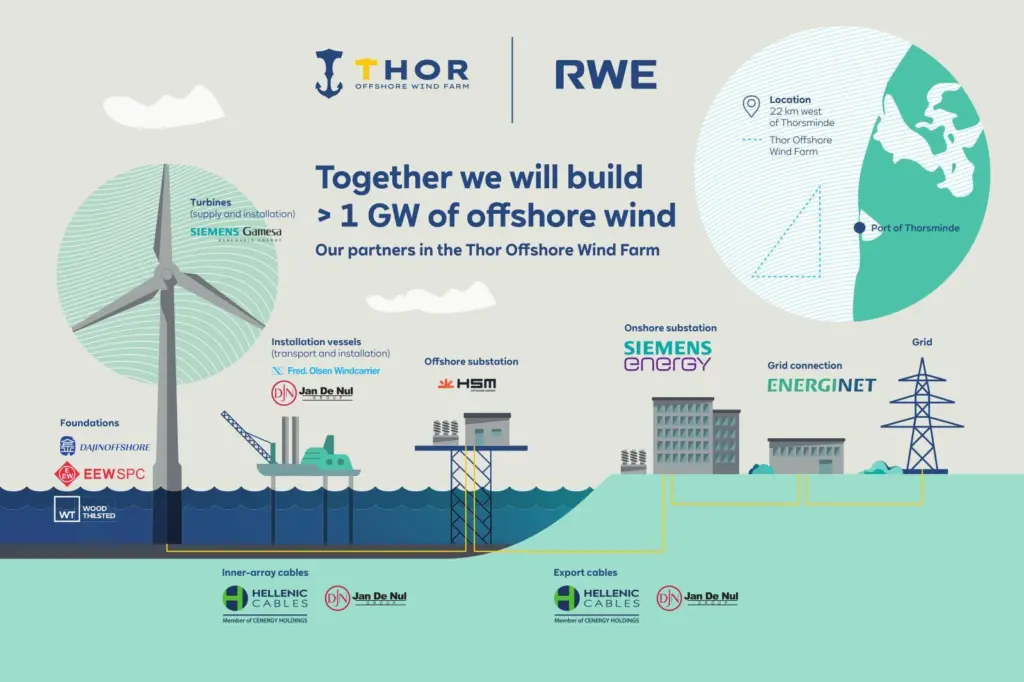
From mid-April to the end of October, the onshore cable works will be carried out at the onshore substation south of Lemvig.
The horizontal directional drilling works will take place at depths of more than 20 metres to protect and preserve the dunes with further smaller horizontal directional drilling works carried out along the approximately 4 kilometres cable route between the onshore substation at Volder Mark and the beach.
Landfall works are being carried out to enable two ducts to run under the dunes and the nearby field to prepare for cable pull-in next year. Each drill hole is approximately 425 metres long and the ducts will measure 71 centimetres in diameter. The duct sections will be welded together on the beach, from where they will be pulled through the drill holes.
East of Torsmindevej, the onshore cables will be divided into three phases each. They will be laid and buried during June and July and led to the onshore substation, where they will be connected. Joint bay, jointing and testing works will be carried out throughout July to October.
The subsea cables that will be led to the shore are export cables from the offshore substation, which will supply the substation on land. The subsea cables will be installed and connected to the onshore cables in 2025.
With a planned capacity of more than 1,000 megawatts, Thor will be Denmark’s largest offshore wind farm to date. Once fully operational in 2027, Thor should be capable of producing enough green electricity to supply the equivalent of more than one million Danish households.
The Thor project is part of RWE’s ambition to increase its offshore wind capacity to 10 gigawatts by 2030. The company already operates Rødsand 2 approximately 10 kilometres southeast of Rødbyhavn.
Related Articles
 FEATURES & VIDEOS
 ENVIRONMENT
 OTHER NEWS