![MaritimeJournal[Seawork]](https://www.maritimejournal.com/wp-content/uploads/2026/09/MaritimeJournalSeawork.svg)






Denmark tests first data-driven remote pilotage
Two Danish companies have completed the first test of a fully remote data-driven pilotage operation before running a test programme already approved by the Danish Emergency Management Agency.
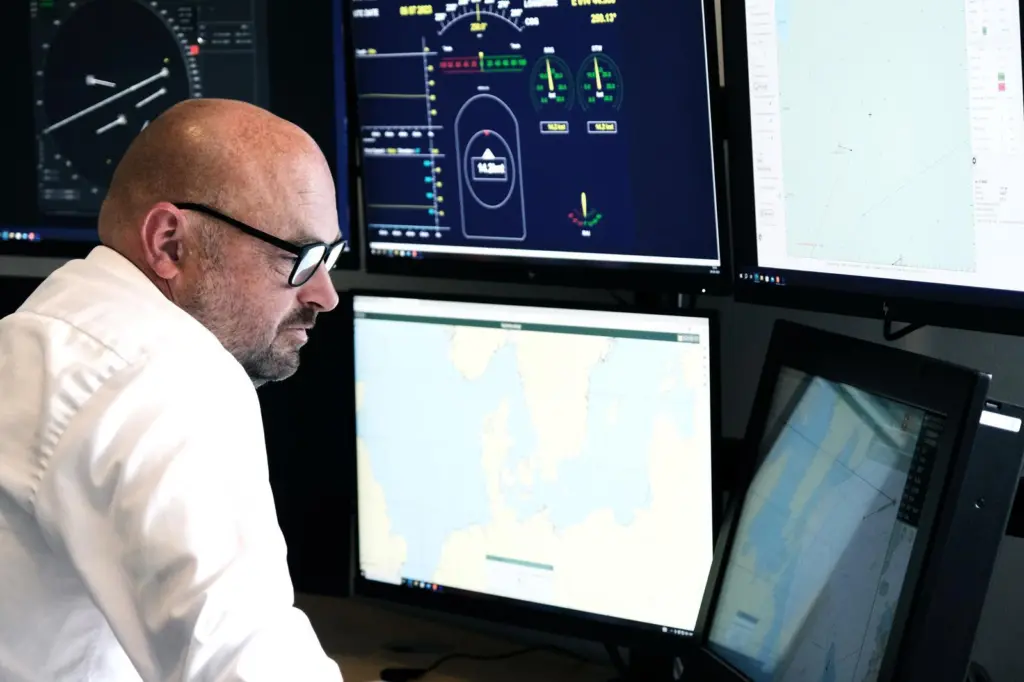
The programme by DanPilot and Danelec will be run in the Kattegat and western Baltic Sea, for the first time allowing pilots to guide selected ships through Danish waters without boarding them physically.
“Remote pilotage is not only a technological breakthrough – it is a strategic step towards safer and more sustainable shipping,” said CEO of Danelec, Casper Jensen. “We are proud to deliver the technological infrastructure that enables safe navigation without the physical presence of a pilot. Here, cybersecurity – a cornerstone of our technology – is a prerequisite for implementing the solution safely and at scale in the global maritime sector.”
The aim is to improve pilot safety and reduce fuel consumption for ships without compromising navigational safety and in this way, ‘support Denmark’s maritime leadership in the shift towards safer and more sustainable shipping’.
DanPilot and Danelec will test the technology on at least 50 operations before seeking approval from classification societies, but this first step has proven a resounding success.
“Remote pilotage makes our work safer and helps reduce both CO₂ emissions and operational costs for our customers,” said Erik Merkes Nielsen, CEO of DanPilot. “We have worked intensively towards this for six years, and now we can finally test it in practice. It has the potential to become a major paradigm shift in how pilotage is carried out.”
First test run
Speaking to Maritime Journal after piloting a mid-sized container vessel through the Danish part of the Baltic Sea together with a colleague in four-hour shifts, DanPilot’s Head of Project and licensed pilot Brian Schmidt Nielsen said it was a very special day.

“This is the first time we have done this, without the pilot on board the vessel,” he said. “We are the first one to use ship data from shore. For many years, we simply didn’t have the bandwidth to get the data from the vessel home, and then Starlink came along.
“We thought, how can we make a system to get data home as simple as possible, with as few moving parts as possible, and when we found the Danish company, Danelec, was already doing that we wondered if we could use it for remote pilotage – and we have.”
It works by having a small vessel remote server – a device about the size of a cigar box, he says – installed on the vessel to be piloted.
A cable connects that to the Voyage Data Recorder (VDR), and is then sent via satellite from the VDR to the vessel remote server.
“We stay on the right side of the firewall, so we cannot access any of the controls of the vessels or anything like that,” he says.
Communications between the remote pilots in their shore-side control room and the crew on the container vessel were done using a Teams-like video call developed by DanPilot, rather than a radio.
“Our main job is still going to be traditional pilotage,” says Nielsen. “We think about 10 per cent of our customers will use remote pilotage, and they will be special ships in special areas, ships that come in and out of Danish waters regularly, perhaps four times a year.
“It’s not as sexy as the traditional pilotage, but it’s common for a pilot to spend as much time transiting to work as a pilot as he or she actually spends piloting, and if this can reduce some of those hours, more can be spent on the pilotage.
“The crew are very happy about the system and they see the benefits, such as not having to have their rest time disturbed by pilots embarkation or disembarkation.
“I don’t think it’s necessarily safer, but I think it’s just as safe,” says Nielsen. “I don’t have to climb the pilot ladder in all sorts of weather conditions, but there are other uncertainties as soon as you go remote.”