![MaritimeJournal[Seawork]](https://www.maritimejournal.com/wp-content/uploads/2026/09/MaritimeJournalSeawork.svg)



Kongsberg lands subsea protection deal as cable sabotage fears grow
Kongsberg will supply technology to protect critical subsea infrastructure as the world struggles to respond to recent sabotage events.

The value of the contract has not been disclosed, but the Norwegian technology group will deliver underwater surveillance and protection for an unnamed international customer.
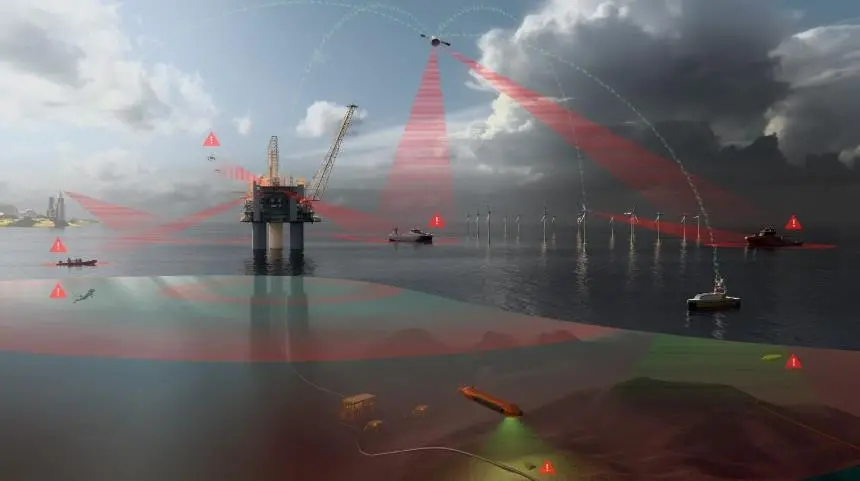
It will focus primarily on protecting subsea infrastructure using technologies that support situational awareness, monitoring, inspection, surveillance and rapid response.
“Preventing and detecting threats and attacks are essential to protect people and critical infrastructure,” said Eirik Lie, president and CEO of Kongsberg. “Kongsberg has the solutions and technology to support countries and industries in their efforts to build resilient systems and maintain operations. This is fundamental in today’s rapidly changing geopolitical landscape.”
Critical infrastructure includes offshore oil and gas installations, subsea telecommunications cables, electricity interconnectors, ports and wider transport networks, all of which have come under increasing scrutiny as governments seek to strengthen resilience against cyber threats, natural hazards and deliberate acts of sabotage.
Camilla Kiss, president of Kongsberg Discovery, said the company’s technology could provide integrated protection across both underwater and aerial domains.
“We are pleased to support this major project with robust protection systems that provide access to data and analysis for time-critical decisions,” she said. “Our technology enables full-scale delivery across air and underwater domains, including situational awareness, response, inspection, surveillance and monitoring.
“The contract underpins how the market for infrastructure protection is evolving from recognising the need, to signing a firm order to implement the right solutions.”
Sabotage
The announcement comes as European governments and infrastructure operators continue to increase investment in subsea monitoring following a series of high-profile incidents involving damage to undersea power and communications cables in the Baltic Sea and elsewhere:
- Baltic connector gas pipeline and telecom cable (October 2023): The Baltic connector pipeline between Finland and Estonia and a communications cable were damaged after investigators concluded a vessel had dragged its anchor across the seabed. The incident became one of the first major cases to focus international attention on the vulnerability of underwater infrastructure.
- EstLink 2 and telecommunications cables (December 2024): Finnish authorities detained the tanker Eagle S after the EstLink 2 electricity interconnector between Finland and Estonia, together with four telecommunications cables, was damaged. Investigators alleged the vessel dragged its anchor across the seabed, although legal proceedings remain ongoing.
- Germany-Finland and Lithuania-Sweden telecom cables (November 2024): Two fibre-optic communications cables were severed in the Baltic Sea within days of one another, prompting sabotage investigations by European authorities. The incidents intensified concerns over the security of critical subsea communications infrastructure.
- Additional Baltic cable incidents (2025-26): Authorities have continued to investigate further damage to telecommunications cables linking Finland, Estonia, Latvia, Lithuania and Sweden. While not every incident has ultimately been attributed to deliberate sabotage, the frequency of cable strikes has prompted NATO to increase maritime patrols and launch its Baltic Sentry mission to strengthen protection of critical underwater infrastructure.