![MaritimeJournal[Seawork]](https://www.maritimejournal.com/wp-content/uploads/2026/09/MaritimeJournalSeawork.svg)


‘Largest ever’ Europort finishes today with themes shaping maritime’s future
Rotterdam Ahoy will close its doors later today after putting on eight halls of intensive innovation, networking, debate and forward focus, with a few themes running throughout – namely digitalisation and sustainability.
Sustainability takes many forms, from different fuels to electrification to the re-use, re-manufacture and recycling emphasis of a ‘Circular Route’ led by ‘Maritime Sisters’ Sylvia and Marjolein Boer and the City of Rotterdam.
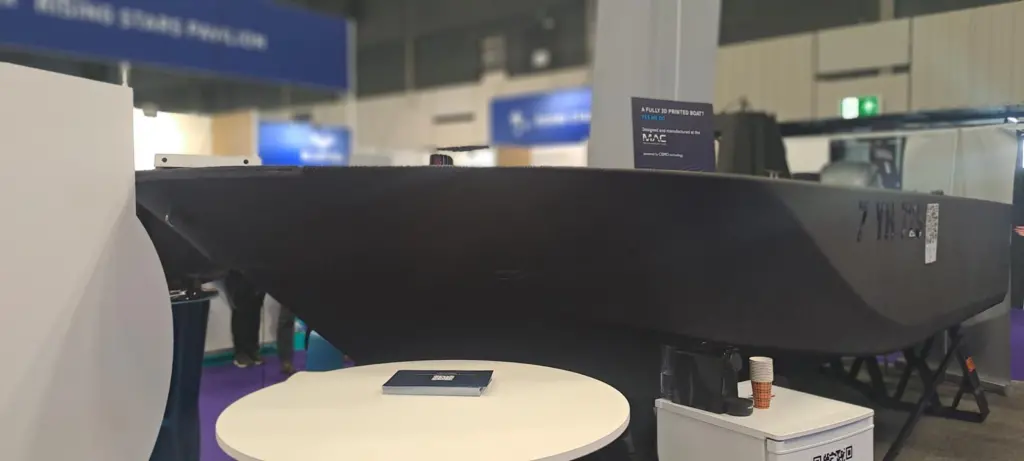
Perfectly encapsulating the sentiment was the 3D printed hull by Delft-based CEAD. The totally recyclable 12m workboat hull was formed in three and a half days, and if needed can be shredded and re-printed, CEAD says.
It’s a complex industry now, and one wonders what everyone talked about before CO2 became a problem.
The eight exhibition halls covered 45,000m3 at the Ahoy centre, which is also famous for hosting the Eurovision Song Contest in 2021 after a year’s delay because of the Covid-19 lockdowns.
One of the aims of the event was to bring more representation of countries to Rotterdam, and this was achieved, with 14 national pavilions on show.
At the time of writing, visitor numbers are not yet known – but organisers are confident the 2023 number of 24,470 will easily be surpassed.
Conferences
Most of the conference sessions were held on two stages – the Green and Smart stages – with private talks held for members only in a separate hall.
The programme was built around several thematic tracks:
- Energy Transition: Many sessions looked at decarbonisation, alternative fuels, zero-emission shipping and circularity.
- Digitalisation: Focusing on AI, cyber-security, remote/autonomous shipping, digital twins and IoT in maritime operations.
- Ship Finance: A dedicated pavilion to address funding models, ESG finance and investment strategies for maritime innovations.
- Human Capital: Under the banner of #YoungEuroport and related tracks, the fair also emphasised attracting talent, crew training and the workforce of the future.
It’s a world of unknowns and stakeholders are having to get to grips with it very quickly: while these themes were addressed and discussed in the panels, there are still no concrete answers in such a rapidly modernising industry. Calls for regulation are increasingly being made as the industry grapples with so many options on the table and not knowing which to opt for.
Exhibitions like Europort and Seawork are becoming vital milestones marking the route to an as yet unknown destination.