![MaritimeJournal[Seawork]](https://www.maritimejournal.com/wp-content/uploads/2026/09/MaritimeJournalSeawork.svg)


American lift for Buoyant Works
How did a Cornish fender manufacturer manage to help US tug builder and operator Signet Maritime take the ‘Most Significant Boat’ award at the 2023 International Workboat Show?
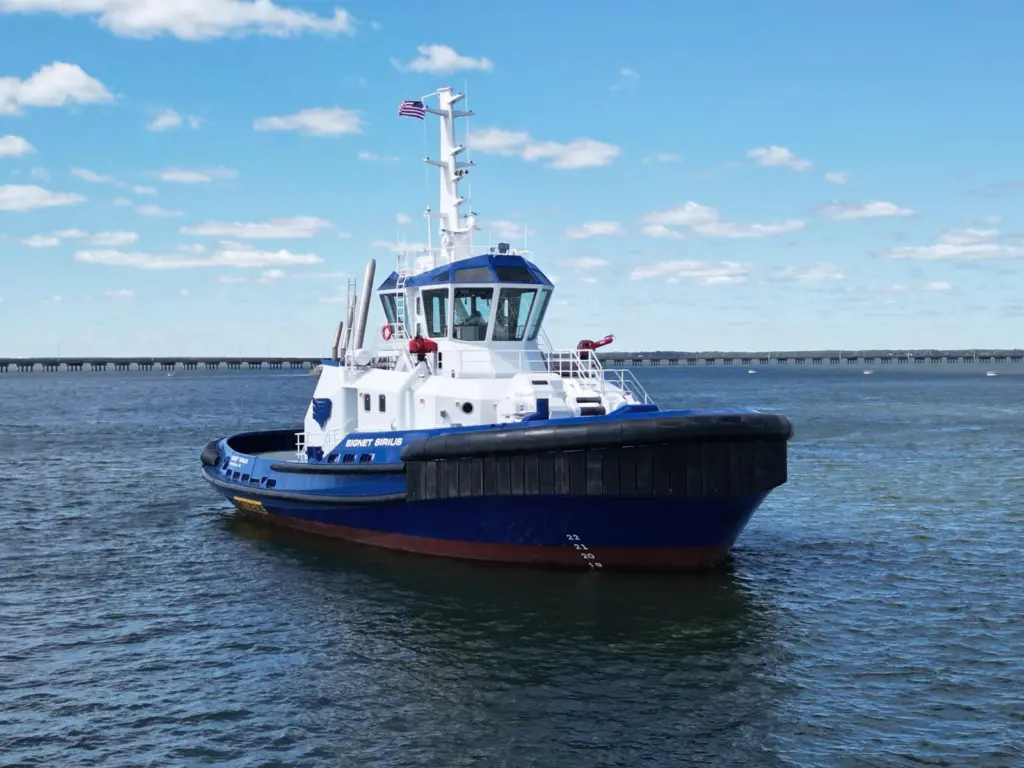
Winning the contract to design and build the fender system for the Robert Allan-designed tug was based on three points, says Jack Wickham, head of Marketing.
First, there’s the high-performance polyurethane fender system with its multiple cavity core. That offers a tailored approach for specific performance parameters.
“A combination of a low reaction force required when working with LNG carriers and an overall weight saving of 10 tonnes gave significant operational benefits,” he says.
Second, a modular approach enabled the traditional one-piece cylindrical bow and stern fenders to be replaced with smaller sections.
These are much easier to handle and if a section is damaged beyond repair, only a small section needs replacing at a much lower cost. That helps spares management and reduces long term maintenance costs
Finally, a highly wear-resistant and non-marking contact surface is beneficial for tug operations.
To be clear, Jack Wickham underlines that tug fenders are not simply an afterthought. They play a significant role in performance.
“Robert Allan and Signet Maritime engaged with us very early in the design process,” he says. “Our fendering solutions contribute to the increased performance of the tug, generate fuel savings and offer long-term maintenance benefits.”
The FenderIT products achieve this by incorporating a network of cavities in high-performance polyurethane, making them 20% to 50% lighter than equivalent rubber fenders.
Material properties are also tuned to requirements, including a low reaction force and high energy absorption generated by progressive resistance. This tailored approach allows varying the contact requirements across the fender.
Buoyant Works, a Seawork exhibitor, also saw another North American breakthrough with a project that involved a chartered fishing boat being converted to a Crew Transfer Vessel for the offshore wind industry.
The bow of the 18m Capt Les Eldridge was redesigned to accommodate the necessary bow fendering.
“It’s one of the most important requirements for a CTV,” says Wickham, adding that last year saw the company pass its 100th CTV installation.
Finally, increasing demand and reach into new markets is being met with product development, along with a second factory due to be completed in the summer.
“Watch this space,” is Wickham’s closing line.