![MaritimeJournal[Seawork]](https://www.maritimejournal.com/wp-content/uploads/2026/09/MaritimeJournalSeawork.svg)

Chartwell to develop ‘market first’ methanol catamaran design
Chartwell Marine, the cross-industry vessel designer, has won a £320k grant to develop and test the feasibility of a methanol-fuelled vessel design.
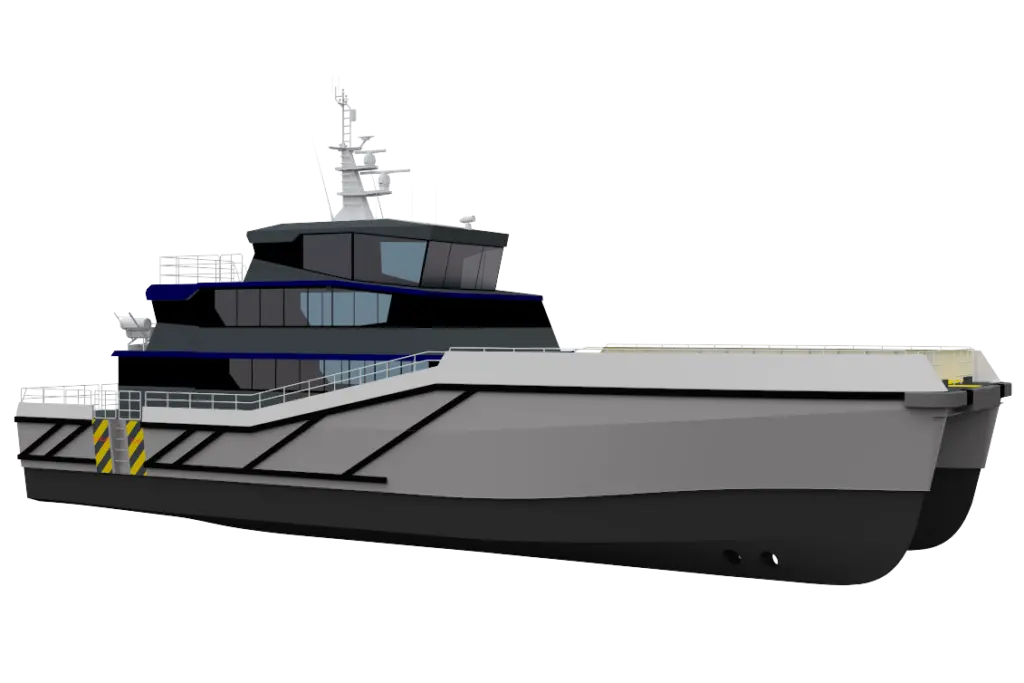
The £320k Innovate UK Smart grant will enable Chartwell and consortium partners Boat Electric & Electronics and Engineered Marine Systems to develop the vessel for use in the offshore wind, commercial workboat and leisure sectors.
“We’re grateful to Innovate UK for the opportunity to delve deeper into the feasibility of methanol-based propulsion. As a company, we’ve delivered over 30% of hybrid vessels in the UK offshore wind market, all complete with the latest state of the art electric-diesel hybrid technology.,” said Andy Page, director and naval architect at Chartwell Marine.
Significant opportunity
Page said methanol presents a significant opportunity to decarbonise in a maritime industry confronting with the debate over sustainable fuel alternatives, as it can be produced from biomass and can carry a near-zero carbon footprint.
Whereas ammonia has sparked concerns about its toxicity to wildlife and pure hydrogen presents continued feasibility challenges, methanol can be stored safely and effectively in standard atmospheric conditions, and spills have little adverse effect on the local aquatic environment.
Though half as energy dense as diesel, methanol can take advantage of reforming technology alongside fuel cells to create energy with virtually zero carbon emissions. Methanol reforming technologies are currently available commercially; however, they have been largely untested in commercial or leisure vessel design.
In applying the technology to a medium-sized vessel with Chartwell’s signature multi-hull design, Page said the company is well placed to use the learning enabled by the Smart Grant to open a path to methanol’s feasibility as a marine fuel.
”That gives us a great starting point to take methanol forward in a meaningful way and cut through some of the challenges we’ve seen in the development of alternative fuels, which may be a long time from full viability,” he said. ”There are still hurdles to overcome with methanol, of course: a lack of refuelling infrastructure onshore, weight issues, and fully efficient conversion to energy, to name some.
“But with the right investment and build partners, we can use our expertise in offshore wind vessel design to target these challenges and create a proof-of-concept methanol vessel that will be cost effective, well engineered and hydrodynamically optimised for deployment worldwide.”