![MaritimeJournal[Seawork]](https://www.maritimejournal.com/wp-content/uploads/2026/09/MaritimeJournalSeawork.svg)






Data collected from world’s most remote seas
Saildrone offers environmentally friendly and cost-effective solutions for capturing air-sea carbon flux data via its fleet of uncrewed vehicles.
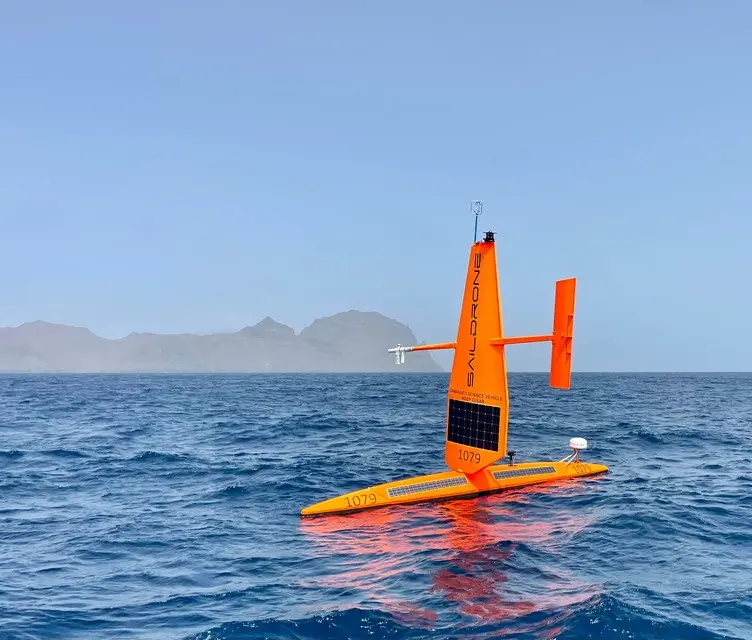
Observations of air-sea carbon flux are essential to understanding carbon cycling and predicting future changes to Earth’s climate. Saildrone pushes technical and endurance boundaries to deliver critical data from areas of the ocean where it has traditionally been out of reach or prohibitively expensive to collect—with a fleet of uncrewed surface vehicles (USVs).
SD 1079, pictured near Cabo Verde, carries an ASVCO2 sensor, shown just behind the wing, developed through a public-private partnership between the National Oceanic and Atmospheric Administration (NOAA)’s Pacific Marine Environmental Laboratory (PMEL) and Saildrone.
Photo: Martin Visbeck/GEOMAR.
As part of the EuroSea project, a multi-national effort to enhance the European ocean observing and forecasting system coordinated by GEOMAR Helmholtz Centre for Ocean Research Kiel, a Saildrone vehicle was deployed on a first-of-its-kind mission to improve both the number and quality of carbon observations in the Tropical Atlantic.
“Our main objective is to better quantify the air-sea gas exchange in the tropical Atlantic; this region is much more under-investigated with regard to carbon than some other areas of the ocean,” said Bjorn Fiedler, a marine chemist at GEOMAR and principal investigator.
The vehicle, SD 1079, was deployed from Newport, RI, in July 2021 and sailed 3,100 nm across the North Atlantic to begin the survey. Research began when it arrived in the vicinity of Cabo Verde. It performed coordinated sampling with an Argo float and the EuroSea team, and then sailed to João Valente Bank for a hydroacoustic sub-survey period in shallower waters to determine the distribution of fish and zooplankton around the remote reef before heading south to sample along the equator.
Data collection was completed in February 2022, and the vehicle began the more than 4,500 nm transit back to the US. SD 1079 was in excellent condition when it was recovered safely in Jacksonville, FL, after a 370-day, 11,910-nautical mile journey.
“This has been a phenomenal mission,” said Richard Jenkins, Saildrone founder and CEO. “Not just by the range and endurance of Saildrone 1079, but by the ability to take these crucial measurements in very remote parts of our oceans.”