![MaritimeJournal[Seawork]](https://www.maritimejournal.com/wp-content/uploads/2026/09/MaritimeJournalSeawork.svg)



18-month engineering restores historic French bridge
A project descibed as one of France’s ‘most ambitious heritage-engineering projects of the decade’ has been completed, witnessed by crowds of residents lining the quays at the Port of Dieppe.
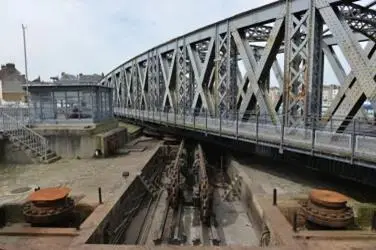
The €19.6 million project blended traditional craftsmanship with advanced engineering, project leader Ports de Normandie said, and involved dozens of contractors and engineers.
Classified in 2020 as a ‘Historic Monument’, the 70-metre, 760-tonne Pont Colbert (Colbert Bridge) is believed to be the world’s last operating hydraulic swing bridge of its kind.
Built in 1889 and now 135 years old, the bridge’s structure of original puddled iron and post-war steel was badly corroded, especially on the underside and picot areas that are always exposed to sea water and spray.
To properly get to all the areas that needed renovation engineers needed 360-degree access, and the decision was taken to remove the bridge and work on it elsewhere rather than build scaffolding over the tidal basin, which would have meant dangerous working conditions. Some of the joints and bearing housings were physically impossible to get to without lifting the bridge from its central pivot, abutments and turntable foundations, which also needed renewal.
Working on the bridge in situ would also have blocked marine traffic to and from what is a busy fishing and offshore support port, Ports de Normandie, which owns the port, said, so it was transferred to a restoration yard, the Cours de Dakar shipyard, at the back of the port, about 1 kilometre away.
Key stages
Lead contractor Eiffage Métal called the removal of the bridge ‘as spectacular as it is strategic’.
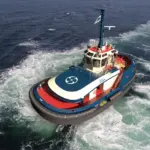
The bridge, with an estimated weight of 840 tonnes, was lifted in one piece onto a barge and then towed to the shipyard with tugs from Thomas Services Maritimes, with heavy-lift contractor Sarens providing the crane.
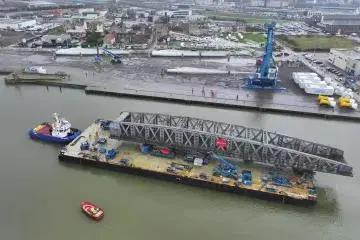
On arrival at the restoration yard the structure was encased in a protective cocoon so it could be stripped, asbestos removed and a full structural survey carried out.
The Ports de Normandie says that over 13 months, every single rivet and plate was inspected, catalogued and reconditioned. Each section was disassembled and documented, then rebuilt to original specifications.
“The finished framework received a three-layer anti-corrosion treatment and epoxy paint designed to endure marine conditions for decades,” the developer said (translated from French). “The restored sections were reassembled on precision jigs to a tolerance of just a few millimetres—no small feat for a structure that had endured more than a century of tidal cycles.”
Below the deck of the bridge, the swing mechanism – an intricate assembly of gears, hydraulic pistons and bearings – had a complete overhaul, with the turntable cleaned and re-lubricated and all seals, valves and pressure lines renewed.
Once all the works were complete and testing finished, the bridge was lifted back onto the barge and returned via port channels to its original home to hundreds of cheering Dieppe residents, the Ports de Normandie said. Hydraulic jacks replaced the bridge on its original bearings in delicate realignment that took several hours and was completed on October 21.
“The operation was an exemplary success of an extraordinary project, born from collective expertise and unrelenting dedication,” said Ports de Normandie President Hervé Morin.
Mechanical and electrical systems will be reconnected over the next few weeks and once load testing and certification is done, Pont Colbert is due to re-open in January 2026.
Key engineers
- Profactal – overall engineering design and integration
- Venna Ingénierie – Foundations, quay coping, drainage, anchoring
- Eiffage Métal – Metal framwork, pivots, mechanisms, coatings
- Cegelec SDEM – Power systems, lighting, automation
- Lhotellier, Osotoit, AEI – Building renovation, roofing
Related Articles
 INDUSTRY NEWS
 MARINE CIVILS
 MARINE CIVILS