![MaritimeJournal[Seawork]](https://www.maritimejournal.com/wp-content/uploads/2026/09/MaritimeJournalSeawork.svg)





Government steps in to fast-track reservoirs
The UK government has seized control of planning procedures to kick-start building two UK reservoirs, the first for 30 years.
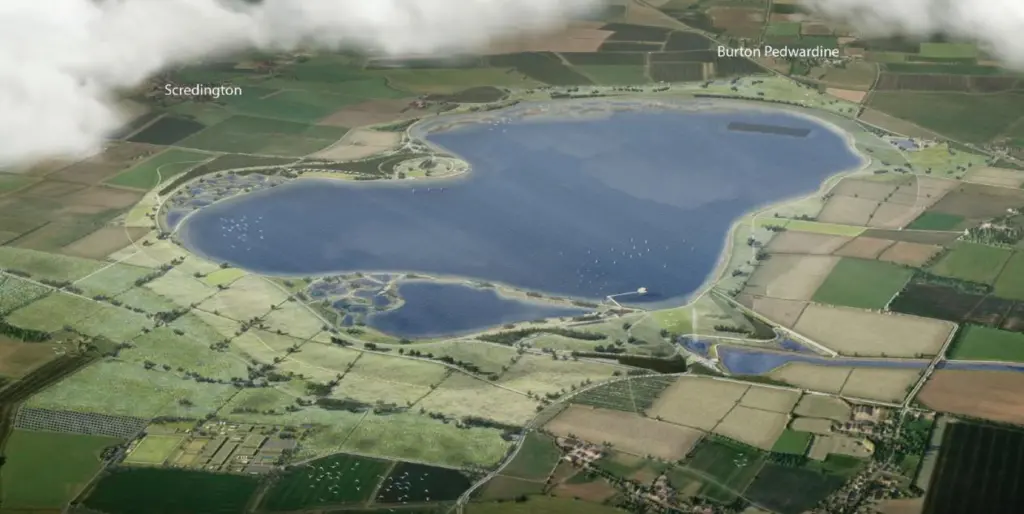
According to a government statement, Environment secretary Steve Reed ‘has seized control of the planning process to build two major reservoirs for the first time since the 1990s’.
They are the first of a total nine that are to be delivered under the Labour government’s ‘Plan for Change’, which Maritime Journal reported on last summer.
“This immediate step delivers on this government’s commitment to fast-track the delivery of nine new reservoirs, supporting its plans to get Britain building and deliver 1.5 million new homes by the end of this parliament,” the statement from the Department for Environment, Food & Rural Affairs (DEFRA) said. “Without these projects, national water supplies will remain under threat and new homes simply cannot be built.”
To escalate the process the Secretary of State has awarded the two projects ‘nationally significant’, which means they will be taken out of local control.
Anglian Water is proposing to build the Lincolnshire Reservoir for operation by 2040. It has also partnered with Cambridge Water to propose the Fens Reservoir to be completed in 2036.
Both projects will now progress to consultation phase, where developers gather views from communities and stakeholders.
Abstraction process
The abstraction process will be used, to draw water from rivers when it’s available so it can be transferred to the reservoir. Equipment includes an intake, a structure made from reinforced concrete built into the bank of the river with an underwater channel to withdraw water, and screens to remove branches or leaves.
It will need mechanical and electrical equipment housed in kiosks and secured by fencing.
Water treatment will be done by adding a solution to the water that makes impurities stick together into larger particles before being removed through filters. Pumping stations will be co-located with the abstraction equipment.
Existing water courses will be used where possible to transfer the water to the reservoir, or new infrastructure built where needed – and when water is transferred through open channels, gravity will do the job.
Underground pipelines will be laid with trenches dug first and once laid, in-filled and wildlife areas reinstated. Pipeline corridors have been identified to allow for pipelines about 50 metres wide.
Water companies have committed to bring nine reservoirs online by 2050, in Lincolnshire, Cambridgeshire, Oxfordshire, Somerset, Suffolk, Kent, East Sussex and the West Midlands. These reservoirs alone have the potential to provide 670 million litres of extra water per day.
The move will no doubt be popular in a country which, according to Trading Economics, is the fourth wettest by rainfall in western Europe yet still regularly enforces hosepipe bans if it doesn’t rain for a week or so.
Related Articles
 INDUSTRY NEWS
 MARINE CIVILS
 MARINE CIVILS