![MaritimeJournal[Seawork]](https://www.maritimejournal.com/wp-content/uploads/2026/09/MaritimeJournalSeawork.svg)





Roman dream of Sicily-to-mainland bridge to become reality
A vision dating back to the days of the Roman Empire is set to become reality with approval granted for a bridge linking Sicily to the Italian mainland.
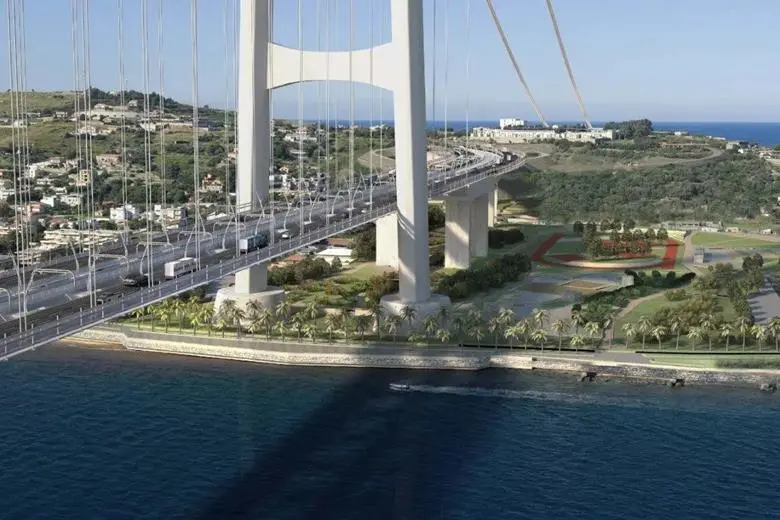
The Italian government has approved the building of what will be the world’s longest suspension bridge, the Bridge over the Strait of Messina.
The 3km bridge has been approved by the Interministerial Committee for Economic Planning and Sustainable Development (CIPESS), the ‘highest institutional coordination of economic planning’.
The idea is more than two thousand years old: in 252 BC a ‘moving bridge’ across the Straits of Messina was created, according to a report by the US Library of Congress, which says it was made of barrels and wood and built to transport war elephants from Carthage to Rome.
The 21st century bridge will span the Straits of Messina between the Port of Messina on Sicily and Calabria, in the ‘toe’ of Italy.
It will be 60 metres wide, house six lanes of traffic and two railway tracks, and all at 400 metres above the sea. The ‘world-record engineering masterpiece’ has been estimated to cost around €13.5 billion and if all goes well should be completed by 2032.
“The launch of a major infrastructure project dedicated to public transport is an extraordinary opportunity for our country,” said Giuseppe Recchi, President of Stretto di Messina S.p.A, the company that holds the concession to design, build and operate a permanent road and rail link between Sicily and Calabria.
“The Strait Bridge will be a national laboratory capable of developing expertise, consolidating best practices, attracting investment and talent, and strengthening Italy’s role in the face of increasingly complex challenges.
“This is an engineering solution studied for decades and recognised internationally: with a 3.3km span, it will be the longest suspension bridge in the world. The same design has been adopted in projects in China, Hong Kong, the United States, and Turkey. Among its distinctive features is the ability to carry both road and rail traffic, essential for maximising the investment’s benefits.”
Anticipated works for this year include access roads, UXO operations, the usual hydrographic and geological surveys and other preliminary activities. Next year will begin road and rail connections, tunnels, interchanges and three new railway stations.
In March 2027, construction of the towers, anchor blocks and suspension system will begin.
“It is a piece of the European transport mosaic to complete one of the main EU North/South corridors, the Scandinavian-Mediterranean corridor, which makes the Strait of Messina area the gateway between the Mediterranean and Europe, and enhances Sicily’s potential as a natural logistics platform,” says the Italian Ministry of Infrastructure and Transport.
“The creation of a stable connection between Sicily and Calabria responds to a specific obligation of Italy associated with four objectives of the TEN-T corridors: cohesion, efficiency, sustainability and increased benefits for users.”
The cost will be recouped by about 2062, the government says, with tolls levied on drivers that it says will be less than €10. The Italian civil engineer company Webuild Group will carry out the works.
Related Articles
 INDUSTRY NEWS
 MARINE CIVILS
 MARINE CIVILS