![MaritimeJournal[Seawork]](https://www.maritimejournal.com/wp-content/uploads/2026/09/MaritimeJournalSeawork.svg)





Two €7bn reservoirs earmarked for eastern England
Consultations have concluded on two reservoirs earmarked for the driest region of the UK at a total life cost of £12.9 billion (€15.9 billion).
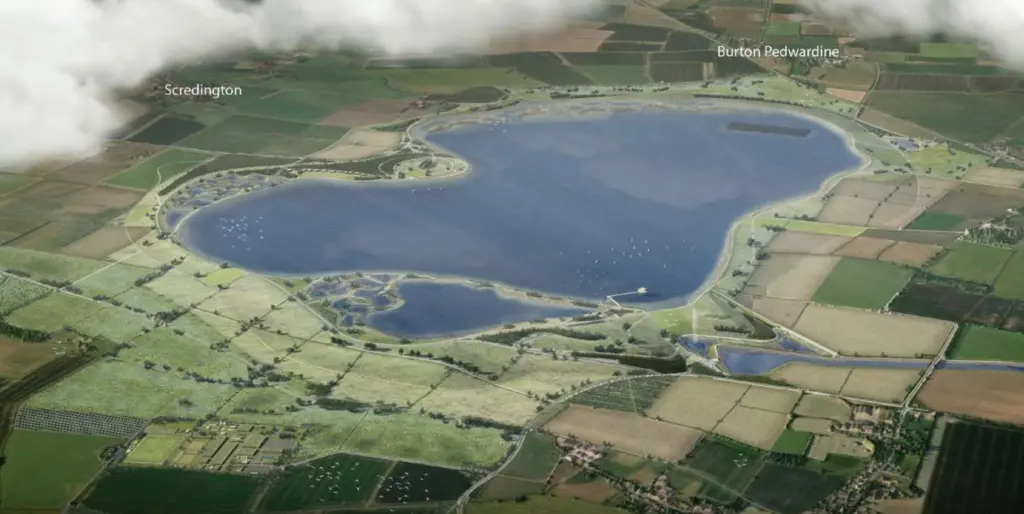
The Fens reservoir will have an initial cost of around £2.2 billion (€2.6 billion) and a whole-life cost of £6 billion (€7.2 billion), says Ofwat, the water services regulatory body for England and Wales.
The other reservoir, the Lincolnshire reservoir, will cost a similar amount, £2.6 billion, with a whole-life estimate of £6.9 billion (€8.7 billion), Ofwat says.
“If no action is taken, there will be a shortfall of 593 megalitres a day in the Anglian Water region by 2050,” it says, quoting Anglian Water, which does not give a source for the claim.
Each proposed site will contain 55 million cubic metres – 50 million of which will be usable volume.
The sites earmarked for the two reservoirs in the east of England, the driest area of the country, are currently farmland, according to photographs taken by the water company leading the project, Anglian Water.
They will be filled during times of high rainfall, when water that would otherwise be lost to sea will be abstracted from local rivers and pumped to the reservoir via pipes and open channels. This water would then be treated and distributed into Anglian Water and Cambridge Water supply via new underground pipes and service reservoirs.
Abstraction process
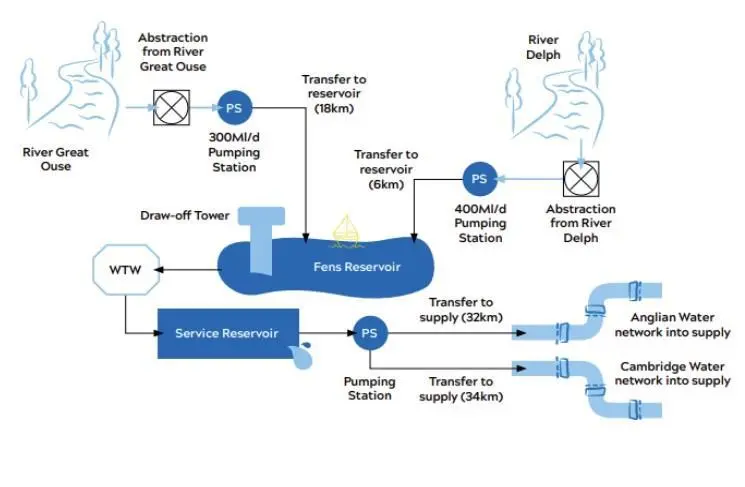
Abstraction is the process for drawing water from rivers when it’s available so it can be transferred to the reservoir.
The equipment includes an intake, a structure made from reinforced concrete built into the bank of the river with an underwater channel to withdraw water and screens to remove branches or leaves.
It would need mechanical and electrical equipment housed in kiosks and secured by fencing.
Water treatment would be done by adding a solution to the water that makes impurities stick together into larger particles before being removed through filters. Pumping stations will be co-located with the abstraction equipment.
Existing water courses will be used where possible to transfer the water to the reservoir, or new infrastructure built where needed – and when water is transferred through open channels, gravity will do the job.
Underground pipelines will be laid with trenches dug first and once laid, in-filled and wildlife areas reinstated.
Pipeline corridors have been identified to allow for pipelines about 50 metres wide.
Mark Malcolm, Anglian Water’s Major Infrastructure Projects director, said: “Our vision goes beyond building a reservoir. This project represents a significant investment in England’s water infrastructure, and an opportunity to deliver lasting benefits.”
Building is expected to begin in around 2029 with water supply to begin in 2036.
Related Articles
 INDUSTRY NEWS
 MARINE CIVILS
 MARINE CIVILS