![MaritimeJournal[Seawork]](https://www.maritimejournal.com/wp-content/uploads/2026/09/MaritimeJournalSeawork.svg)




Seawork winner expanding production
Since winning the overall innovation prize at Seawork International last year with its prototype innovative oil pollution control system, the UKs Gobbler Boats has spent the year developing the concept into a full production version.
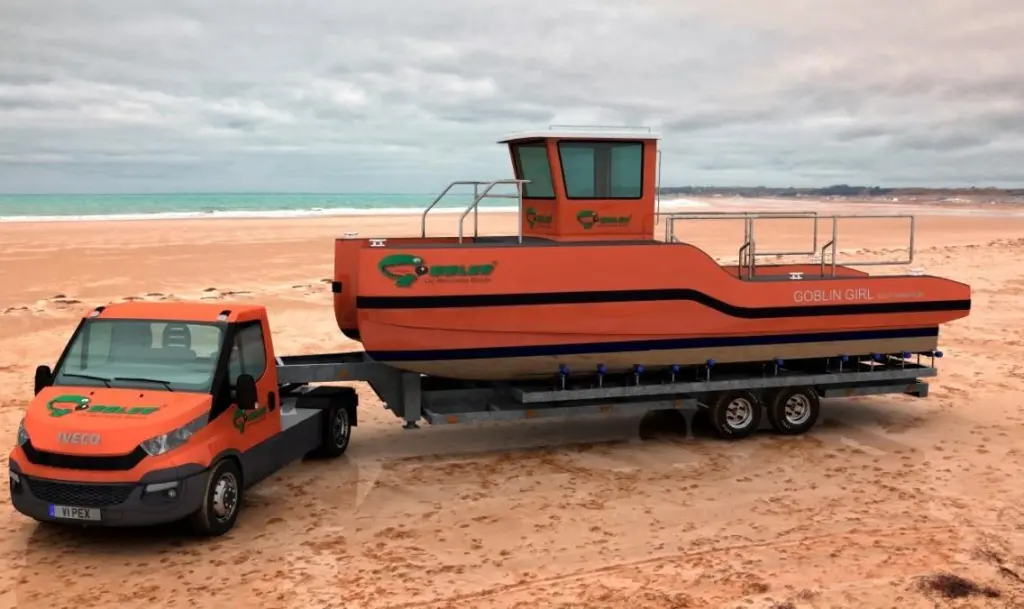
With a new factory in Wales and construction work progressing on a new facility in the US, Gobbler Boats will be ready to meet the expected high demand for its concept.
Paul Jauncey, the managing director of Gobbler Boats commented, “Since our Seawork success of last June, and extensive testing of the prototype over the past six months, we decided that rushing into production of the vessel too soon would be counter-productive if we didn’t take advantage of everything we had learned from our tests. Although the shape of Gobbler is externally unchanged, and the interior will remain so for the hand lay-up boats we build, for the majority there will be internal changes that are a cataclysmic advance for our manufacturing future”.
Gobbler has upgraded its production engineering, at considerable expense, to allow the hulls and deck to be built using resin infusion techniques. The hull sides and deck are made using foam sandwich, but to retain the structural integrity of the bottom for off-shore certification, it remains single skin composite. Certification of the design is now undertaken by DNV-GL.
The prototype was fitted with a Hamilton jet coupled to an FNM 250hp diesel but now Gobbler can offer clients a range of jets including Rolls Royce/Kamewa or Namjet. The standard engine is now a Steyr 298hp, with 350hp and 400hp options by Marine Diesel Sweden for heavy duty use. All engines are EIAPP and EPA tier 3 certified, with SOLAS certification as an option.
Because the Gobblers are designed for offshore operations SHOXS shock mitigating seating is fitted. The wheelhouse design has been modified and a wide range of quality electronic equipment is installed. Although comprehensively equipped as standard, there are upgrades to the wheelhouse equipment that includes optional satellite communications and FLIR infra-red oil seeking cameras.
The Gobbler system uses bladders to store the recovered oil and because these can be quickly changed when full and towed ashore, or alternatively simultaneously pumped to ships using Gobbler “Pods”, the oil recovery operation can become a continuous process. To allow 24 hour operations the bladders are fitted with solar navigation lights and can be fitted with an AIS unit.
“Changing to infusion will increase our production capacity many fold. Six new moulds and the latest infusion equipment, fibreglass and foam pre-cut to shape, skilled staff and a secure supply chain, together with an efficient production line will enable six boats + per week, with several kept for stock and/or emergencies should they arise”, commented Jauncey.
By Dag Pike

Related Articles
 ACCESSORIES & EQUIPMENT
 ENVIRONMENT
 MARINE CONSTRUCTION