
Digging deep for Vallettas new quay
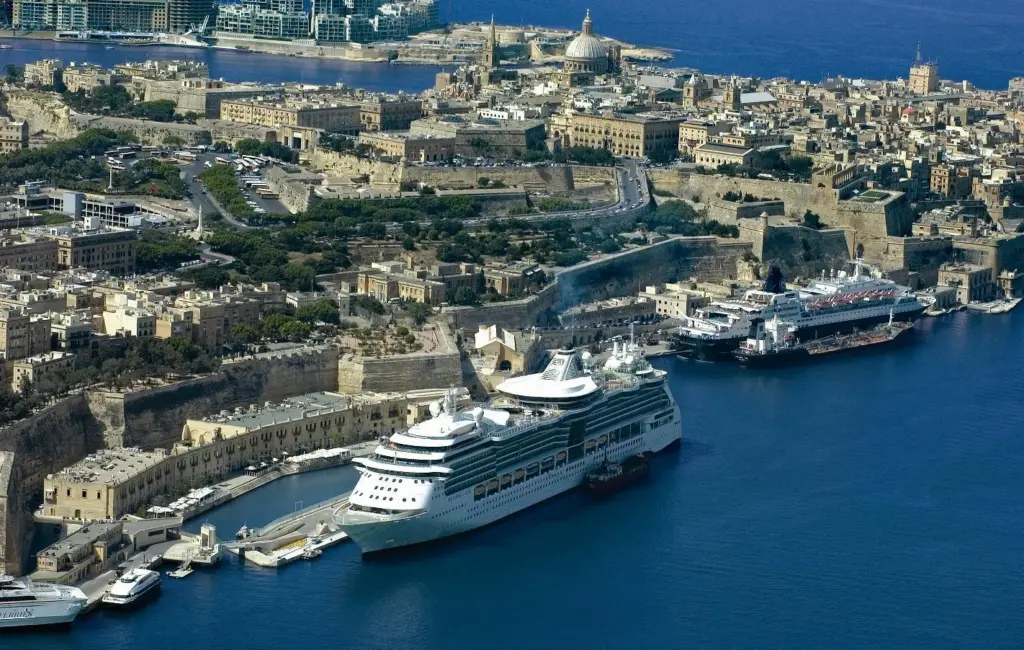
The main obstruction to the development of the Valletta Waterfront as a major cruise destination and homeport was a physical one, the old ro-ro ferry ramp which projected from the existing quay at its eastern end prevented the berthing of the larger cruise ships. And works to remove maritime infrastructure take on a whole new aspect when placed within the confines of a busy port.
One challenge identified by the consultants, the Maltese A&CE Architecture Project and UK engineers Colin Toms and Partners, was the need to prevent any disturbance to a nearby bascule bridge, a moveable, counterweighted arrangement that unfortunately shared some of its foundations with the old ro-ro ramp. Added to this was the ramp’s proximity to a nearby lagoon. Also, the construction of the new seawall had to take place on a steeply sloping surface, covered by a mixture of clay, sand and boulders.
The consultants came up with a plan which used two rows of 1m diameter piles. These would give temporary support and containment during the old seawall excavation (with walings and props inserted as work progressed) and then the space between the pilings would be concreted in to become the new seawall.
In early 2009 the piling was carried out using two rigs, a Bauer BG28 and an IMT AF150 under the auspices of Polidano Brothers and the Maltese main contractor, The Constructors Ltd. Piles were drilled utilising temporary steel casings and concreted via tremie pipe. The idea was to ensure the new seawall foundation extended 13m below datum, giving the new wall 11m of water depth.
However, the clay, sand and boulder matrix at foundation level had insufficient compressive strength to contain the stresses of the new wall and prevent disturbance to the adjacent structures. So, half of the front row of piles were taken into the bedrock some 25m to 35m down.
On completion, the first stage dig was carried out using Hyundai backhoe excavators and a temporary blinding was inserted to allow the steel walings and props to be fabricated and installed. Then the main dig continued using the Hyundai machines fitted with extension arms.
A 500mm thick graded rock foundation layer was placed and levelled, and following this a 3,000 m3 mass concrete pour was carried out in one continuous operation, a process surprisingly completed ahead of schedule in just 16 hours.
A reinforced concrete capping beam (tied into the original quay to distribute bollard pulls) was cast, and then full demolition of the ro-ro ramp’s seawall got underway using the Hyundai excavators and the barge ‘Magnus’, fitted with a Liebherr 992 excavator, was used to remove the old fill material, retrieve debris from the seabed and carry out dredging works.
Lawrence Bugeja, project manager at VISET Malta plc, operators of the Valletta Waterfront, commented that the site constraints and limited time frames were a challenge. However, the operation ran smoothly and completion of this work gives Valletta a straight quay length in excess of 300m, ready for the next season’s liners.