




Serial production offers bridge to the future
There’ s an interesting development that quite literally seeks to build bridges between traditional maritime architecture and new materials.
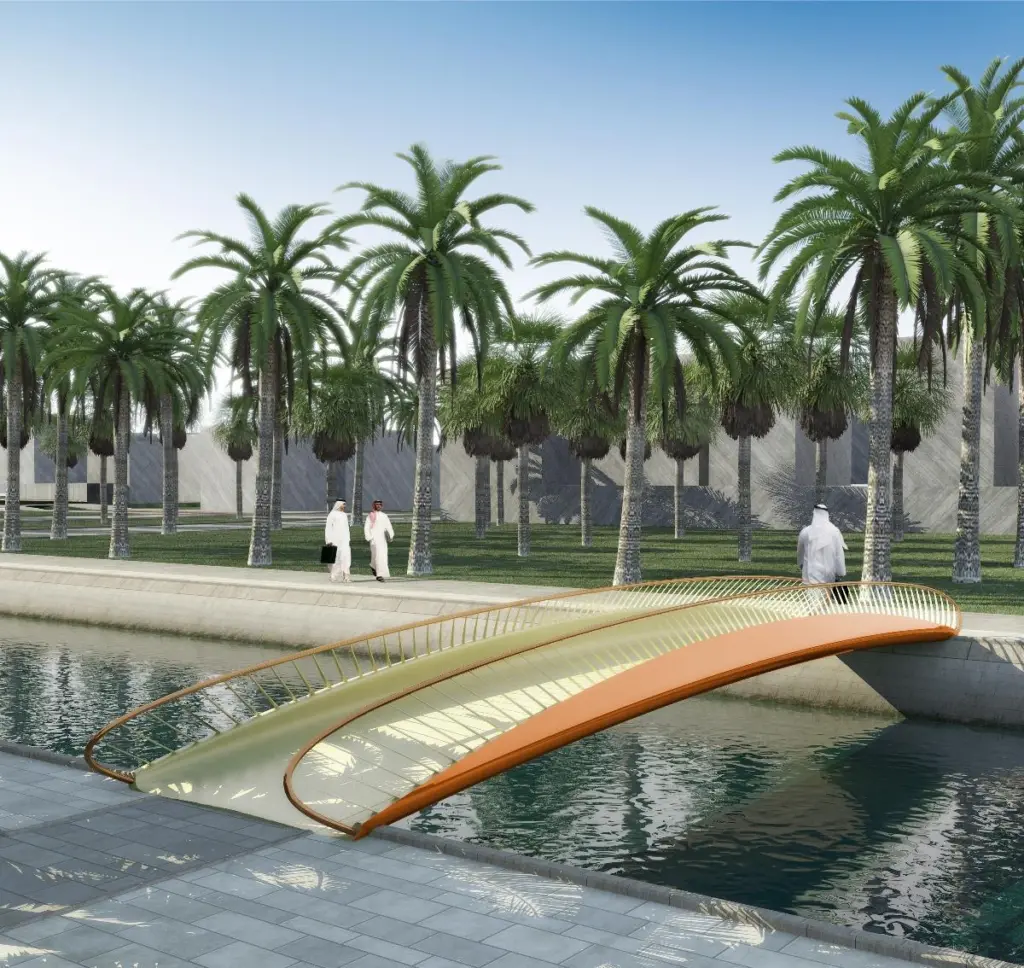
A 100% fibre reinforced plastic (FRP) composite is the building block of the new Delft Design Bridge. It is lightweight, sustainable, safe and easy to maintain, and it looks good.
Jan Peeters of FiberCore explained to MJ that the company started in 1996 with a one off composite bridge, ‘But the mould itself was more expensive than the bridge would have been in steel! So then we thought, why don’t we test them and sell them as you would cars, asking “what size and colour do you want?” We aim to take away a lot of the fuss, so that people can buy a tried and trusted, fully tested unit.’
The application of high-tech composites is certainly no longer a novelty in the world of industrial design. Composites offer huge benefits in comparison to more traditional materials, such as steel, aluminium and timber, particularly when the designs in question are suitable for serial production. Composite materials are already widely used in the aerospace, automobile and furniture industries but this trend has yet to catch on in the building sector, where the traditional route of individually designing and constructing things like bridges can adversely affect quality while adding considerable costs.
The Delft Bridge, a joint venture between Royal Haskoning and FiberCore Europe, makes use of the fact that composite bridges are ideally suited to serial production. The length and width of the bridge deck can be varied to fit each location thanks to the inclusion of a prismatic mid-section in the moulds. Where aesthetics are important, the colour schemes are also customisable, giving a harmonised finish that will blend into different settings.
Jan Peeters explained the bridge material has a stiffness much greater than steel, which means the units are extremely lightweight, can be swiftly manufactured and are very easy to install. No excavations are needed because the bridge doesn’t require much in the way of foundations, so installation causes little disruption of the surroundings. This also means that bridges can be easily relocated.
As to safety, vibrations and resonance do not jeopardise the bridge, which has an intrinsic damping effect. The composite material has an inherent resistance to fatigue and is also fire resistant.
The long lifecycle FRP is environmentally friendly, with the bridges having an estimated lifespan of around 100 years. It also makes for extremely easy maintenance. FRP is resistant to graffiti as it simply washes off and the sides of the bridge can be given anti-graffiti treatment.
The arrival of serial design with its cost saving factors into waterways, marinas and other maritime environments may be building a bridge to the future.
Related Articles
 OTHER NEWS
 MARINE CIVILS
 MARINE CONSTRUCTION