![MaritimeJournal[Seawork]](https://www.maritimejournal.com/wp-content/uploads/2026/09/MaritimeJournalSeawork.svg)


Offshore wind surge sparks safety warnings at sea
The rapid expansion of offshore wind farms and wave energy devices around the UK coastline is creating serious hazards for shipping, navigation systems and emergency rescue operations, according to guidance published by the Maritime and Coastguard Agency (MCA).
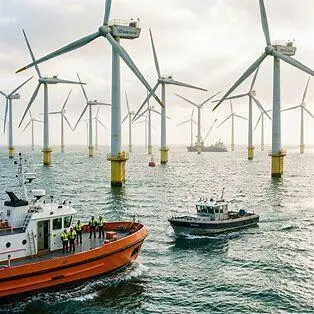
The agency warns that the ‘location, size and irregular shape’ of Offshore Renewable Energy Installations (OREIs) present ‘new challenges to the safe navigation and communication of shipping and emergency rescue’, and that these difficulties ‘could contribute to a marine casualty leading to injury, death or loss of property, either at sea or among the population ashore’.
Research by the Maritime Research Institute Netherlands found that the risk of a turbine being hit by a ship is increasing by around 1.5 to 2.5 times a year, with some 2,500 wind turbines set to be installed in the North Sea by 2030 and around 80 ships reported drifting in the North Sea each year.
Researchers also said a collision with an installed wind turbine carried a real risk of the turbine toppling onto the vessel, seriously endangering crew, passengers, the ship itself, and the environment.
Although not many incidents have been reported of vessels crashing into turbines, there have been a few cases in the past couple of years and the number of incidents is unlikely to decrease.
The MCA says any failure of radar, navigation or communication systems in the vicinity of offshore installations ‘could reduce safety levels, lead to marine casualties, and reduce the effectiveness of emergency service operations’. If such an incident involves a passenger vessel or a ship carrying dangerous cargo, it ‘could have serious consequences for the public and the environment, both at sea and ashore’, the guidance, which was published on the government’s website, warns.
Off the radar
Of particular concern is the effect of wind turbines on marine radar.
Scientific research carried out at the North Hoyle wind farm off the North Wales coast found that turbines produce ‘very large radar cross-sections, which scatter a large proportion of any incident electromagnetic energy’ and cast shadows behind themselves that can mask other vessels.
At close range, turbines may produce multiple reflected and side lobe echoes that can mask real targets’, with interference developing at around 1.5 nautical miles and radar displays becoming worse as the range closes.
Where a shipping lane passes within that range, the MCA warns that ‘considerable interference may be expected along a line of turbines’.
Wave and tidal devices
The guidance also highlights the danger posed by wave and tidal energy devices, which are far harder for mariners to spot than wind turbines.
Unlike wind farms, some of these installations are totally submerged, while others may only protrude slightly above the sea surface” making them an invisible hazard to passing vessels.
The MCA says mariners will ‘have difficulty seeing systems using wave or tidal energy’ and must familiarise themselves with the wide range of device types and their different methods of attachment to the seabed.
Port authorities and coastguard services face particular difficulties. VTS operators and emergency services such as the Royal National Lifeboat Institution and HM Coastguard rely on the ability to rapidly detect and react to maritime casualties. The MCA warns that OREIs can disrupt the consistent and effective radio communications systems that are essential to those operations.
Wind turbine spacing – usually 500 metres or more apart depending on the size of the turbine – means that some vessels may attempt to navigate between the structures, bringing them within the most dangerous interference range.
The agency cautions that wind farm structures could over time affect the depth of water in their vicinity ‘through scouring of the seabed making depth information unreliable’, while tidal streams may be obstructed locally, ‘creating eddies nearby’.
The guidance emphasises that developers bear responsibility for assessing and mitigating these risks. OREIs should not be sited, built or decommissioned without close consultation with the MCA, and developers are required to assess ‘navigational and communication impacts or difficulties around the site area’, consult with local and national search and rescue authorities and plan contingency arrangements to deal with marine casualties in or adjacent to sites, including responses to environmental pollution.
On GPS systems, the research found the impact to be ‘minimal’ unless a receiver was within 70 metres of a turbine. Similarly, interference to VHF radio communications was found to be ‘negligible’ due to the wavelength of the systems involved.
The MCA says that while permanent safety zones are not expected around entire wind farm groups, temporary exclusion zones will be established during construction, major maintenance and decommissioning, monitored by support craft including fishing vessels employed as guard vessels.
Mariners are reminded that there is “no right of access to any type of OREI,” that the installations are “private property,” and that access “requires skill and is limited by the state of the sea.”