![MaritimeJournal[Seawork]](https://www.maritimejournal.com/wp-content/uploads/2026/09/MaritimeJournalSeawork.svg)



Ferry trio kicks off canal upgrade programme
After a slight delay, the first of sixteen 30m eco-friendly hybrid ferries has been delivered for service on the Kiel Canal, writes Tom Todd.
A spokeswoman for the Waterways and Shipping Administration (WSV) – which is responsible for the canal – told Maritime Journal the Covid pandemic had meant some “operational restrictions” at Baltic Workboats, which is building the first three newbuilds. She stressed however the restrictions had caused only minor delays.
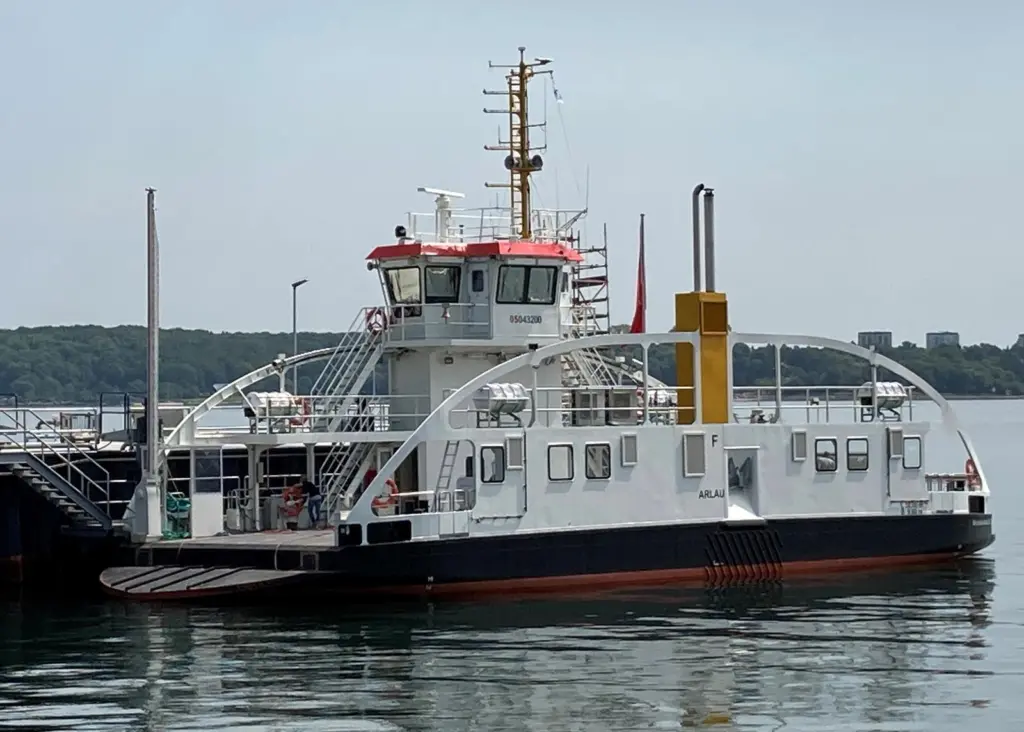
The first of the identical trio, Arlau, had originally been due in spring but did not actually arrive until July after a four day tow from Estonia. It was undergoing final checks at the local WSV and Gebr. Friedrich shipyards, while personnel were doing simulator and docking training. That was being followed by completion of a first new canal landing facility and berthing system.
The delivery of a second ferry was due before the end of summer and a third was expected in autumn, the WSV said. Funded by the German Government and costing €21 million, the three ferries are being described as the “forerunners of a new generation” of low-emission, eco-friendly cross-canal ferries.
Under a long-term programme to replace old tonnage, some dating back to the1950s, the WSV said it was hoping eventually to retire all sixteen 45 and 100 ton ferries currently in canal service.
The new boats are 9.6m wide, draw maximum 1.48m and have two vehicle lanes of total 23.5m and a load capacity of 45 tons. Each has two Voith Schneider VSP 12R4 cycloidal propellers and a 297kW Volvo diesel. Speed is put at 13kms/h. The WSV said the integrated hub of the power and drive concept including the generator was a Siemens battery-supported, diesel-electric hybrid system.
Tenders for the remaining 13 newbuilds planned for the canal were being invited as soon as the first three ships have been successfully tested, the WSV told Maritime Journal.
The Kiel Canal is the world’s busiest man-made waterway. It runs from Brunsbüttel on the North Sea Elbe Estuary near Hamburg to Kiel on the German Baltic, some 98kms. Traffic figures dipped last year because of the pandemic but were up again this year when 13,429 ships of all types passed through the waterway in the first half of 2021.