![MaritimeJournal[Seawork]](https://www.maritimejournal.com/wp-content/uploads/2026/09/MaritimeJournalSeawork.svg)

Stolt Tankers signs MOU for shorepower study
The largest chemical tanker firm in the world is to carry out a six-month feasibility study at the Port of Rotterdam.
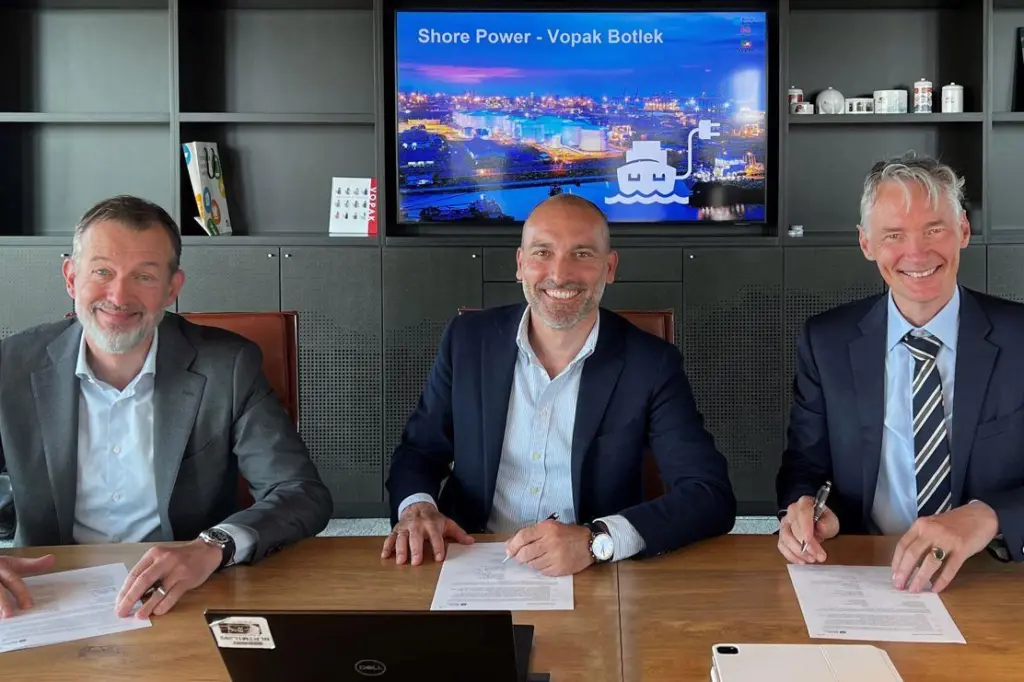
Stolt Tankers and the Port of Rotterdam will examine the use of shore-based power for chemical tankers at the Vopak Botlek terminal so that while in port, tankers can switch off their diesel generators and switch to mains power, which ideally would be from a renewable source.
”As chemical tankers are required to comply with higher safety standards than many other types of vessels, the results of this study will be important for the whole chemical tanker industry,” says Stolt. ”The project poses several significant technical hurdles, which make it unique. The aim of the feasibility study is to discover effective solutions to these challenges that can be used to form the basis of an agreed international standard.”
“We have identified several ships with the potential to take part in the trial, which if successful will also present opportunities for our ships calling at ports to plug into power from renewable sources,” said Stolt President Lucas Vos.
While stressing the potential of shorepower to reduce emissions, the company did warn that it will only be viable if the industry can agree a single standard.
”Shipowners will need confirmation that their ships can safely and reliably connect to shorepower in multiple ports before investing in the necessary ship adjustments, which is why it is essential to design a standardised solution in partnership with other leading organisations,” the company said.
Stolt Tankers also announced that it had agreed to buy another three tankers, to be delivered between this July and September.
The three 33,600 dwt stainless steel chemical tankers will be built in Japan.
“This acquisition is an excellent opportunity for Stolt Tankers to secure competitively priced tonnage ahead of an expected cyclical upturn in the chemical tanker industry,” said Stolt Tankers President Lucas Vos. ”The newly added ships will lower our fleet age profile and can trade in any of our deep-sea lanes increasing flexibility across our fleet.”
Stolt claims to have the world’s largest fleet of chemical parcel tankers with 160 ships, including more than 70 deep sea ships integrated with regional fleets in Europe, Asia and the Caribbean.
As well as coastal fleets, Stolt operates inland barging services in Europe and the US Gulf.