Lithium batteries: the hidden dangers of a great technology
By Mike Schwarz, CEO, International Institute of Marine Surveying
Over the past five years, I have developed a keen interest in lithium-ion battery technology, not from a technical aspect, as the chemistry is just far too complex for me to comprehend, but from a safety angle.
My interest was rudely awakened following a number of devastating incidents in recent years on ships and boats, caused as a direct result of lithium-ion battery fires that have sent far too many vessels to the bottom of the ocean, costing insurers millions. Let me be clear. In most instances fires are not as a direct result of the propulsion system itself malfunctioning, rather the electric vehicles, toys and devices onboard misbehaving.
The aim of this article is not to extol the virtues, or otherwise, of this amazing technology. It is incredible, but I want to warn people that things can and do go wrong with devastating consequences, and to provide some best practice guidance.
We are surrounded daily by lithium-ion batteries of all types. Our lives are dominated by them increasingly through the vehicles we drive, the vessels we sail, wearable tech, our laptops, mobiles phones and so on.
Case study
Confusion around lithium-ion battery incidents and fires abounds. Let me share with you the recent case of a Dufour sailing yacht in Palma, Mallorca, which was designed to have electric propulsion.
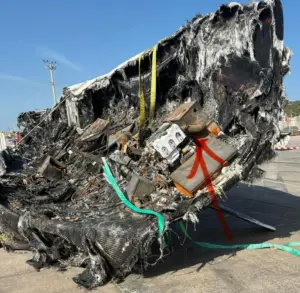
Unconfirmed information about the incident is that the yacht was sailing hard and leaning over. There was a loud bang from the aft part of the vessel. The lazarette hatch was opened to reveal water and flames. The assumption was that a seacock had broken during the ‘bang’, allowing water into main power cabling, which caused a short circuit.
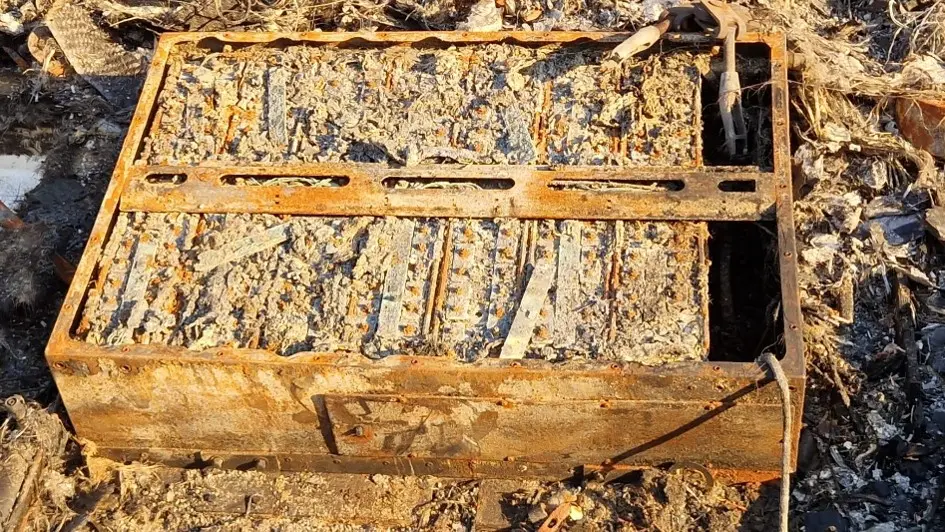
The heavy battery pack, which was assumed to be LFP (lithium iron phosphate), was closer to the keel, some metres away. The resulting conflagration was intense as the photos show, but the event was not a battery chemistry issue specifically. However, once the water came into contact with the batteries, there was only one outcome.
The local marine newspaper headlined the incident ‘Thermal runaway in the bay’, which strictly speaking was incorrect and adds to the confusion surrounding this power option.
The newspaper finished the article by saying, “However, the fundamental question, beyond the performance that electric motors can offer, is whether it is really worth giving up the reliability and safety of a diesel propulsion system and assuming the risk of carrying lithium batteries on board to save the atmosphere a negligible amount of carbon dioxide. It is worth keeping one fact in mind: recreational craft account for 0.1% of global greenhouse gas emissions.”
What we see is something that at first sight appeared to be obvious – a direct lithium-ion battery explosion of some magnitude. But as the ongoing investigation unravelled the facts, this turned out not to be the case.
The reason for sharing this case study is to highlight that having some knowledge about this technology only gets us so far. There are clearly things that are beyond our control as this case study highlights. However, many of the lithium-ion battery accidents we observe at sea and on land are caused by human error and are thus preventable.
Safety tips
- Make sure that li-ion batteries are certified to UL, CE or IEC standards.

Mike Schwartz - Avoid the temptation to use cheaper products, such as chargers. Stick to the manufacturer’s specifications.
- There is no place for non-marinised batteries on board. Call it out.
- Any li-ion battery propulsion installation must be installed by a competent person.
- Does the installation meet the ISO 23625:2025 Small craft – Lithium-ion batteries standard, published in 2025?
- Don’t leave devices on charge overnight unattended.
- When charging in the daytime, it is good practice to be able to have line of sight to your device.
- Never accept a charger offered by someone else. You cannot vouch for its authenticity.
- Never cover chargers and make sure they are charged in well-ventilated areas.
- Lithium-ion batteries do not like extremes of temperature. Avoid charging in direct sunlight, hot environments, or extreme cold.
- Never charge a lithium-ion battery device in a place where you would need an escape route – the speed, rapid spreading of any fire and heat intensity could block your way out.
- If you see white vapour that may look like smoke coming from a lithium-ion battery then get out, stay out and call the fire service immediately.
Further reading. “Lithium-ion battery fires: What we know so far” is a free 48 page guide and can be downloaded at https://bit.ly/483vqhi.